AI + Human Operations
A Human Response to the Rise of Chatbots
AI has moved far beyond the chatbot boom. The operating question Alan posed years ago is more urgent now: how do we design the human side of customer service to work with increasingly capable machines?

"How many data scientists does it take to screw in a lightbulb?" goes the familiar joke. "None, we've already automated it." While this elicits a chuckle, its less optimistic cousin, "how many data scientists does it take to do data science?" (let that sink in) paints a bleaker picture. This idea of AI overtaking humans has been around at least since Samuel Butler's 1863 article, "Darwin among the Machines."
It took clearer form in E.M. Forster's chilling 1909 novella, "The Machine Stops." And the concept has increasingly appeared in academic literature and popular culture over the intervening century. But in recent years the drumbeat has intensified. From IBM Deep Blue defeating Garry Kasparov at chess, to Watson winning Jeopardy!, convincing deepfakes, generative AI, and the rise of chatbots in our everyday lives, AI has arrived en force and has captured the imagination. Witness the popularity of Ray Kurzweil's "The Singularity Is Near" and the broader cultural fascination with whether machines will eventually catch - or pass - us.
As humans, perhaps to our disadvantage (against the bots?), we tend to fixate on the ominous notes. We haven't forgotten Marc Andreessen's prophecy that "software is eating the world." We now know that he was right, and it's easy to extrapolate this to AI. So, we assume, not unreasonably, if AI is destined to eat the world, perhaps customer service is the appetizer. Most of us, even with limited brand engagement, have already faced a chatbot.
In 2026, many of those bots are no longer simple decision trees. They can summarize long histories, retrieve knowledge, draft responses, classify intent, recommend next steps, and increasingly take action across workflows. Fluency, of course, is not the same thing as judgment, accountability, or empathy. But the old question - whether software can participate meaningfully in customer service - has largely been answered.
The investment community, it would seem, agreed. The 2019 venture count I cited when I first wrote this piece is no longer very useful evidence; conversational and generative AI are now part of the mainstream customer-service technology landscape. There is no denying a revolution is underfoot.
That said, full replacement was never the only question, and it is not the most useful one now. Brad Birnbaum argued in 2020 that customer service remained the human touch point in an increasingly digital customer ecosystem. P.V. Kannan and Josh Bernoff made the parallel case that successful AI-powered customer service depends on bots working with humans, not replacing them. The tools have changed. The operating question has not.
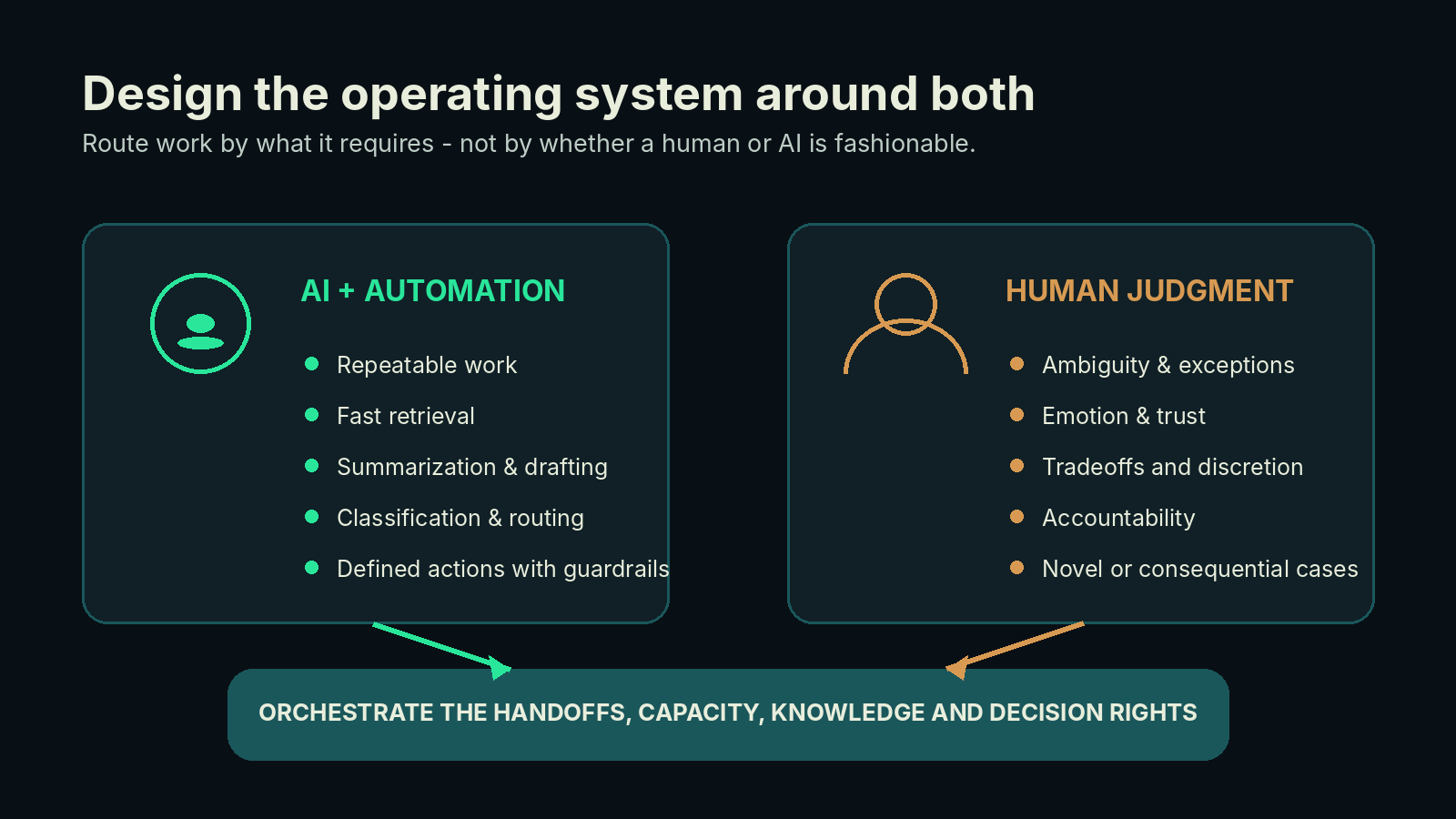
But that raises some serious questions for today's customer service leaders. If so much innovation is focused on AI for customer service, who is innovating in the human-powered space? If AI is introduced upstream from human labor, doesn't the downstream need to be modernized? If AI tackles the more routine questions and tasks, doesn't that mean humans will receive an increasingly difficult set of tickets, raising the bar on skills and performance? A more nuanced question: how does one properly allocate traffic among the available resources, which now include humans, chatbots, copilots, and increasingly agentic systems?
Putting these into focus: How do we design a human-powered customer service program that is meant to coexist with increasingly capable AI? I still think that is the human response the industry needs.
Sources & References
- IBM. Deep Blue history — Reference for the Deep Blue milestone.Reference 1
- IBM. Watson / Jeopardy! history — Reference for the Watson Jeopardy! milestone.Reference 2
- Marc Andreessen. Why Software Is Eating the World — Reference for the software-eating-the-world framing.Reference 3
- Ray Kurzweil. The Singularity Is Near — Reference for the broader cultural fascination with machine intelligence.Reference 4
- Brad Birnbaum, Forbes, 2020. AI Is Growing, But The Robots Are Not Coming For Customer Service — Reference for customer service as a human touch point in a digital ecosystem.Reference 5
- P.V. Kannan and Josh Bernoff, MIT Sloan Management Review, 2019. The Future of Customer Service Is AI-Human Collaboration — Reference for the human + AI collaboration argument.Reference 6