AI + Human Operations
AI Changes the Sourcing Decision — Not the Need for One
AI is changing what customer-operations leaders are buying, how they evaluate providers, and where responsibility sits. That makes sourcing more important—not less.

What if AI does not make the sourcing decision disappear? What if it makes the decision more consequential?
For years, outsourcing decisions in customer operations were often framed around a relatively familiar set of variables: labor cost, geography, language coverage, service levels, scale, and the operating track record of a provider. Those variables still matter. But AI is adding a new layer to the problem.
The unit of analysis is no longer just a seat, an agent, a site, or even a provider. Increasingly, the thing being designed is a blended operating system: people, automation, models, workflows, data, controls, and external partners working together.
That does not eliminate sourcing. It changes what sourcing has to accomplish.
The old question was “Who can do this work?”
That question made sense when the work itself was relatively stable. If a company needed 300 people answering a defined class of contacts, it could compare providers on labor markets, recruiting, training, quality, technology, management, and price.
AI complicates the premise because some of the work may no longer be performed the same way next year—or even next quarter.
A provider may be excellent at operating today’s process but weak at redesigning it. Another may bring strong AI engineering but little operating depth. A software company may automate part of the workflow but leave the hardest customer moments to people. An internal team may own the data and product context but lack elastic capacity.
So the sourcing question becomes larger: What should be done by people? What should be automated? What should be AI-assisted? What belongs inside the company? What should sit with a specialist? And who should be accountable when all of those pieces touch the same customer?
AI turns sourcing into an architecture decision
This is the part I think many organizations will underestimate.
When technology changes quickly, the instinct is often to delay a sourcing decision until the future becomes clearer. But uncertainty is not an argument for having fewer options. It is usually an argument for designing more optionality into the system.
A good sourcing process now has to examine at least five things at once: what capabilities are needed, how the workflow should be divided, which providers can contribute which capabilities, how the pieces will be governed, and how performance will be measured across the whole system.
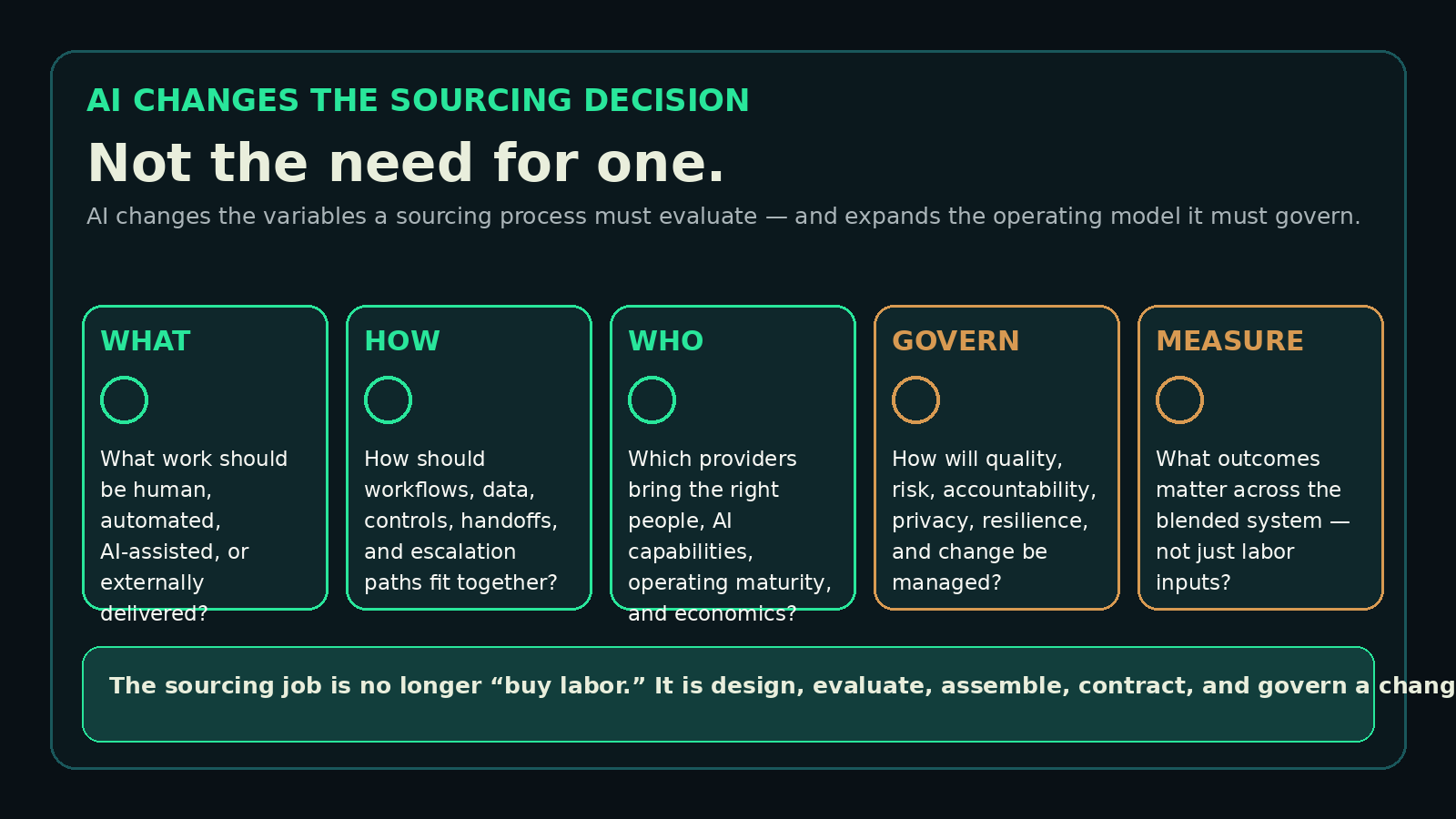
That is much closer to supply-chain design than traditional vendor shopping. You are not buying one static input. You are designing a network that has to keep adapting as technology, economics, customer expectations, and internal capabilities change.
The provider evaluation has to change, too
The obvious temptation is to add an “AI capability” line to the RFP and move on.
That is not enough.
If AI becomes part of service delivery, buyers need to understand how a provider actually uses it: where models sit in the workflow, what data they touch, what humans review, what happens when confidence is low, how changes are tested, and who owns the outcome when an automated decision creates a customer problem.
The National Institute of Standards and Technology makes a related point in its AI Risk Management Framework. NIST treats AI risk management as a lifecycle discipline—govern, map, measure, and manage—not a one-time product check. It also explicitly recognizes third-party providers, developers, vendors, and evaluators as actors whose technologies may be complex or opaque and whose risk tolerances may not match those of the deploying organization.
That has a direct sourcing implication: evaluating a provider’s AI story cannot be separated from evaluating its governance, operating discipline, transparency, testing, escalation paths, and ability to change safely.
“Build versus buy” becomes “build, buy, assemble, or orchestrate”
AI also makes the old binary choice between insourcing and outsourcing less useful.
A company might build the customer-facing product experience internally, use a third-party model, contract with a specialist for automation, use a BPO for human service delivery, and retain another provider for surge capacity or a specialized queue. The answer may be one provider. It may be several. It may change by workflow.
The point is not vendor proliferation. More vendors can create more interfaces, more switching costs, and more governance work. The point is to avoid forcing a changing operating problem into a sourcing structure that was optimized for yesterday’s assumptions.
One provider may still be exactly right. But it should win because the operating design supports that conclusion—not because the organization stopped asking the question.
The contract has to leave room for learning
There is another consequence. If the operating model is changing, contracts built around static assumptions can become a constraint.
Traditional pricing and service-level structures often describe a known volume of human work. AI can change handle time, containment, escalation patterns, staffing ratios, quality controls, and the division of work between people and machines.
That means commercial design has to anticipate change. Buyers need mechanisms for adding or removing scope, testing new workflows, changing measures, sharing productivity gains where appropriate, preserving data and transition rights, and moving work when a provider no longer fits the operating model.
The commercial model should reward the outcome the organization actually wants—not accidentally reward keeping labor in a process that technology could improve.
AI raises the value of a broader market view
This is where I think the next generation of sourcing gets interesting.
No single provider is likely to have the best answer to every combination of industry context, language, geography, customer segment, AI platform, workflow, regulatory constraint, labor model, and pace of change.
That does not mean buyers should collect vendors like trading cards. It means they should preserve the ability to compare different approaches and assemble the right combination when the problem requires it.
Markets are useful because no participant has all the knowledge. AI does not change that. If anything, it increases the amount of specialized knowledge distributed across software companies, BPOs, data providers, workforce models, consultants, and internal teams.
Sourcing is how an organization exposes itself to that distributed knowledge instead of assuming the answer already lives inside one incumbent relationship.
The sourcing team becomes an operating-design team
The most important change may be organizational.
If sourcing remains a periodic procurement event, it will struggle to keep up with an operating model that is continuously changing. The better model is closer to a control tower: continuously observing capabilities, economics, risks, performance, and new options—and then making disciplined changes when the evidence supports them.
That requires procurement, customer operations, technology, finance, security, legal, and providers to work from the same operating thesis. The job is not simply to negotiate a lower rate. It is to keep the system fit for purpose as the underlying technology changes.
AI does not remove the decision. It changes the variables.
We should be skeptical of any technology story that ends with “therefore you no longer need to choose.”
Choice does not disappear when the market changes. The dimensions of the choice change.
AI is expanding what is possible in customer operations. It can remove mechanical work, give people better tools, and create operating models that were impractical a few years ago. But those possibilities still have to be evaluated, assembled, governed, tested, contracted, and improved.
The organizations that benefit most from AI will not be the ones that stop sourcing. They will be the ones that get better at sourcing for a world in which the answer keeps changing.
Sources & References
- National Institute of Standards and Technology. NIST AI Risk Management Framework (AI RMF 1.0)Reference 1
- National Institute of Standards and Technology. Artificial Intelligence Risk Management Framework: Generative Artificial Intelligence ProfileReference 2
- National Institute of Standards and Technology. NIST AI Resource Center / AI RMF CoreReference 3