Network Design & Orchestration
Are We Missing a Layer in the Customer Journey? — The Experience Chain Behind Customer Operations
Customer journeys show what customers experience. They do not always show the chain of people, providers, systems, rules, data, and capacity that has to work behind each moment. That hidden chain is often where the experience succeeds or fails.

I have always liked customer journey maps. They force an organization to look at the business from the outside in instead of starting with its org chart.
But after years of working around customer operations, outsourcing, technology, and multi-provider delivery, I think the traditional journey map can create a blind spot. It shows the moments a customer moves through. It does not always show the operating chain that has to cooperate to make those moments work.
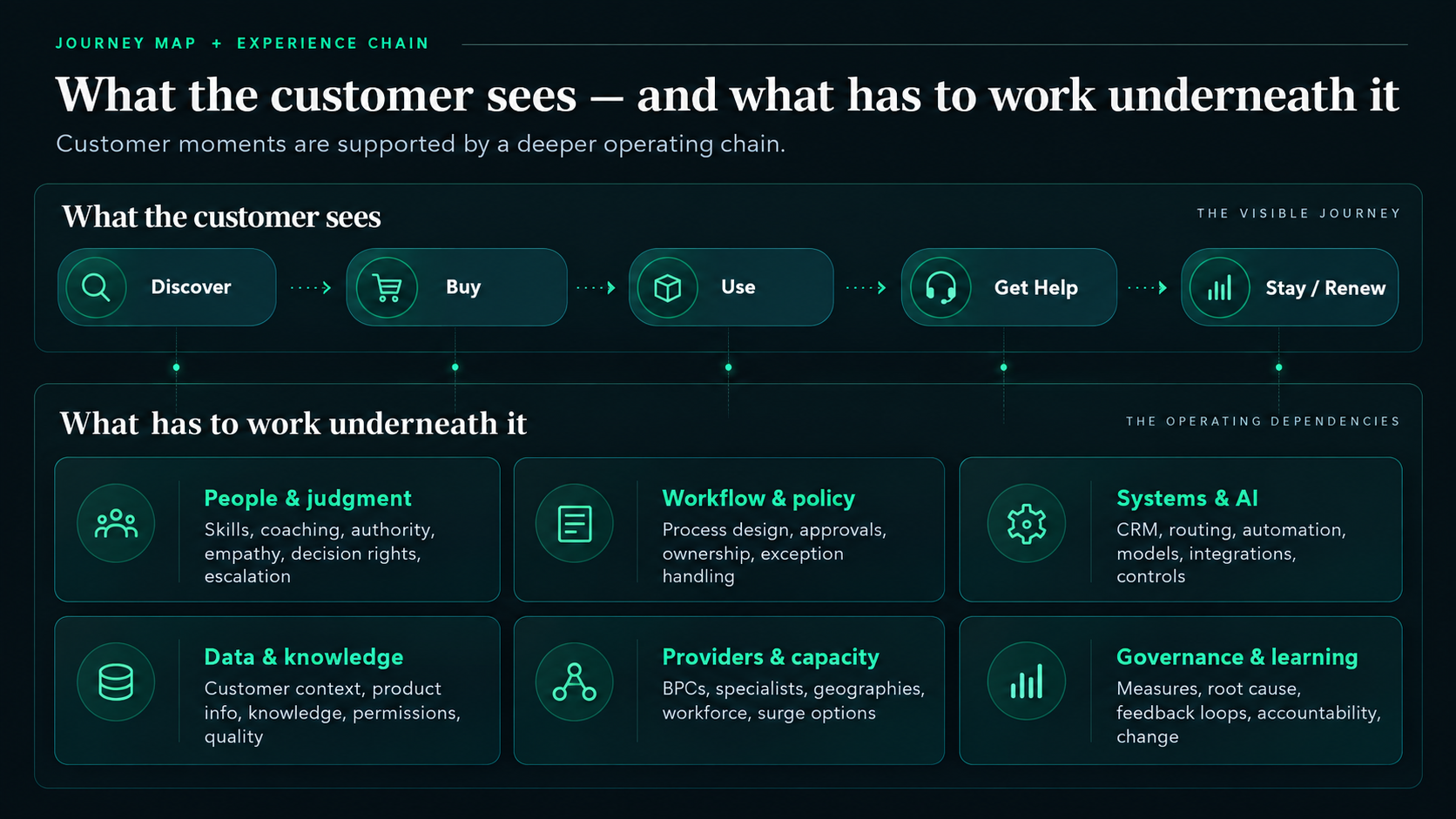
Most journey maps are drawn horizontally: discover, buy, onboard, use, get help, renew. Customer operations usually appears as one box somewhere in the middle or late in the sequence. The operating reality underneath that box is much more vertical.
The journey is visible. The dependency structure is not.
Take a simple support interaction. A customer asks why a refund has not appeared.
The experience may look like one touchpoint: customer contacts company; agent answers; issue gets resolved. But the quality of that moment can depend on identity data, order history, a payment processor, CRM configuration, the refund policy, knowledge content, the agent’s authority, staffing availability, routing logic, an escalation path, and sometimes another company entirely.
If one of those dependencies fails, the customer experiences the failure at the front door. The root cause may be several steps upstream. This is why I find it useful to think about an experience chain: the set of operating dependencies that must work together behind the customer journey.
This is not a replacement for service blueprinting
Service designers will fairly point out that the backstage has been part of the discipline for a long time. Service blueprinting deliberately connects the customer experience to frontstage actions, backstage actions, support processes, and the interdependencies among them. Research on customer journeys likewise recognizes that customers encounter brand-owned, partner-owned, customer-owned, and external touchpoints over time.
More recent service-design research has pushed the frame outward again, treating the service concept, the service system, and individual encounters as connected levels of design. That matters because modern customer experiences routinely cross interfaces, teams, technologies, and organizational boundaries.
So I am not using “experience chain” to claim a new service-design discipline. I am using it as a practical operating lens for leaders who have to source, assemble, run, and improve customer operations across a fragmented ecosystem.
What belongs in the experience chain?
The exact chain will vary by business, but six layers show up repeatedly.
- People and judgment. Skills, coaching, authority, empathy, decision rights, and escalation determine what the human side of the system can actually do.
- Workflow and policy. A great employee cannot compensate forever for a process that routes work badly, creates unnecessary approvals, or gives nobody clear ownership of an exception.
- Systems and AI. CRM, routing, automation, models, integrations, and controls increasingly shape what information appears, what work is automated, and when a human gets involved.
- Data and knowledge. Customer context, product information, knowledge articles, permissions, and data quality determine whether the person or system handling the moment knows enough to act.
- Providers and capacity. BPOs, specialists, geographies, workforce models, and surge options determine whether the required capability is available when demand arrives.
- Governance and learning. Measures, feedback loops, root-cause analysis, change control, and accountability determine whether the system gets better or simply repeats the same failure with more efficient reporting.
A touchpoint score can identify pain without identifying the cause
This distinction matters because most customer metrics are collected close to the visible experience. That is useful. It tells us where the pain is felt. But where the pain is felt and where the problem originates are not necessarily the same place.
An agent can receive a poor satisfaction score because a policy is inflexible. A BPO can miss a service level because forecast inputs arrived late. A self-service flow can fail because the underlying account data is inconsistent. A retention team can look ineffective because a product problem upstream keeps generating preventable contacts. If we only optimize the touchpoint, we can end up coaching the person who inherited the problem instead of fixing the system that produced it.
Outsourcing makes the chain more important, not less
The same logic changes how I think about outsourcing. A provider is not the customer experience. It is one link in the experience chain. Sometimes it is a very important link, but it still depends on what enters the relationship and what surrounds it.
That means a sourcing decision should examine interfaces, not just capabilities. What data will the provider receive? Which decisions can it make? Who owns exceptions? What technology has to integrate? What happens when volume moves outside the forecast? How quickly can policy or workflow changes be implemented? Where does another provider, internal team, or software partner enter the picture?
One provider may be the right answer. Several may be better when the work genuinely benefits from different geographies, specialties, technologies, or capacity sources. The design should follow the customer need, not an ideological preference for more or fewer vendors.
AI adds another dependency — and another reason to see the whole chain
AI makes this operating view even more important because it can change the division of work without removing the dependencies.
An AI assistant may improve retrieval, summarize context, recommend an action, or automate a routine step. But it still depends on data quality, process design, permissions, model behavior, human review, exception paths, and governance. If those are weak, AI can make a broken workflow faster without making the experience better. The useful question is not “Where can we add AI?” It is “Where in the experience chain can technology remove friction or improve judgment without creating a new failure mode somewhere else?”
Design backward from the customer moment
The practical method is simple enough to use without turning every operating review into a six-month transformation program. Pick one customer moment that matters. Define the promise being made. Then work backward through the chain.
What has to be true for this moment to work? Which people, systems, policies, data, providers, and capacity sources does it depend on? Where can failure originate? Who owns each handoff? Which dependencies are fragile, slow, or impossible to change? What signal would tell us the chain is starting to degrade before the customer tells us?
That exercise changes the conversation. The goal stops being “improve the contact center” and becomes “improve the system that produces this customer outcome.”
The customer does not experience our org chart
This may be the most obvious point in the article, but it is the one organizations forget most easily:
Customers do not care which internal function owned the policy, which provider owned the queue, which software company owned the workflow, or which team failed to update the knowledge base. They experience one company.
That is why the customer journey is still essential. It keeps us honest about what the customer sees.
But for operators, I would add one more view underneath it:
Map the experience chain. Make the dependencies visible. Design the handoffs on purpose. Measure the health of the system, not just the last person who touched the customer.
The journey tells us where the customer is going. The chain tells us whether the organization can reliably get them there.
Sources & References
- Katherine N. Lemon and Peter C. Verhoef, Journal of Marketing, 2016. Understanding Customer Experience Throughout the Customer JourneyReference 1
- Mary Jo Bitner, Amy L. Ostrom, and Felicia N. Morgan, California Management Review, 2008. Service Blueprinting: A Practical Technique for Service InnovationReference 2
- Lia Patrício, Raymond P. Fisk, João Falcão e Cunha, and Larry Constantine, Journal of Service Research, 2011. Multilevel Service Design: From Customer Value Constellation to Service Experience BlueprintingReference 3