AI + Human Operations
Bots Won’t Make Us Better People, but They Might Make Our People Better
AI does not have to replace the human side of service to transform it. The more interesting opportunity is using software to remove mechanical friction around people so judgment, empathy, and creativity can matter more.

Bots won’t make us better people. That is asking far too much of software.
But they might help us build better systems around people - and that can make our people better at the work we actually hired them to do.
For years, customer service technology has been sold through a replacement story: automate the conversation, automate the task, automate the agent. Sometimes that is useful. Repetitive work should be automated when the technology can do it reliably and customers are well served.
But replacement is the least imaginative way to think about the opportunity.
The human problem is often a system problem
A customer-service rep can be empathetic, intelligent, and motivated and still deliver a miserable experience inside a badly designed operating system. Give that person conflicting priorities, incomplete context, six disconnected tools, rigid scripts, poor routing, inadequate authority, and a queue that never stops growing. Then measure the outcome and call it an “agent performance” problem.
We are very good at attributing system behavior to individual character.
AI gives us a chance to reverse that habit. Instead of asking how to make software act more human, we can ask how software can remove the mechanical constraints that keep humans from acting human.
Five places software can improve the human system
The framework is still simple: focus, resource allocation, scalability, resilience, and decision optimization.
Focus
Put priorities into routing, permissions, quality standards, knowledge, incentives, and management cadence so people do not have to reconcile every competing objective from memory.
Resource allocation
Use better classification, skills data, context, and optimization to get the right work to the right capability instead of relying on crude queues and organizational shortcuts.
Scalability
Treat capacity as a set of levers - internal teams, partners, shared pools, automation, self-service, AI, hours, channels, and specialized resources - rather than assuming the only answer is more headcount.
Resilience
Build multiple ready paths so work can move when a site, system, provider, geography, or workforce pool is impaired. Technology can help coordinate the shift, but readiness has to exist before the event.
Decision optimization
Move judgment closer to the customer where local information matters, while the system provides guardrails, context, recommendations, and feedback.
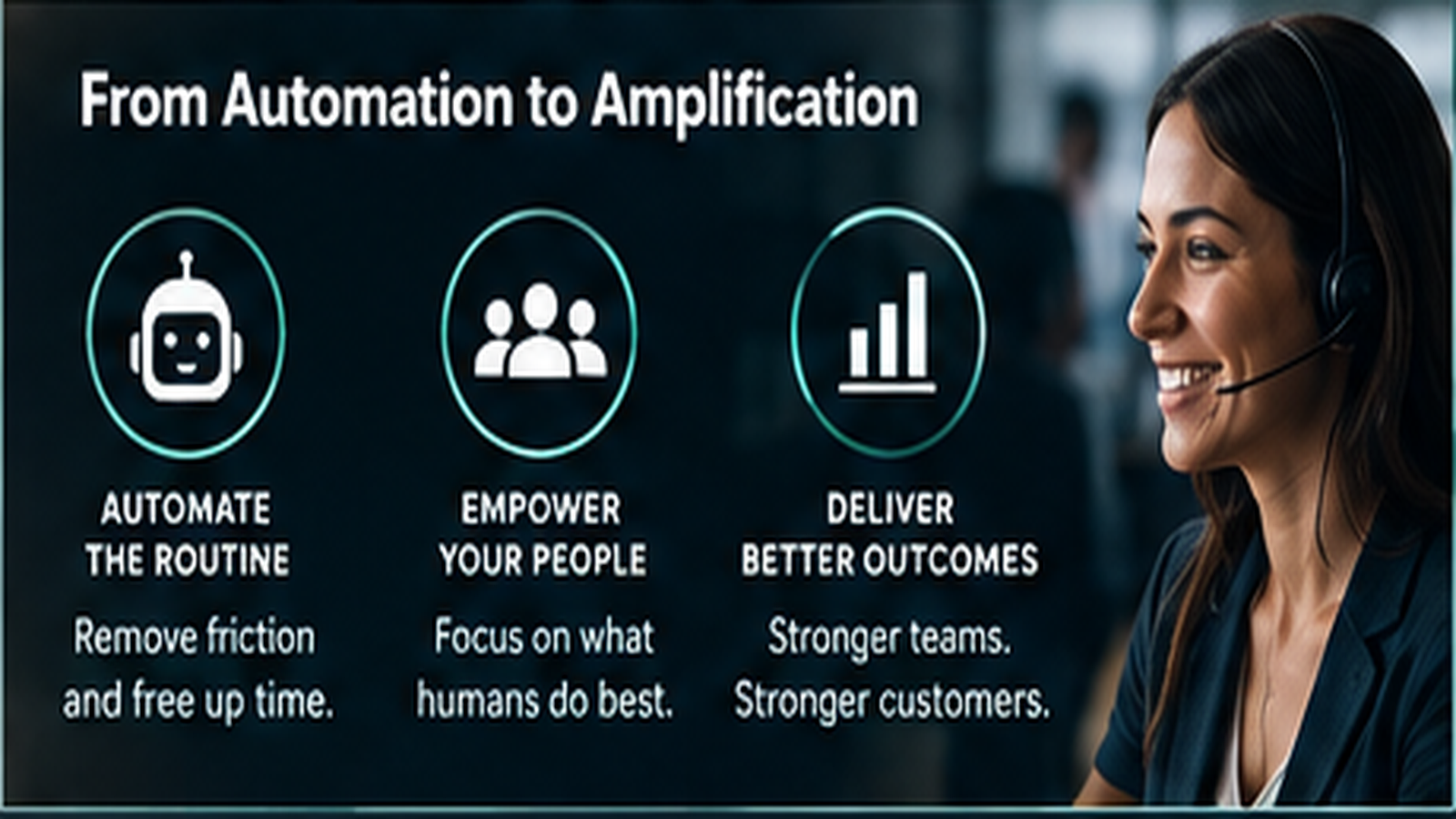
The AI era makes the point more important, not less
In 2026, AI is already participating in service workflows: summarizing histories, retrieving knowledge, drafting responses, classifying intent, recommending next actions, and increasingly taking action across systems.
At the same time, service leaders are redesigning rather than simply deleting human work. Gartner reported that 85% of service and support leaders in a 2025 survey were expanding human-agent responsibilities as AI changed the work mix. In a separate 2026 customer survey, 87% said access to a human agent was essential when companies use generative AI.
That combination is telling. The machine is getting more capable, and the human role is becoming more important in the places where judgment, trust, empathy, exception handling, and accountability matter.
Automation should create room for agency
The best version of this future is not a contact center where humans imitate bots while bots imitate humans.
It is a system where software handles more of the mechanical coordination: finding context, moving work, checking rules, recognizing patterns, suggesting options, and executing routine actions. People get more room to interpret, connect, negotiate, reassure, improvise, and decide.
That is what I mean when I say bots might make our people better. Not morally better. Not magically smarter. Better positioned.
At the individual level, customer service is still people helping people, with our glorious range of differences and personalities. The operating system around them should be sophisticated enough to let those differences become an advantage instead of a source of friction.
Bots won’t make us better people. But if we design the system well, they can help our people do better work.
Sources & References
- Gartner, April 28, 2026. Gartner Survey Finds 31% of Service and Support Leaders Have Implemented or Are Planning AI-Driven Frontline Layoffs Through 1Q27 — Survey of 321 service/support leaders found 85% expanding human-agent responsibilities as AI changes work.Reference 1
- Gartner, August 4, 2026. Gartner Survey Finds 87% of Customers Say Companies Using GenAI for Customer Service Must Provide Access to a Human Agent — Survey of 3,566 B2B/B2C customers found 87% consider access to a human agent essential when companies use GenAI.Reference 2
- ArenaCX. ArenaCX Website V2 Legacy Content Raw Materials v1.2 — Historical Alan-authored source preserved in the ArenaCX legacy-content archive.Reference 3