BPO Sourcing & RFP Management
The ArenaCX BPO RFP Template
A practical framework for defining your requirements, standardizing provider responses, and making a BPO selection process easier to compare and defend.

A BPO RFP should produce a decision, not just a questionnaire. This working template helps you define the requirement before release, standardize how bidders respond, make assumptions visible, and create a cleaner record for evaluation, diligence, commercials, and implementation.
Buyer fields define the requirement and should be completed before the RFP goes to market. Provider-response fields are answered by each bidder in the same order, so responses stay comparable. Adapt the template to the size, risk, regulatory context, and complexity of your program.
What a modern BPO RFP should evaluate
Move beyond price alone. A comparable response set lets you assess the operating model, risk profile, people system, technology, flexibility, and commercial governance behind the outcome.
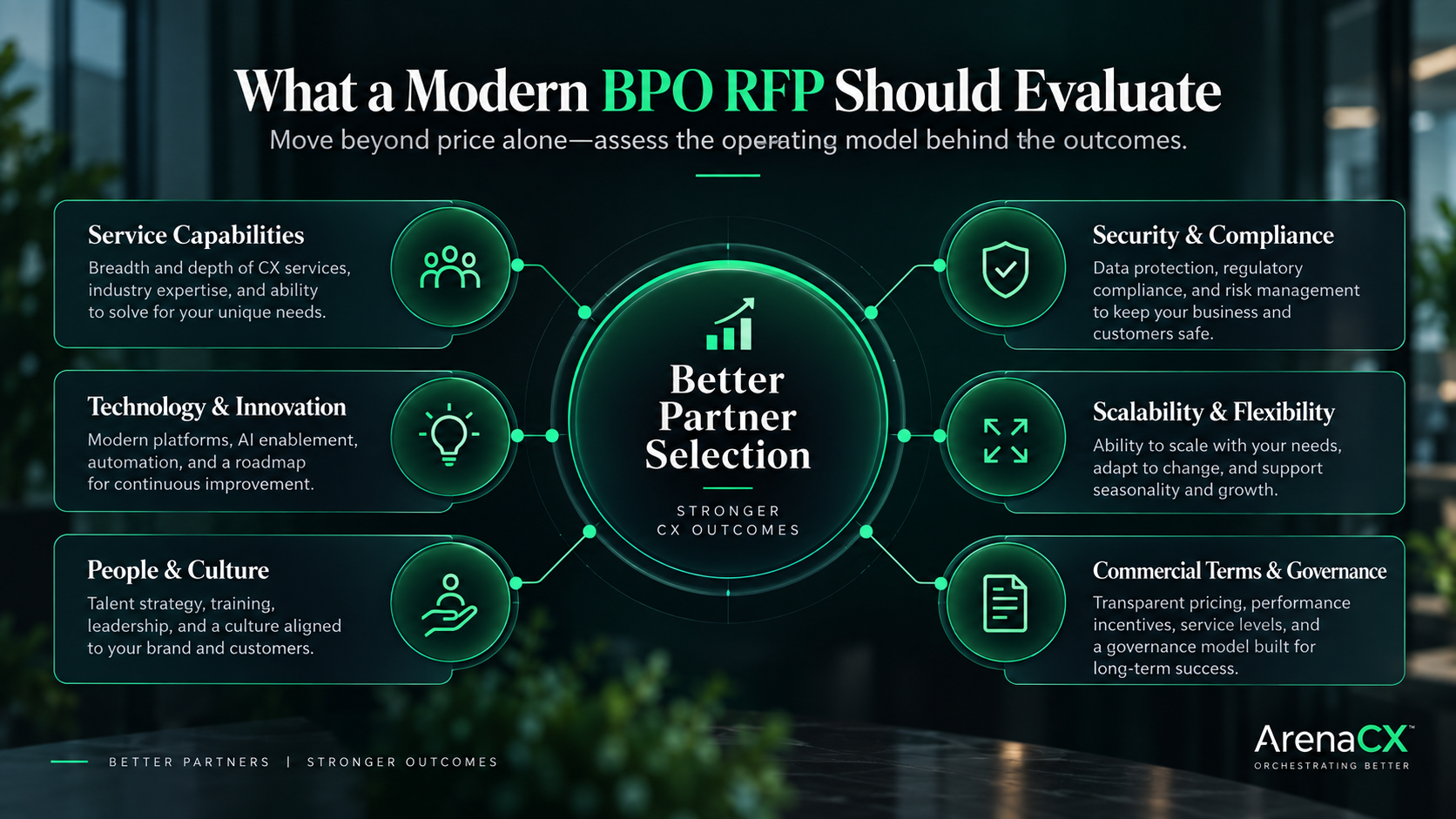
How the template is organized
The workbook follows the sourcing process from definition through selection, with a consistent response structure in every section.
- Buyer project brief — objectives, scope, channels, geographies, demand profile, constraints, and decision priorities.
- RFP process & timeline — one process calendar and one communication path for all bidders.
- Provider profile & stability — scale, ownership, operating footprint, and material risk factors.
- Relevant experience & solution fit — comparable evidence rather than generic credentials.
- Delivery model, workforce & capacity — where and how the work is delivered, plus location detail.
- Training, knowledge & quality — readiness, knowledge currency, and quality mechanisms.
- Workforce management & performance — forecasting, staffing, intraday control, and metric definitions.
- Technology, data, security & AI — system ownership, integration boundaries, controls, and an AI evaluation framework and worksheet.
- Implementation & change management — dependencies, testing, readiness, and cutover risk.
- Business continuity & resilience — how continuity is designed, tested, activated, and restored.
- Governance & account management — post-launch cadence, escalation, reporting, and improvement.
- Commercial response and normalization — comparable economics on a common demand scenario.
- References & diligence — reference detail and finalist diligence.
- Exceptions, assumptions & certification — every material exception stated in one place.