BPO Sourcing & RFP Management
BPO Sourcing Is Not Vendor Shopping
The real job is not to gather familiar provider names. It is to define the operating requirement, create a meaningful option set, expose the tradeoffs, and choose a structure that can adapt as the business changes.

Vendor shopping starts with names. Strategic sourcing starts with the work.
A vendor-shopping process usually begins with a familiar question: Which BPOs should we look at? That sounds reasonable, but it starts one step too late.
The better opening question is: What operating problem are we trying to solve, under what constraints, and what structure gives us the best odds of solving it well? A BPO is not a commodity SKU. Every proposal carries assumptions about geography, labor model, management depth, technology, automation, staffing flexibility, commercial risk, implementation, and how the relationship will evolve after launch.
That is why good BPO sourcing is less like shopping and more like operating-model design. The goal is not to collect a shelf of recognizable logos and pick the most persuasive presentation. The goal is to create a defensible decision about where work should sit, how it should be delivered, what it should cost, how it should change when conditions move, and who will be accountable when assumptions fail.
1. Define the operating requirement before you define the vendor list
Weak sourcing processes ask providers to react to an under-specified problem. Strong ones translate the business need into a set of operating requirements that can actually be compared.
That means getting specific about outcomes, not just seats. What customer experience are you trying to protect or improve? What demand pattern must the model absorb? Which channels and contact types are in scope? What languages, hours, compliance constraints, systems, skill levels, and escalation paths matter? What must be true on day one, and what can mature over time?
The requirement should also expose uncertainty. If volume is expected to move by plus or minus 20 percent, say so. If a product launch could create a short spike, model it. If AI may deflect simple contacts but increase the complexity of the work that remains for humans, treat that as a design variable rather than a footnote.
The point is not to predict the future perfectly. It is to make the assumptions visible enough that providers can respond to the same problem - and buyers can see where proposals rely on different assumptions.
2. Build an option set, not a beauty pageant
Once the requirement is clear, sourcing should widen the option set before it narrows it. The right answer may be one excellent provider. It may be an incumbent with a redesigned scope. It may be a specialist in one geography or capability. It may be a blended structure that combines internal teams, external delivery, technology, and more than one provider. It may even be that the best decision is not to outsource a particular workstream at all.
This is where vendor shopping often becomes self-limiting. If the process starts with a short list of familiar names, the operating model gets shaped by the choices already on the list. Strategic sourcing works the other way around: define the problem, create meaningful alternatives, then let the evidence narrow the field.
Deloitte's 2024 Global Outsourcing Survey, based on more than 500 executives, describes this broader shift as multidimensional sourcing: organizations are combining outsourcing, insourcing, global in-house centers, digital workers, and other talent models while trying to govern the whole extended workforce more coherently. That is a useful reminder that the modern sourcing decision is not simply 'which vendor?' It is 'which combination of capabilities and delivery models fits this work?'
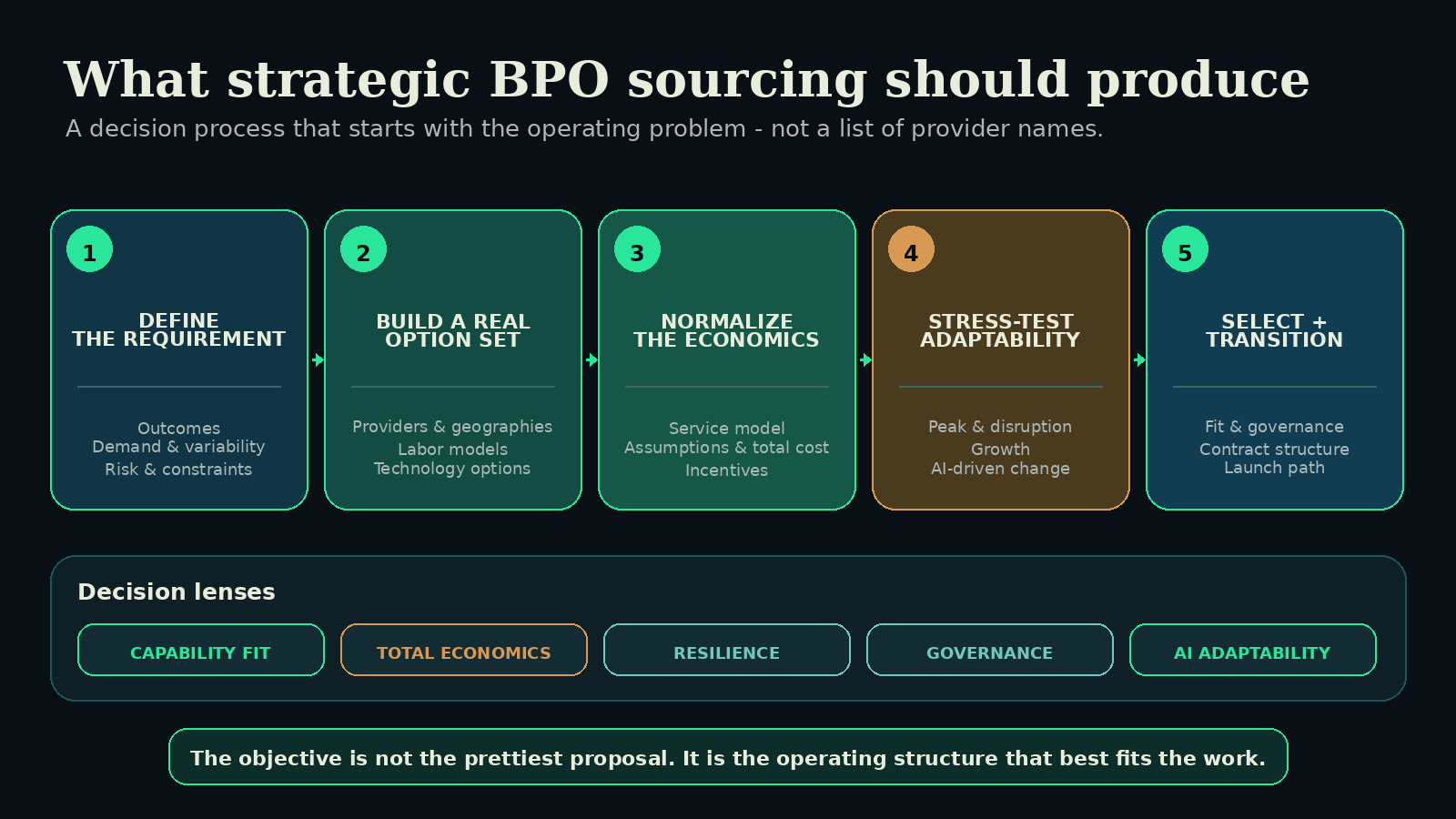
3. Normalize the economics before you compare the price
Rate cards are easy to compare because they look precise. They are also one of the fastest ways to create false confidence.
Two providers can quote similar hourly rates and produce very different economics once you account for productivity, shrinkage, attrition, training, management ratios, technology charges, recruiting costs, minimum commitments, ramp assumptions, paid idle time, quality failures, rework, transition costs, and the internal effort required to manage the relationship.
The comparison therefore needs a common economic model. Normalize what each provider assumes about productive time, occupancy, staffing ratios, service levels, technology, and volume. Separate fixed from variable cost. Show what happens when volume rises, falls, or shifts by channel. Put implementation and switching costs somewhere visible instead of treating them as someone else's problem.
Depending on the work, cost per resolved contact, cost per productive hour, cost per unit of output, or cost-to-serve by contact type may be more useful than a single headline rate. There is no universal denominator. The point is to compare the economics of the operating model, not just the invoice unit.
4. Stress-test the model before the real world does
A provider can look excellent in the base case and still be a poor fit for the operating conditions that matter most.
Good sourcing asks every serious option to explain what happens under stress. What if demand is 30 percent above plan for two weeks? What if a major site is impaired? What if a new product requires a different skill mix? What if the business wants to move more work to chat, messaging, or self-service? What if automation changes handle time or the number of contacts that reach an agent? What if the company needs to exit a geography, add a language, or move quickly after an acquisition?
You do not need a giant simulation model for every sourcing event. You do need enough scenario discipline to reveal which operating models are brittle and which preserve options. A proposal that works only when the forecast is right is not a resilient proposal.
5. Treat AI adaptability as a sourcing criterion - not a technology appendix
AI is already inside the outsourcing decision. Deloitte's 2024 survey reported that 83 percent of surveyed executives were leveraging AI as part of outsourced services. The same survey also noted that governance and contracting challenges were limiting the benefits organizations were realizing. That combination matters: AI adoption can move faster than the operating and commercial structures around it.
A modern sourcing process should therefore evaluate a provider's ability to adapt as the AI stack changes, not just whether it can demo a chatbot or agent-assist feature today.
Useful questions include: Who owns the data, prompts, workflows, knowledge assets, and process improvements created during the engagement? Can the customer change models or platforms without rebuilding the entire delivery structure? How are AI outputs tested, monitored, and escalated? What human controls remain around high-impact decisions? How does the commercial model change if automation reduces volume, handle time, or staffing needs? Can the provider absorb a shift from simple transactional work to fewer but more complex human contacts?
NIST's AI Risk Management Framework is intentionally technology- and sector-agnostic, but its lifecycle approach is relevant here: organizations using AI still need governance, measurement, oversight, and risk management across design, deployment, use, and change. For sourcing teams, that means AI governance belongs in diligence, contracting, operating review, and transition planning - not only in the IT questionnaire.
The exact tools will change. The more durable sourcing question is whether the operating model can change with them.
6. Use structure to expose tradeoffs - not to manufacture a fake score
RFPs, RFIs, scorecards, and evaluation matrices are useful because they create discipline. They are dangerous when the math creates more certainty than the evidence deserves.
A weighted score can help force clarity about priorities, but a 92.4 should not magically become more 'true' than an 89.7. Some criteria are hard gates. Some are tradeoffs. Some are risks that need mitigation rather than points. Some only become clear through references, workshops, site visits, security review, operating-model sessions, or a pilot.
The sourcing process should separate those categories. Security or regulatory requirements may be pass/fail. Geography might be a constraint. Commercial flexibility might be a weighted tradeoff. Transition readiness might require evidence. AI adaptability may need both technical diligence and contract language. The evaluation framework should help the team see these differences rather than flattening everything into one number.
A good process produces a decision that can be explained later: what mattered, what was learned, what tradeoffs were accepted, what risks remain, and why the selected structure fits the requirement better than the alternatives.
7. Select the operating structure - then make the transition executable
Selection is not the finish line. It is the point where a sourcing hypothesis becomes an operating commitment.
Before declaring a winner, connect the decision to the transition path. What has to happen between signature and productive work? Who owns knowledge transfer, systems access, recruiting, training, nesting, QA calibration, workforce planning, security validation, and launch governance? What are the dependencies? What are the exit criteria for each phase? What will trigger escalation?
This is also where the one-provider-or-many question should be resolved pragmatically. Multiple providers are not automatically more sophisticated. One strong provider may be exactly right for a stable, well-bounded requirement. A second provider only creates resilience if it is genuinely ready to take work. Additional complexity should earn its keep.
The design should follow the problem. Sometimes that means concentration. Sometimes diversification. Sometimes technology reduces the need for labor. Sometimes the most important thing is preserving an option that is not needed today but may matter six months from now.
What a strong sourcing process should leave behind
At the end of the process, the buyer should have more than a signed contract and a presentation deck. The work should leave behind a clear operating requirement, a documented option set, normalized economics, explicit tradeoffs, a record of diligence, a view of the risks, an AI and technology adaptability position, and an executable transition plan.
That is the difference between choosing a vendor and designing an operating model.
Vendor shopping asks, 'Who should we buy from?' Strategic BPO sourcing asks a harder and more useful question: 'What structure gives this work the best chance to perform - now, under stress, and as the business changes?'
Sources & References
- Deloitte, 2024. Global Outsourcing Survey 2024Reference 1
- NIST. AI Risk Management FrameworkReference 2