Seasonal & Surge Operations
Building an Elastic Workforce: Planning, Systems, and Execution
Workforce management is not only a forecasting problem. The harder challenge is building the operating levers to add, shift, and release capacity when demand moves differently than planned.
If you have ever been responsible for customer service, you know the frontline staffing problem is personal.
You can have a great product, a thoughtful support strategy, excellent training, and a strong team. But if too many customers need help at the same time and you do not have enough capable people available, the experience breaks down quickly. Customers wait. Team members absorb the stress. Leaders explain the misses. Everyone starts asking the same question: Why didn't we see this coming?
That experience creates a predictable instinct: we need more staff.
Sometimes that is exactly right. But permanent headcount is an expensive answer to a demand pattern that may be temporary, seasonal, volatile, or simply hard to forecast. The better question is not only, How many people do we need? It is also, How quickly can we change the amount and mix of capacity when reality departs from the plan?
That is the difference between workforce planning and workforce elasticity.
Planning matters. But planning is still a model.
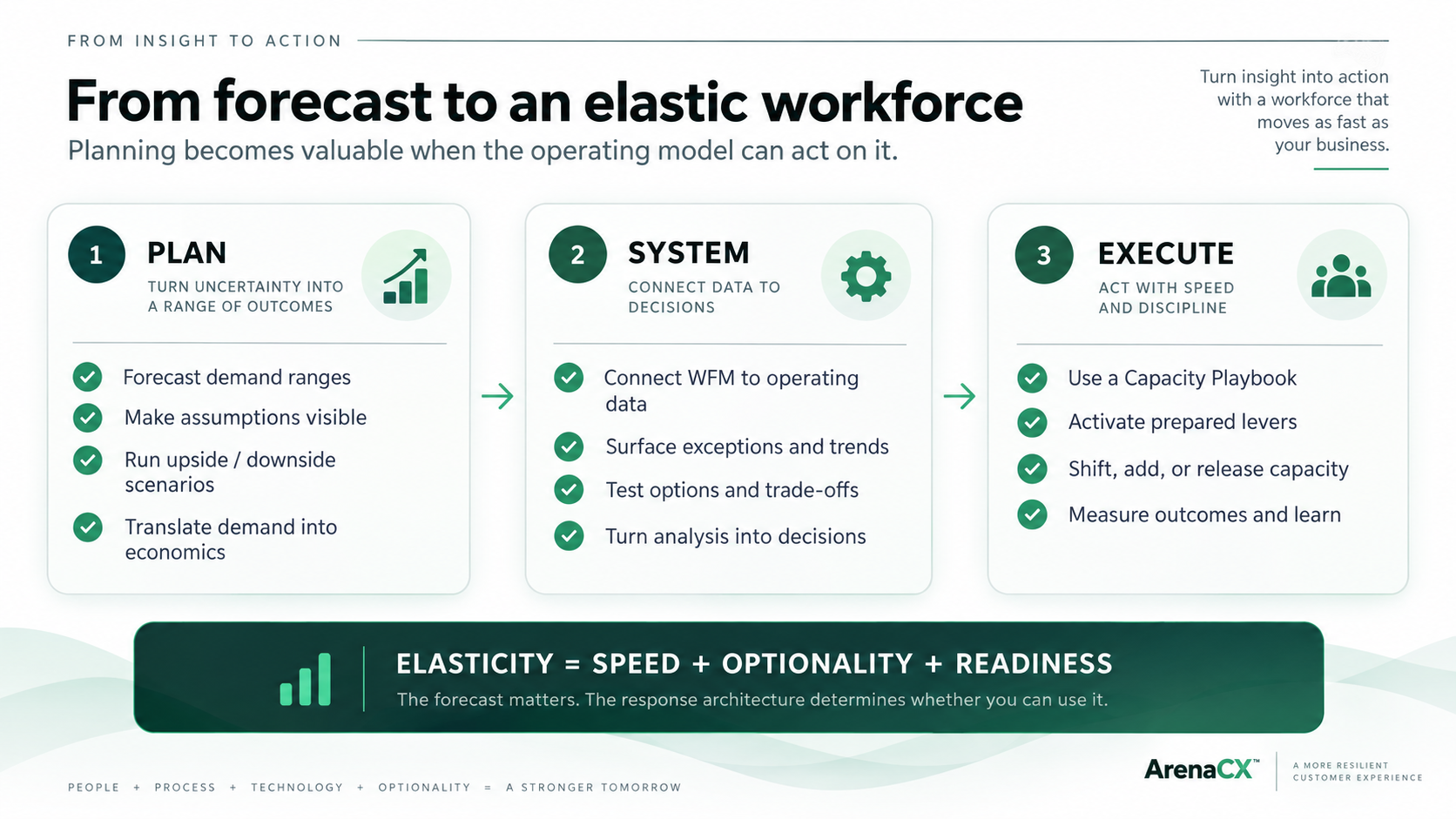
Good workforce management starts with planning. Forecasting gives an operation a disciplined way to translate expected demand into staffing requirements, schedules, hiring plans, budgets, and operating decisions.
Modern WFM tools can incorporate more signals, more history, more scenarios, and more complex assumptions than a spreadsheet ever could. That is useful. But no system gets to skip the uncertainty built into the future.
A forecast is still a model. It is an informed view of what is likely to happen, not a promise about what will happen.
That means the goal should not be to produce one supposedly perfect number. A stronger planning process does several things at once:
- uses current, realistic operating assumptions;
- connects demand forecasts to staffing and scheduling decisions;
- considers upside and downside scenarios, not just a base case;
- makes the financial implications of those scenarios visible;
- defines the actions the operation will take when actual demand moves outside the expected range.
That last point matters most. A forecast that says you will be short 100 people next month is valuable only if the organization has a practical way to do something about it.
The system has to make the plan actionable.
A WFM platform should do more than create an elegant forecast. It should help the organization convert information into decisions.
That starts with integration. Workforce planning becomes much more useful when it is connected to the systems that describe what customers are actually doing: CRM, CCaaS, ticketing, quality, knowledge, and other operating data. The objective is not to create a bigger technology stack. It is to shorten the distance between a change in demand and a staffing response.
The most useful systems also make assumptions visible. If the plan depends on a certain handling time, shrinkage rate, occupancy level, hiring yield, training duration, or provider ramp, those assumptions should not disappear inside a black box. Leaders need to understand what is driving the recommendation and what changes when an assumption changes.
And increasingly, AI can improve this decision layer. It can help teams detect patterns, test scenarios, surface anomalies, and evaluate more operating options than a human planner could reasonably model by hand. But AI does not eliminate the execution problem. A recommendation to add capacity is still only a recommendation until the operation has somewhere to get that capacity.
The system should therefore answer two questions clearly:
- What is likely to happen?
- What can we actually do about it?
If it answers only the first, you have forecasting. If it helps answer both, you are getting closer to workforce management.
Execution is where workforce plans succeed or fail.
Organizations fail to execute workforce plans for reasons that have little to do with forecasting accuracy.
Sometimes the team is too focused on today's fires to act early. Sometimes hiring cycles are too slow. Sometimes a leader does not trust the model. Sometimes the company has only one recruiting channel, one geography, one provider, one site, or one staffing model. Sometimes the technology sees the problem but the operating model has no lever to pull.
The common thread is constraint.
A rigid operation has very few choices when demand changes. An elastic operation has more.
This does not mean carrying excess capacity everywhere or adding providers for the sake of adding providers. It means deliberately creating practical options that fit the economics and risk profile of the program.
For one organization, elasticity may come from cross-training internal teams and using voluntary schedule extensions. For another, it may come from a supplemental BPO that can ramp during defined peaks. A larger program may justify multiple delivery locations, providers, or workforce models. A smaller program may need only one well-designed backup path.
The architecture should match the requirement. The principle is the same: do not wait until the peak to discover that your only capacity lever takes eight weeks to move.
Build a Capacity Playbook before you need it.
The practical bridge between planning and execution is a Capacity Playbook.
A Capacity Playbook is simply a pre-defined set of actions the operation can take to add, shift, protect, or release capacity as conditions change. The purpose is not to create a thick emergency manual. The purpose is to make the available choices explicit before everyone is under pressure.
A useful playbook can organize capacity levers by speed, cost, operational risk, and the amount of capacity they can realistically produce.
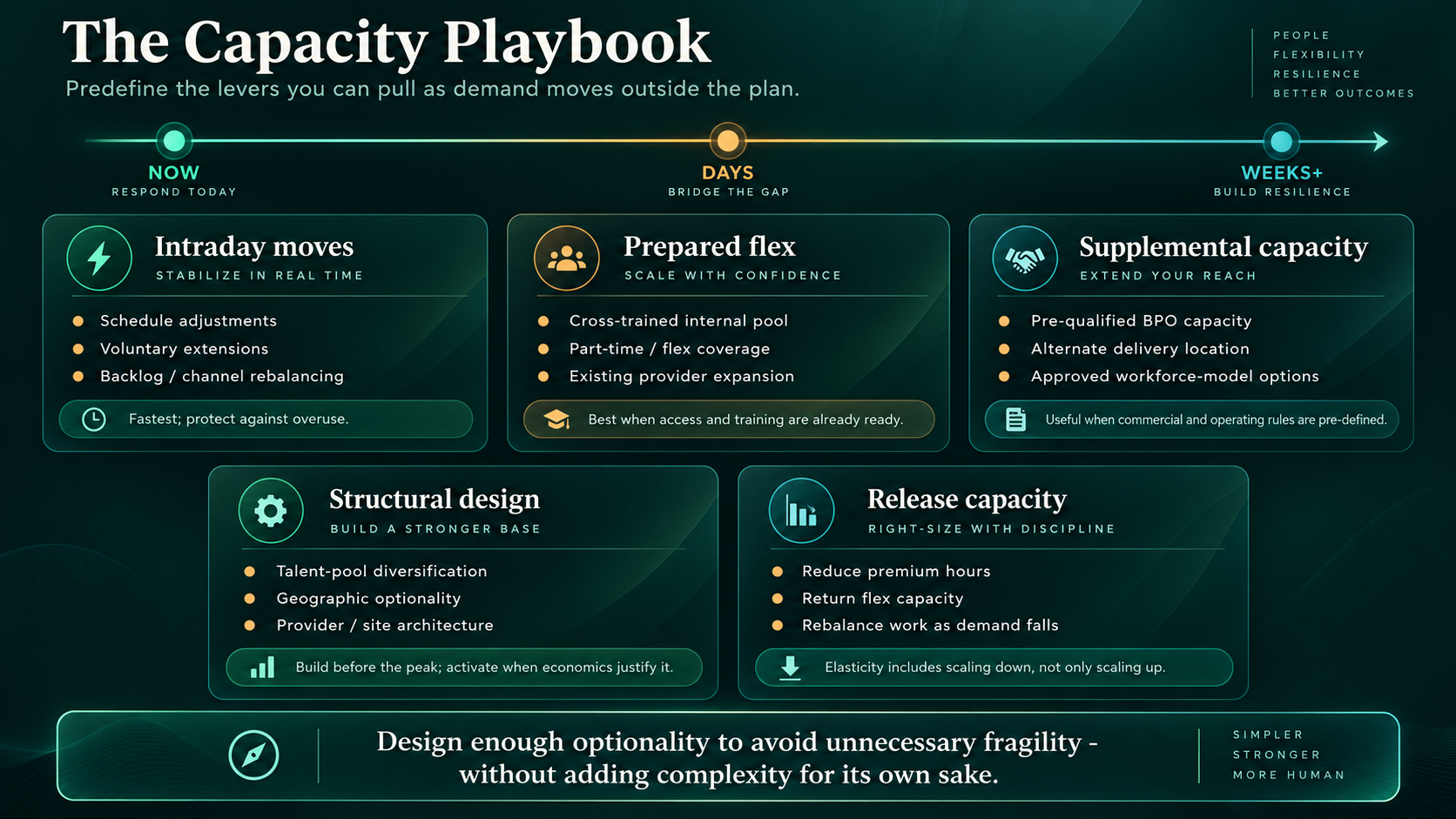
Immediate levers
These are moves that can be activated within the existing operation: intraday schedule adjustments, voluntary extensions, overtime, break optimization, backlog prioritization, channel rebalancing, or temporary movement of cross-trained people.
They are fast, but they are not free. Repeated use can create burnout, quality risk, or hidden cost. They are pressure valves, not a permanent operating model.
Near-term levers
These may take days rather than hours: activating trained flex pools, changing schedules, adding part-time coverage, moving work across existing teams, expanding hours with a current provider, or shifting volume to another prepared delivery location.
These options become much more valuable when the people, access, training, and operating rules are already in place.
Structural levers
These are the decisions that create long-term elasticity: how many talent pools you can access, which geographies are available, whether a supplemental BPO is qualified, whether work can move across providers or sites, how much cross-training exists, and whether contracts and technology actually allow capacity to expand and contract.
Structural levers take longer to build. That is why they should be designed before the operation is under stress.
Optionality is more useful than idle capacity.
One of the easiest ways to protect service levels is to overstaff. It is also one of the most expensive.
Elasticity offers a different idea: instead of permanently carrying every unit of capacity you might need, create options to access capacity when conditions justify it.
Optionality can come from several dimensions:
- internal and external teams;
- dedicated and shared capacity;
- full-time, part-time, flexible, or other approved workforce models;
- multiple recruiting channels or labor markets;
- more than one delivery geography where the program warrants it;
- cross-trained teams that can move between work types;
- pre-qualified supplemental providers that can be activated when needed.
The right mix depends on the program. More options are not automatically better. Every additional provider, location, or workforce model creates coordination cost. The goal is not maximum complexity. It is enough optionality to avoid unnecessary fragility.
That is why elasticity should be designed economically. A capacity option is valuable only if its cost, speed, quality, and activation risk make sense relative to the problem it is meant to solve.
Outsourcing can be a capacity lever, not just a sourcing decision.
Traditional outsourcing is often framed as a binary choice: keep the work in-house or move it to a BPO.
That is too narrow for workforce planning.
A BPO can also be one element in a broader capacity design. It can provide a supplemental talent pool, a different geography, different hours, specialist capability, surge coverage, or a way to avoid carrying peak infrastructure all year.
But outsourcing creates elasticity only when it is prepared in advance.
If the provider still needs to be sourced, contracted, integrated, trained, credentialed, and operationally validated after demand has already spiked, it is not elastic capacity. It is a future project.
The operating work has to happen early: define the role, qualify the capacity, establish the commercial model, decide how work will be allocated, connect the systems, train the people, test the process, and define the activation trigger.