Impact & Business for Good
Business for Good in Customer Operations: Four Lenses for Impact
Customer-operations spend can do more than buy capacity. When impact is defined clearly and evaluated alongside performance, sourcing can widen opportunity without turning purpose into a substitute for operating fit.

Business for good gets vague quickly.
The moment impact enters a sourcing conversation, practical questions follow. What counts as impact? What evidence is strong enough to rely on? How much weight should it carry? And what happens when an impact objective collides with quality, cost, scale, security, or implementation readiness?
Those questions are useful because they force impact out of the realm of slogans and into operating design.
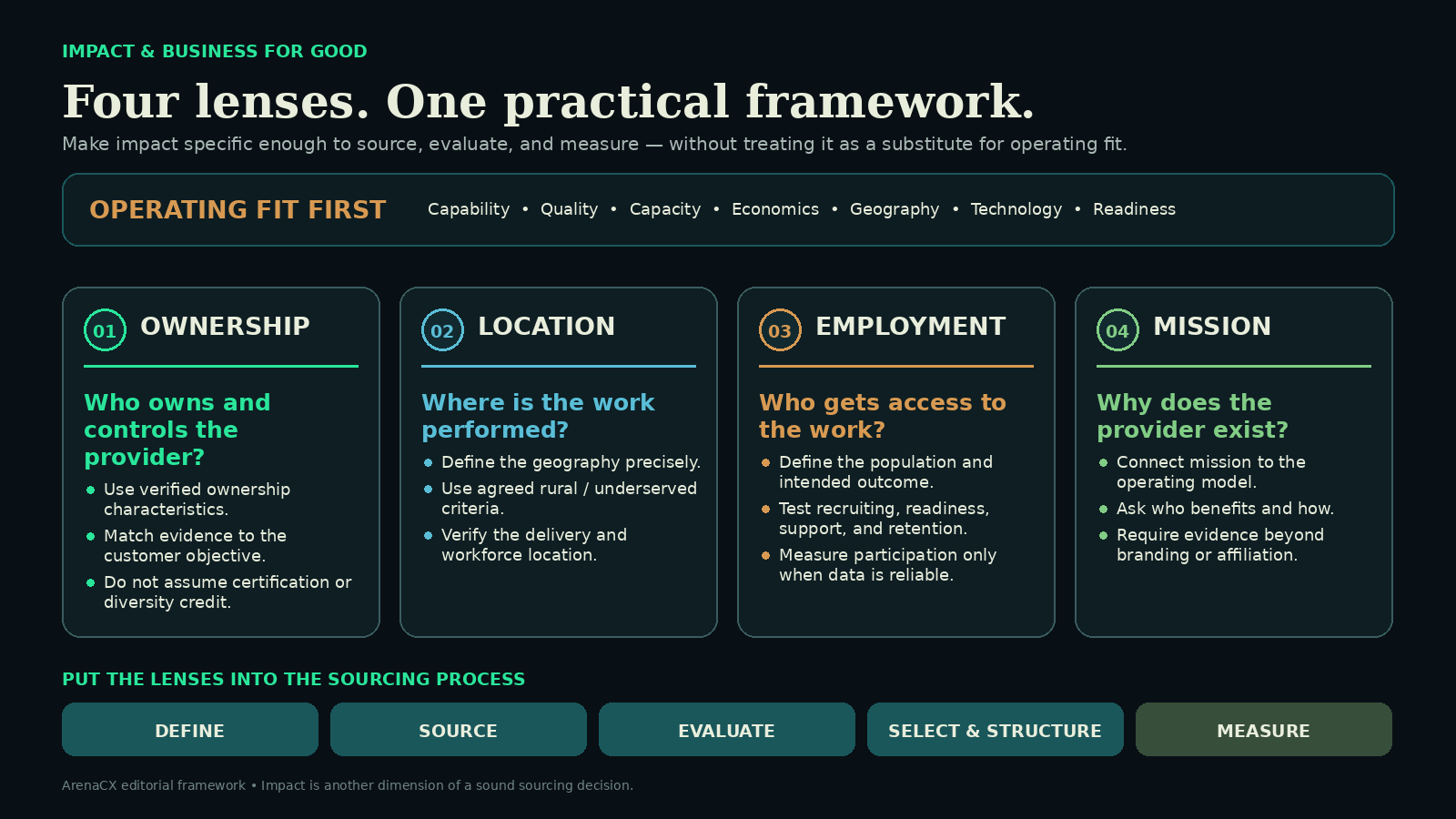
For customer operations, ArenaCX uses four lenses to make the conversation more concrete: Ownership, Location, Employment, and Mission. They are not four certifications, four moral rankings, or four reasons to relax performance standards. They are four ways to ask where a sourcing decision can create broader economic or social value while the provider still has to meet the operating need.
Start with the guardrail: operating fit still comes first
A provider does not become the right choice because its impact story is compelling. It still has to deliver the service.
That means capability, quality, capacity, economics, geography, technology fit, security, resilience, and implementation readiness remain part of the decision. Impact is an additional dimension that can influence which providers are considered, how a solution is structured, where work is allocated, and what the program chooses to measure.
This guardrail matters in both directions. It prevents “business for good” from becoming charity disguised as sourcing. It also prevents buyers from treating impact as something that must live in a separate corporate-social-responsibility program, disconnected from the ordinary decisions that determine who receives work.
Lens 1: Ownership — who owns and controls the provider?
Ownership is the most familiar impact lens because many buyers already encounter ownership classifications in supplier-diversity and public-sector programs.
The important word is verified. Formal programs often use specific ownership-and-control tests rather than broad labels. The U.S. Small Business Administration, for example, applies defined eligibility standards to programs including Women-Owned Small Business, 8(a), HUBZone, and Service-Disabled Veteran-Owned Small Business certification. Those standards differ by program, and a provider’s eligibility or certification belongs to that provider; it does not automatically transfer to ArenaCX or to a customer program.
For a commercial sourcing decision, the useful questions are straightforward: Does ownership matter to the customer objective? If it does, what classification or evidence is relevant? Is formal certification required, or is another form of verification sufficient for the purpose at hand?
Ownership can broaden supplier participation. But ownership alone does not tell you whether a provider is operationally strong, whether its workforce benefits from the work, or whether the program will create the outcome a buyer has in mind. That is why it is one lens, not the whole framework.
Lens 2: Location — where is the work performed?
Where work happens can matter independently of who owns the company.
A customer may want to create opportunity in a rural community, an economically challenged region, an Indigenous community, or another geography where access to quality employment is more constrained. But “underserved” and “rural” are not precise enough by themselves. Definitions vary by program and purpose. The U.S. Department of Agriculture’s Economic Research Service explicitly notes that multiple rural definitions are used, based on different geographic concepts and population thresholds.
The practical implication is simple: define the geography before evaluating the providers. A location lens should be tied to something that can be checked — a delivery site, a workforce location, a program-specific geographic definition, or another agreed criterion.
Otherwise, location becomes storytelling. A provider may have a mailing address in one place while the work is delivered somewhere else. A national employer may recruit broadly but concentrate the actual program in a major metro. If location matters, the sourcing process should verify the location that actually matters to the customer objective.
Lens 3: Employment — who gets access to the work?
The employment lens asks a different question: who is gaining access to the opportunity?
Customer operations can create entry points, career paths, flexible work, and remote or distributed employment. Depending on the objective, a buyer may care about access for people with disabilities, veterans, refugees, trafficking survivors, second-chance populations, or other groups for whom quality employment may be harder to access.
The need is not theoretical. In its March 2026 release on 2025 labor-force characteristics, the U.S. Bureau of Labor Statistics reported that 22.8 percent of people with a disability were employed, compared with 65.2 percent of people without a disability. The U.S. Department of Labor also operates Reentry Employment Opportunities programs specifically aimed at improving workforce outcomes for justice-involved and formerly incarcerated people.
Those facts do not mean that every program serving a named population is automatically high-impact. The operating model still matters. How does the provider recruit? What readiness standards apply? Are accommodations or supports available where needed? Can people succeed and remain in the work? Is the work itself sustainable and appropriately compensated?
Employment impact is strongest when access is connected to a credible operating system, not just a hiring label.
Lens 4: Mission — why does the provider exist?
Mission is the broadest lens and, in some ways, the easiest to overstate.
A mission-driven provider may be a nonprofit, a social enterprise, a faith-based organization, or a conventional company whose business model is deliberately designed to create a social or economic benefit for a particular community. The legal form is not the point. The operating connection is.
The questions here should be demanding: Is the mission materially connected to how the provider operates? Who is intended to benefit? How does the business model create that benefit? What evidence can the provider show? Does growth reinforce the mission, or is the mission mostly a brand statement?
Religious affiliation by itself does not make a provider disadvantaged or preferable. Nor does a strong mission excuse weak performance. The relevant question is whether the mission and operating model create a supportable benefit that matters to the customer’s objective.
The four lenses are not four boxes
One provider may fit more than one lens. Another may fit only one. Neither is inherently better.
A woman-owned provider operating in a major metro may create meaningful ownership diversity without fitting a location objective. A conventionally owned provider may run a strong employment model for people with disabilities. A rural provider may create local opportunity without having a formal supplier-diversity certification. A mission-driven organization may be compelling but still not fit the service requirement.
That is why the four lenses work best as a decision framework rather than a scorecard. They help buyers ask better questions without pretending that impact is one-dimensional.
Make impact part of the sourcing process
If impact matters, it should change the sourcing process — not just the slide deck.
Define. Agree on the impact objective, the definitions, the evidence standard, and how much weight impact should carry relative to the operating requirements.
Source. Identify capable providers whose ownership, location, employment model, or mission may be relevant to the objective.
Evaluate. Review the impact evidence alongside capability, service design, commercials, technology, risk, and implementation fit.
Select and structure. Choose the provider or provider mix that best fits the complete need. Impact may influence which provider is selected, which geography is used, or how work is allocated across a multi-provider solution.
Measure. Track only what the program can measure reliably. Depending on the objective, that might include spend directed to qualified providers, workforce participation, delivery location, retention, or another agreed indicator.
The point is not to manufacture an “impact score.” It is to make the intent operational enough that someone can tell what was actually done.
Measure what you can defend
Impact programs lose credibility when the measurement is more ambitious than the underlying data.
A buyer does not need a giant dashboard to begin. One or two clearly defined measures are often more useful than a long list of estimates. The definition, time period, denominator, and source should be clear. If the provider supplies the data, that should be understood. If a number cannot be reproduced or explained, it should not become a headline claim.
The same rule applies to supplier classifications and public-sector goals. A provider’s certification, ownership status, workforce characteristics, or geographic attributes should not be treated as automatic statutory, set-aside, subcontracting-plan, or supplier-diversity credit. The applicable program rules control.
Business for good works best when it is operational
Customer-operations sourcing already determines where substantial amounts of work go, which companies receive business, where teams are built, and who gets access to employment. That makes impact a natural design consideration when it matters to the customer.
But the useful version of “business for good” is not performative. It does not ask buyers to choose purpose instead of performance. It asks whether a sound operating decision can also widen opportunity — and whether that opportunity can be defined, verified, structured, and measured with the same discipline used for the rest of the program.
Ownership. Location. Employment. Mission.
Four lenses are enough to make the conversation practical. The work still has to work.
Sources & References
- U.S. Small Business Administration. SBA business certifications: 8(a), WOSB, HUBZone, SDVOSBReference 1
- USDA Economic Research Service. Rural Classifications — What is Rural?Reference 2
- U.S. Bureau of Labor Statistics. People with a Disability: Labor Force Characteristics — 2025Reference 3
- U.S. Department of Labor, Employment and Training Administration. Reentry Employment OpportunitiesReference 4