Impact & Business for Good
Business for Good Without the Trade-Off: Designing Impact Into Customer Operations
A practical framework for designing impact into customer operations while keeping operating fit, evidence, and business requirements intact.

Executive summary
Business for good and high-performing customer operations are not mutually exclusive. The practical question is not whether purpose should replace performance. It is whether impact can be designed into the operating model while capability, quality, compliance, economics, and customer fit remain non-negotiable.
The trade-off is often a design failure
Impact conversations can become polarized quickly. One side treats social or community benefit as something that must be purchased at the expense of operating performance. The other treats positive intent as evidence that business outcomes will automatically improve. Neither is a sound operating model.
A better approach is to separate three questions: Can the provider and operating model do the work? What kind of impact matters in this context? Which operating choices can advance that impact without weakening the first answer? That sequence turns a values discussion into a design discipline.
Start with operating fit
Before impact enters the decision, the normal operating requirements still apply. The solution must meet the work: capability, language, channel, compliance, security, geography, staffing model, management depth, economics, quality requirements, and the customer experience itself.
This is the guardrail that keeps “business for good” from becoming a marketing exception. A provider should not be selected because it has an attractive impact story if it cannot reliably perform the work. Conversely, once multiple capable options exist, buyers have room to make more intentional choices about where opportunity is created and how the work is structured.
Define impact intent with four lenses
ArenaCX uses four lenses to make impact intent explicit. They are not scores, certifications, or automatic qualifications. They are questions that help a sourcing team define what it is trying to support and what evidence it would need to verify.
Ownership Who owns and operates the business? This may matter when a buyer wants to broaden access to spend or support enterprises with particular ownership characteristics, subject to verification.
Location Where is the work located? Geography can matter when a buyer wants to create opportunity in communities, regions, or labor markets that are aligned with a defined impact objective.
Employment How are people recruited, paid, trained, supported, and given access to opportunity? This lens keeps the focus on the quality and accessibility of work rather than counting jobs alone.
Mission What broader purpose does the provider advance, and how is that purpose evidenced? Mission should be relevant, inclusive, and verifiable; affiliation alone is not a substitute for evidence.
These lenses define intent. They do not, by themselves, determine the operating design. That requires translating intent into choices.
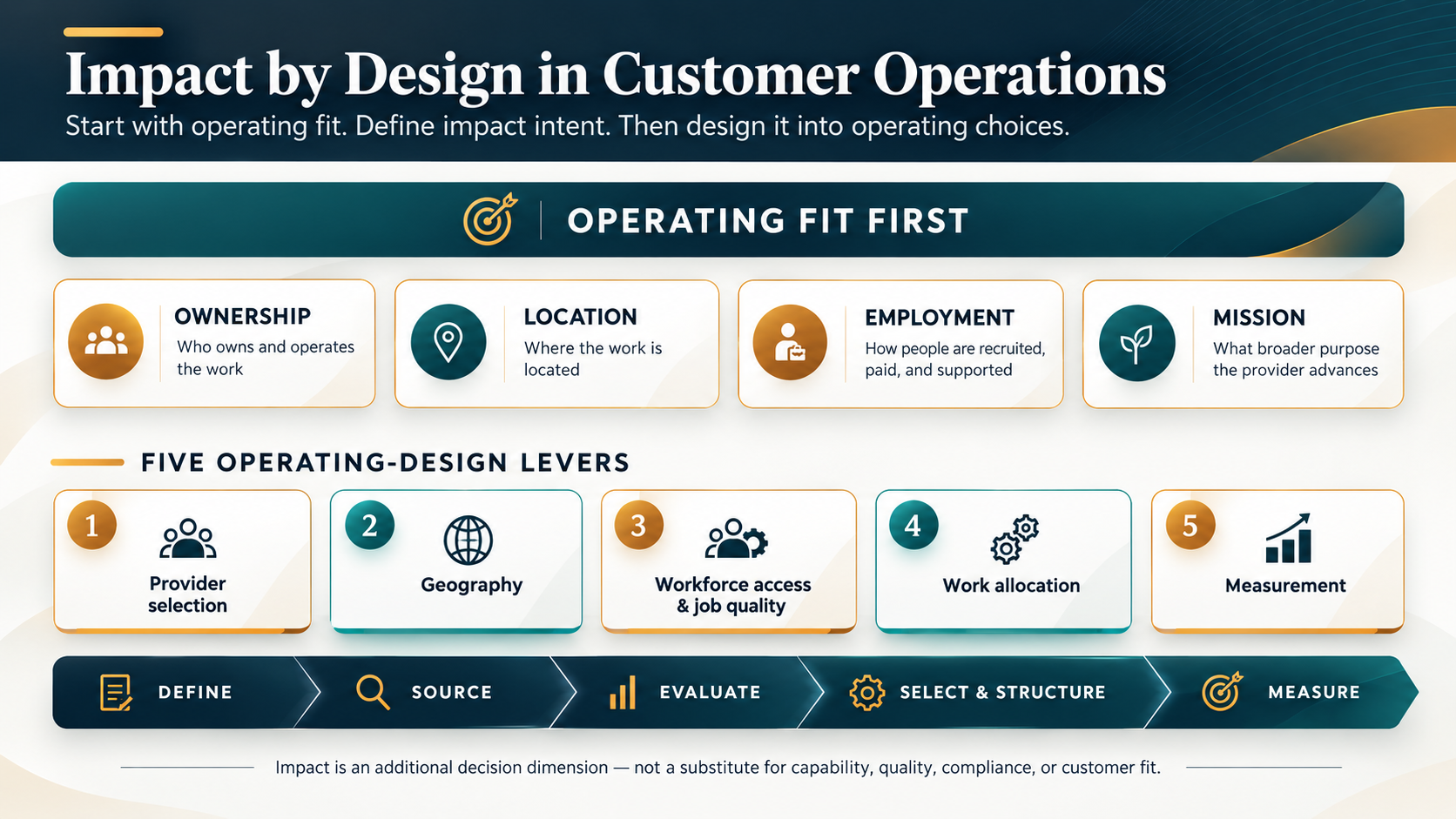
Five levers turn intent into operating design
1. Provider selection
Once operating fit is established, impact criteria can become part of the comparison among qualified providers. The discipline is to state the criterion in advance, identify the evidence required, and avoid treating an unverified claim as a differentiator.
2. Geography
Location can be designed at the program level, not just inherited from a vendor footprint. A sourcing team can decide whether certain work is suitable for a particular community or labor market, then evaluate the operational implications of language, connectivity, supervision, labor supply, resilience, and customer requirements.
3. Workforce access and job quality
Impact is not simply a headcount question. Buyers can ask how people gain access to the work, what barriers are reduced, how workers are supported, and what job-quality dimensions matter in context. External frameworks such as the U.S. Good Jobs Principles and ILO work on job quality are useful reference points, but the measures selected should fit the actual program.
4. Work allocation
Impact can be influenced by how work is distributed across a network. Instead of making one all-or-nothing sourcing decision, a buyer may structure an appropriate share of work, a defined workflow, or a staged expansion so that impact objectives and operating evidence can develop together.
5. Measurement
Good intentions are not a measurement system. Decide what can actually be verified, establish a baseline where possible, name the owner of each measure, and report the result without converting correlation into causation. Measures should help the team learn and govern the program, not merely decorate a case study.
Performance first does not mean impact last
The phrase “operating fit first” can be misunderstood as “impact only after every commercial decision is finished.” That is not the intent. The point is to preserve the performance gate while moving impact considerations upstream enough to shape sourcing and design.
For example, a buyer can define impact intent before the market scan, include it in provider discovery, evaluate it alongside operating requirements, and structure the final allocation so that both sets of objectives are visible. The performance gate remains intact, but impact is no longer bolted on after the contract is signed.
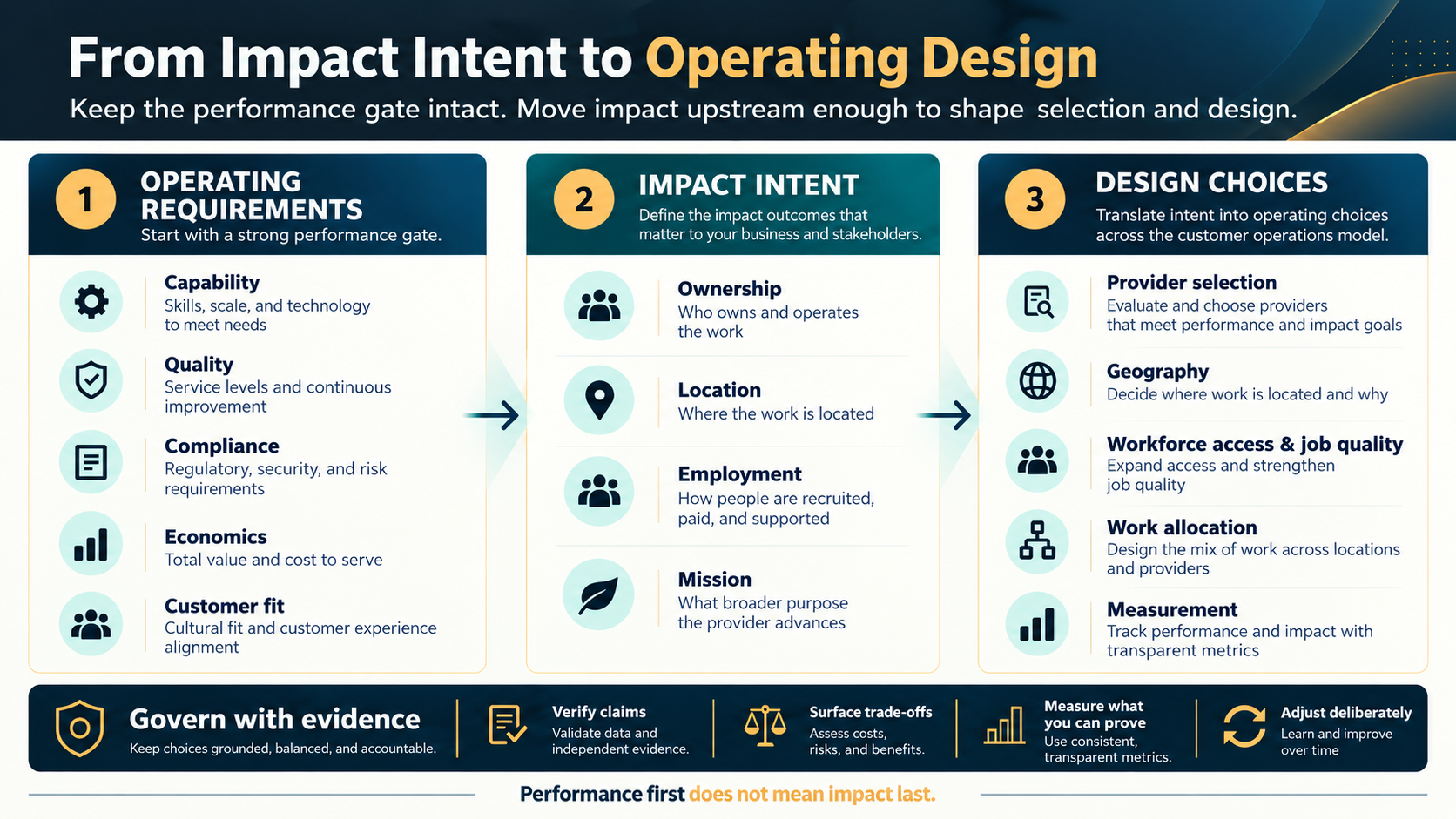
Trade-offs can still be real
Not every impact objective will be compatible with every workload, geography, timeline, or economic requirement. Sometimes the desired location does not have the needed labor pool. Sometimes a provider with a compelling mission lacks scale. Sometimes a buyer cannot verify the ownership or workforce claim it hoped to use. Those are operating facts to surface, not failures to hide.
The right response is transparency: identify the constraint, decide whether it can be redesigned, and record the decision. Impact by design is not a promise that trade-offs disappear. It is a method for seeing them earlier and making them deliberately.
Measure what you can prove
The measurement standard should be conservative. Avoid claims that impact sourcing automatically produces better quality, lower cost, stronger retention, greater resilience, or superior customer outcomes unless the program has evidence that supports that conclusion. External research can inform hypotheses, but program-specific claims require program-specific evidence.
- Define the measure before declaring the outcome.
- Distinguish provider-reported data from independently verified facts.
- Keep job quantity separate from job quality.
- State the period, population, denominator, and methodology for quantitative claims.
- Treat certifications, ownership status, mission claims, and public-sector implications as verification items, not assumptions.
- Use measures to improve operating decisions over time, not just to support marketing language.
A practical sourcing sequence
ArenaCX organizes the work as a five-step Impact sourcing process:
- DEFINE — Clarify the operating requirement and the impact intent.
- SOURCE — Identify qualified providers with relevant ownership, location, employment, or mission characteristics.
- EVALUATE — Test operating fit and verify the impact evidence that matters to the decision.
- SELECT & STRUCTURE — Choose capable providers and design the allocation, commercial structure, governance, and implementation path.
- MEASURE — Track the agreed evidence, learn from the operating results, and adjust where appropriate.
This sequence is deliberately unglamorous. That is the point. Business for good becomes more durable when it is treated as part of operating design rather than a campaign layered onto sourcing after the fact.
The goal: impact by design, not impact by decoration
Customer operations is a large, distributed system of work, suppliers, labor markets, technology, and management decisions. That creates many practical places to make impact more intentional—without asking purpose to substitute for performance.
The discipline is straightforward: fit the work first, define the impact that matters, use verified evidence, design through the levers you actually control, and measure only what you can support. The result is not a guarantee of better business outcomes. It is a more deliberate way to decide where opportunity is created and how customer operations can contribute to broader goals while still doing the job they exist to do.
Sources & References
- International Organization for Standardization. ISO 20400:2017, Sustainable procurement — Guidance — ISO states that the standard provides guidance on integrating sustainability within procurement.Reference 1
- U.S. Department of Labor / Department of Commerce. Good Jobs Principles and implementation materials — Used only as a reference point for job-quality dimensions; no ArenaCX outcome claims are derived from it.Reference 2
- International Labour Organization, 2023. A rough guide to measuring job quality in market systems development — Used to support the principle that job quality is context-specific and should be defined and measured deliberately.Reference 3