Resilience & Readiness
Customer Operations Resilience Readiness Check
Use this assessment to evaluate your current state, identify gaps, and strengthen your readiness for disruption in customer operations.

About this assessment
The Customer Operations Resilience Readiness Check is a practical assessment for leaders who want to understand whether their continuity plans translate into a capability that can actually operate under pressure.
This page summarizes the tool and explains how to use it. The full assessment, scoring guide, evidence prompts, and action-planning worksheet are in the downloadable file.
The assessment is designed to surface evidence, not confidence. It asks whether critical capabilities are defined, current, tested, owned, and supported by evidence - and where gaps still need attention.
What is in the download
- 24 readiness checks across eight domains
- A 0-3 evidence-based scoring guide
- Directional maturity bands for discussion and prioritization
- Four critical-path checks that warrant extra attention
- Space to capture evidence, gaps, owners, and next actions
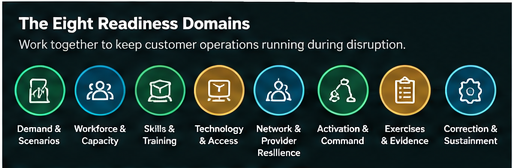
The eight readiness domains
The assessment looks across eight connected areas. A weakness in one can undermine strengths elsewhere, so the goal is to evaluate the system rather than a single plan or provider.
- Demand and scenarios
- Workforce and capacity
- Skills and training
- Technology and access
- Network and provider resilience
- Activation and command
- Exercises and evidence
- Correction and sustainment
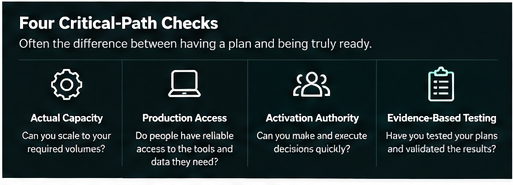
Four critical-path checks
All eight domains matter, but four checks deserve extra attention because a failure in any one can stop a response even when the overall score looks strong.
- Actual capacity - Can the organization access real, scalable capacity when it is needed?
- Production access - Can contingency personnel reliably access the systems and tools required to work?
- Activation authority - Are decision rights, escalation paths, and event leadership explicit and reachable?
- Evidence-based testing - Has the capability been exercised in a way that proves it works rather than assumes it will?
How to use the assessment
- Download the worksheet and score the current state, not the intended future state.
- For each check, record the evidence supporting the score.
- Review low scores and any critical-path item below 2 before focusing on the total.
- Turn the most important gaps into an action list with owners, evidence required for closure, and retest dates.
- Repeat the assessment after material operating changes or on a recurring readiness cadence.
How to interpret the score
Use the 0-3 scale consistently: 0 = not established; 1 = defined or partially implemented but incomplete, stale, or untested; 2 = operational and validated with meaningful gaps remaining; 3 = current, tested, evidenced, owned, and maintained through an explicit review and correction cycle.
Directional maturity bands: 0-17 Foundation missing; 18-35 Developing; 36-53 Operational; 54-72 Tested & maintained. These bands are an ArenaCX management aid, not an external benchmark, certification, assurance opinion, or prediction of outage performance. A critical-path score below 2 should be treated as a priority remediation item regardless of the total score.
Download the full assessment
The worksheet contains the full 24-check assessment, scoring guide, evidence fields, maturity bands, and action planner.
Sources & References
- National Institute of Standards and Technology, 2010, updated 2010. SP 800-34 Rev. 1, Contingency Planning Guide for Federal Information SystemsReference 1
- Federal Emergency Management Agency. Continuity Toolkit / Continuity Guidance CircularReference 2
- Cybersecurity and Infrastructure Security Agency. CISA Tabletop Exercise Package documents and After-Action / Improvement Plan materialsReference 3