Seasonal & Surge Operations
How to Manage Fluctuating Customer Support Demand
Forecasting matters. But the operating advantage comes from detecting the gap between demand and effective capacity early, then activating the right lever before service degrades.

A forecast is a hypothesis, not capacity
Customer-support demand does not move in a straight line, and neither should the operating model built to serve it. Volumes rise with launches, seasons, billing cycles, outages, marketing campaigns, enrollment periods, product defects, policy changes, weather, and simple randomness. Handle time moves too. So do absenteeism, proficiency, channel mix, and the share of customers who solve the problem before they ever reach an agent.
That is why I think “forecast accuracy” is often asked to carry more weight than it should. A good forecast is useful. A perfect forecast is not available. The operating job is to build a system that can absorb the difference between what we expected and what actually arrived.
The useful unit of analysis is not headcount. It is the gap between workload and effective capacity, measured at the horizon where a decision can still change the outcome.
Start with the equation that actually matters
At a simple planning level, demand can be translated into workload. If D is the number of contacts in a period and h is average handle time in minutes, then gross workload hours are approximately W = D × h / 60. That is already better than planning from contact counts alone because a 20% increase in contacts with a 20% decrease in handle time is a very different problem from a 20% increase in both.
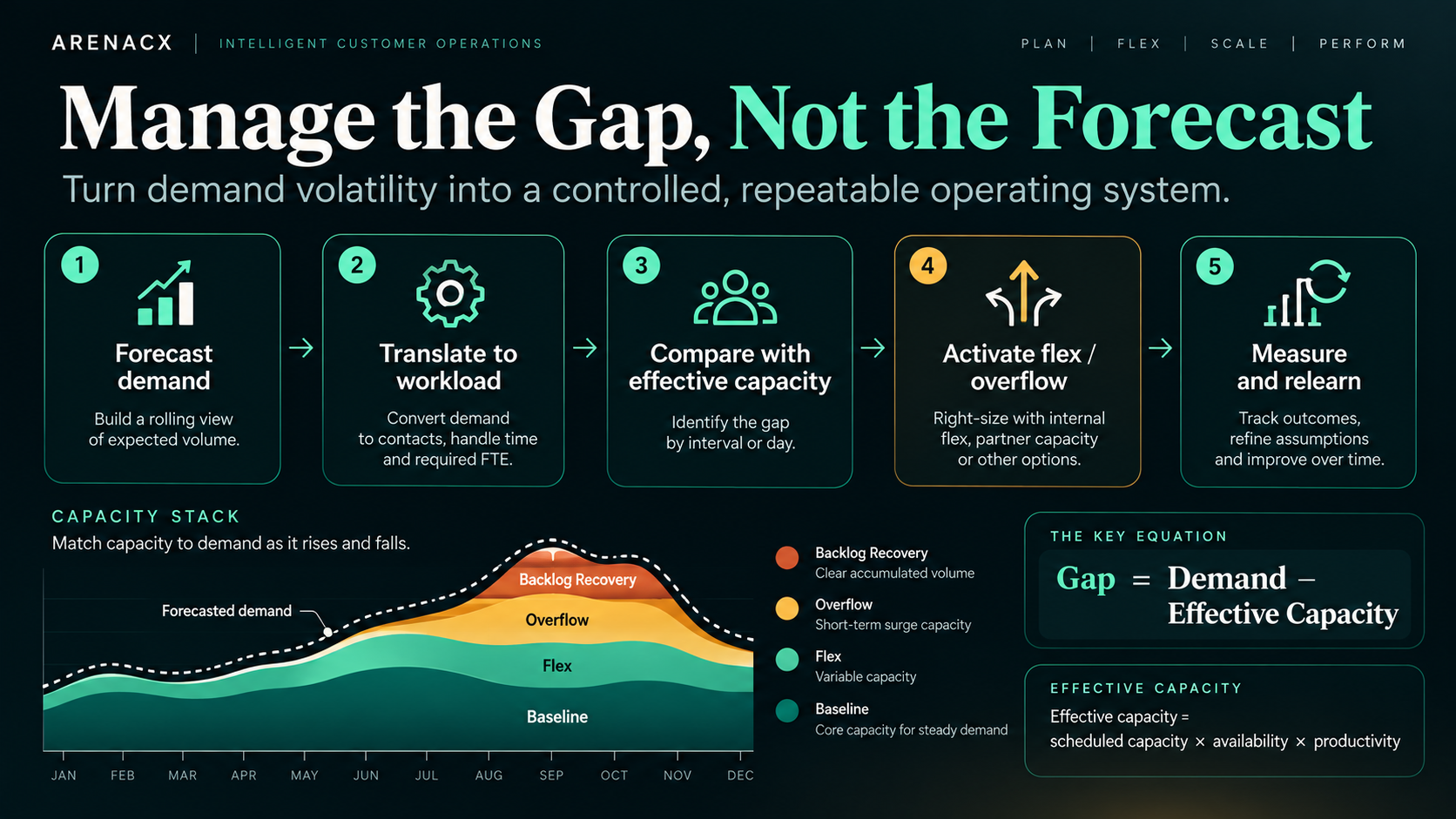
Capacity needs the same discipline. Scheduled hours are not the same as productive hours. Training, meetings, breaks, absence, systems friction, skill mismatch, new-hire ramp, and channel concurrency all change what a schedule can actually produce. A useful conceptual model is: effective capacity = scheduled capacity × availability × productivity. It is not a substitute for a proper WFM or queueing model; it is a way to make hidden assumptions visible.
Then define the operating gap: G = workload - effective capacity. If G is positive, something has to give: waits grow, backlog accumulates, service levels fall, work moves, or more capacity is activated. If G is negative, you may be carrying idle cost. That framing turns “volume is high” into a decision problem.
Do not optimize the average
Averages are convenient because they collapse uncertainty into one number. They are also where capacity plans go to die. If demand has meaningful variation, planning only to the expected value means you have implicitly decided who absorbs the tail risk: customers through delays, employees through overload, the business through emergency premiums, or the balance sheet through excess permanent capacity.
A better planning conversation uses ranges. What does a normal case look like? What does a plausible high case look like? What does an ugly-but-credible case look like? You can express those as scenarios, confidence bands, or percentiles. The notation matters less than the discipline: make uncertainty explicit before it becomes an incident.
The right reserve level depends on the economics of failure. A queue supporting password resets should not necessarily carry the same buffer as a queue handling regulated transactions, high-value renewals, or a time-sensitive public event. The cost of capacity and the cost of delay belong in the same decision.
Manage three planning horizons at once
Fluctuating demand is easier to manage when decisions are separated by lead time. The strategic horizon is measured in months or quarters. That is where you decide whether you need hiring, a different geography, another provider, a larger cross-trained pool, a technology change, or a different commercial structure. These are slow levers, so they have to be chosen before the peak.
The tactical horizon is measured in weeks. This is where schedules, overtime, training timing, PTO constraints, temporary assignments, supplemental partner capacity, and skill mix can still be adjusted. The forecast is more accurate here, but the solution set is narrower because some long-lead decisions are already locked.
The intraday horizon is measured in intervals. Now the questions are routing, callbacks, queue priorities, cross-skilling, overflow, backlog triage, break movement, deferrable work, and whether a pre-arranged surge path should be activated. At this horizon, the important question is not whether a platform can recalculate the forecast. It is whether the organization can detect the variance, decide what it means, and move capacity before the interval is gone.
The common mistake is to use a slow lever against a fast problem. Recruiting after the surge starts is not a surge strategy. Neither is signing a backup provider after the queue is already on fire.
Build a capacity stack, not a single staffing number
I like to think about capacity as a stack of levers with different cost, lead time, quality, and reversibility. Baseline capacity handles the steady state. Internal flex can absorb modest variation through schedule changes, cross-trained teams, overtime, or temporary reassignment. Supplemental or overflow capacity absorbs larger peaks. Technology can remove, shorten, or redirect some work. Recovery capacity clears backlog after the peak.
The design question is not “How many agents do we need?” It is “Which combination of levers gives us enough capacity, at the right quality, with acceptable activation time and total cost?” That is a portfolio problem.
Each lever should have an activation rule. If overflow takes two weeks to train and provision, a trigger based on yesterday’s SLA is useless. If overtime can be activated in hours but becomes expensive and exhausting after several days, it belongs in a different layer of the stack. If a partner can absorb work only after system access and knowledge validation, availability on a contract is not the same thing as operational readiness.
Use queueing math where queueing math matters
For asynchronous work, gross workload and backlog equations can get you surprisingly far. Voice and other real-time queues are less forgiving. As utilization rises, waiting time does not increase neatly in a straight line. Near saturation, delay times can increase dramatically. That is why contact-center staffing has long used queueing models such as Erlang C and its extensions rather than simple workload division.
The practical implication is straightforward: use the simple math to expose the variables and screen scenarios, then use the appropriate WFM or queueing model for interval staffing. Do not turn a convenient spreadsheet identity into a service-level guarantee.
This distinction also helps explain why “we were only 5% understaffed” can produce a customer experience that feels much worse than 5%. In a tightly loaded real-time queue, small capacity gaps can have nonlinear consequences.
Build the control loop before you need it
A capacity system needs signals, thresholds, owners, and pre-approved actions. I would rather have six useful indicators with explicit response rules than fifty dashboard tiles nobody is authorized to act on.
Useful signals usually include forecast error, contact arrival rate, handle time, shrinkage or availability, occupancy, service level, backlog volume and age, abandon rate, transfer rate, self-service containment, and major business events that can move demand. Not every operation needs every metric. The point is to detect whether the gap is widening before the customer tells you.
Then define the control loop: observe, compare, decide, activate, verify, learn. Who sees the variance? Who decides whether it is noise or a real shift? Which lever can be activated at that threshold? How quickly should the effect show up? When do you escalate to the next lever? After the event, which assumptions get updated?
This is where scenario planning becomes operational instead of decorative. A base case, high case, and low case are only useful if they map to different decisions. What changes at each threshold? Which capacity lever moves first? How much lead time does it require? What does it cost? What happens if the demand signal is wrong? The model earns its keep when scenarios become pre-decided operating moves, not when the software produces a prettier chart.
Treat AI as a variable on both sides of the equation
AI complicates capacity planning in a useful way because it can change both demand and capacity. Self-service may reduce some contacts. Agent assist may shorten some work. Better routing may reduce transfers. At the same time, successful automation can remove the easiest interactions and leave humans with a harder mix, which can raise average handle time or increase the need for specialized skill.
That means “AI will deflect 20%” is not a capacity plan. It is an assumption that should be measured. Track what happens to contact volume, containment, escalation rate, handle time, repeat contacts, quality, and customer outcomes. Then feed the observed result back into the forecast and staffing model.
The more dynamic the human-and-AI operating model becomes, the more important the control loop becomes. AI can help detect patterns, classify demand, simulate scenarios, and recommend actions. It cannot manufacture trained, provisioned capacity after the fact.
Put the economics into the model
Every capacity decision is a tradeoff among cost, service, and risk. A useful conceptual objective is to minimize expected total cost: permanent baseline capacity + flex premiums + overflow capacity + backlog and delay cost + abandonment or lost-demand cost + quality and rework cost. You do not need perfect dollar values for every term to improve the decision. Even rough ranges force the team to state what it is optimizing.
This is also why permanently staffing to the peak is rarely the only answer. It buys low activation risk by accepting high idle cost. Running extremely lean does the opposite: it lowers steady-state cost while pushing more risk into service failure and emergency response. The right point on that curve depends on the business, the queue, and the reversibility of the capacity levers available.
A mature operation makes that tradeoff deliberately instead of discovering it through overtime invoices and angry customers.
The operating standard: detect, decide, deploy
Managing fluctuating customer-support demand is not primarily about predicting one number more accurately. It is about building a system that can see the variance, translate it into workload, compare it with effective capacity, and activate the least-cost lever that protects the outcome.
Forecast the demand. Model the workload. Build ranges, not just points. Separate decisions by lead time. Maintain a capacity stack with known activation rules. Use queueing math where real-time queues demand it. Instrument the control loop. Measure what AI actually changes. Put the economics in the decision.
If those pieces are in place, a forecast miss is information. Without them, it becomes an emergency.
Sources & References
- Gans, Koole & Mandelbaum, 2003. Telephone Call Centers: Tutorial, Review, and Research Prospects — Manufacturing & Service Operations ManagementReference 1
- Kolesar, Peter & Green, Linda, 1998. Insights on Service System Design from a Normal Approximation to Erlang’s Delay Formula — Production and Operations Management, 7(3), 282–293Reference 2