BPO Sourcing & RFP Management
How to Select the Right Contact Center Partner
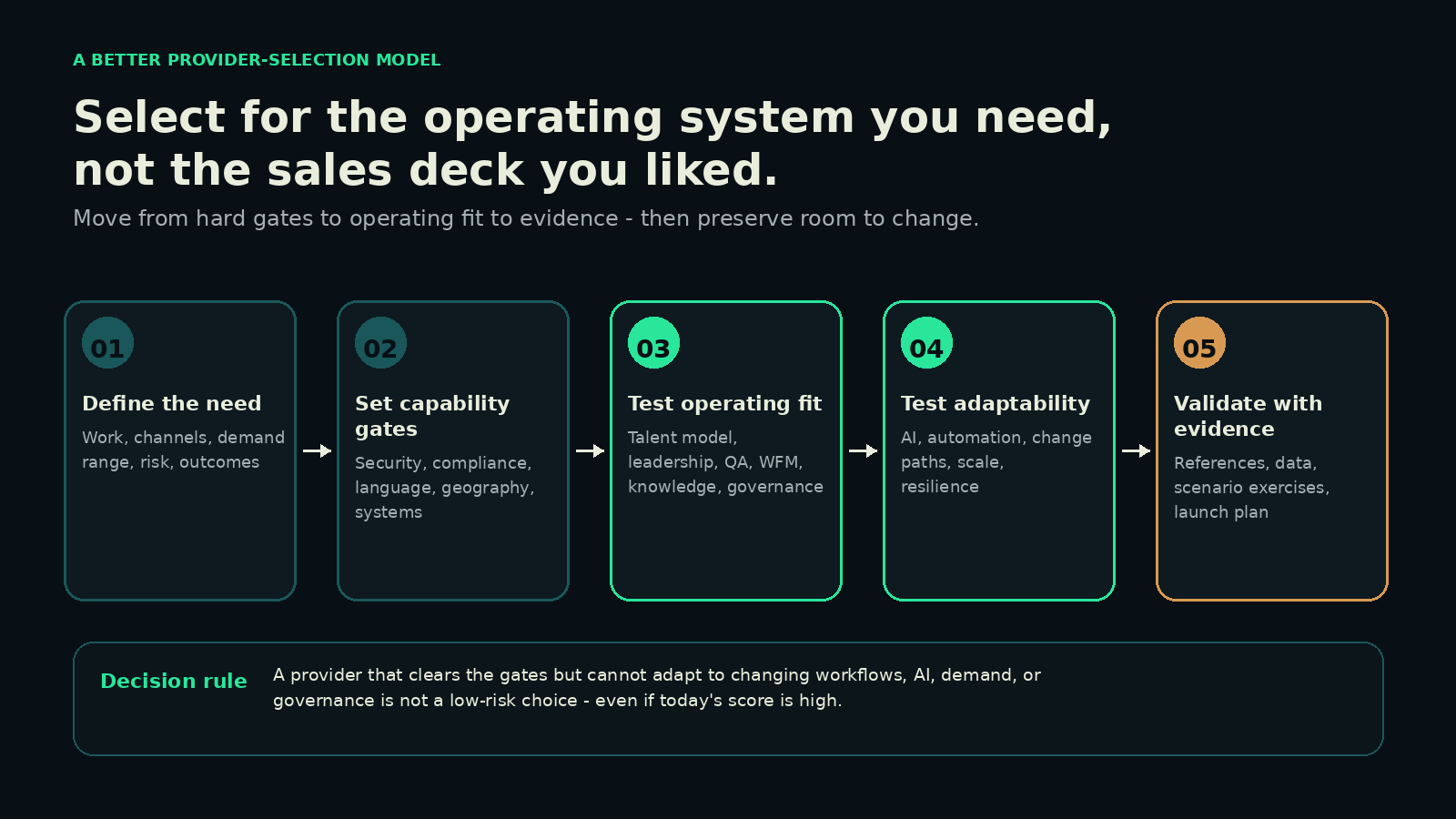
The right BPO is not the company with the best pitch. It is the provider whose operating model fits your work, clears your risk constraints, can prove the fit with evidence, and can keep adapting as demand, technology, and AI change the job.

Start with the operating need, not the provider list.
Provider selection gets much easier when you stop treating it as a search problem and start treating it as an operating-design problem. The question is not “Which BPO is best?” There is no universal answer. The useful question is “Which operating model best fits the work we actually need done, under the constraints we actually have?”
That distinction matters because contact centers can look remarkably similar in a proposal. Everyone can show logos, quality programs, training decks, technology partnerships, and attractive leadership biographies. Those things may be real. They still do not tell you whether a provider will work well inside your specific system.
Before you build a shortlist, define the work. What channels are in scope? What languages and hours matter? How variable is demand? How complex are the interactions? What decisions can agents make? What customer data will they touch? What failure modes would be unacceptable? What outcomes matter enough that you would pay more to protect them? A provider can only be “right” relative to that need.
Separate non-negotiable gates from tradeoffs.
One of the most common sourcing mistakes is mixing hard requirements and preferences into one giant scorecard. That can create the illusion of precision while obscuring the decision.
Some criteria are gates. If a provider cannot meet a required security, regulatory, language, geography, data-handling, business-continuity, or systems requirement, a high score somewhere else should not compensate for it. A provider that fails a true constraint is not a slightly weaker option. It is not an option.
Other criteria are tradeoffs. Maybe one provider has stronger domain experience while another has a better labor market. One may be more expensive but easier to scale. One may have a more mature AI roadmap while another has deeper experience in your current platform. Those are judgment calls. They belong in comparative evaluation only after the hard gates are cleared.
Evaluate the operating system behind the agents.
Headcount is visible. Operating discipline is harder to see and often more important.
Look at how the provider recruits, screens, trains, coaches, schedules, forecasts, manages knowledge, handles quality, escalates risk, and runs day-to-day leadership. Ask who actually owns your program after the sales team leaves. Inspect the management ratios, reporting cadence, decision rights, workforce-management practices, change process, and how quickly the provider can diagnose a problem without waiting for you to do the analysis for them.
The goal is not to find a provider with the thickest process manual. It is to understand whether the machinery behind the service will produce the outcomes you need under normal conditions and under stress.
Security and risk should be provable, not reassuring.
The legacy version of this article was right to put security and fundamentals near the top of the list. The bar should now be higher: do not ask only whether a provider has a security program. Ask what evidence supports it, how supplier and subcontractor risk is governed, what happens after a material incident, and how security responsibilities are divided across your systems and theirs.
NIST’s Cybersecurity Framework 2.0 places additional emphasis on governance and supply-chain risk, and NIST’s supply-chain guidance explicitly encourages organizations to define and communicate supplier requirements. That is a useful sourcing principle even outside technology procurement: turn vague trust into explicit requirements, evidence, ownership, and escalation paths.
The same logic applies to business continuity. A “backup site” is not meaningful if access, training, routing, permissions, and management coverage are not actually ready. Selection should distinguish theoretical capability from usable capability.
Treat AI adaptability as a provider-selection criterion.
You are not selecting a contact center for a static labor model anymore. AI is changing which work reaches humans, how agents perform that work, what knowledge they need, how quality is measured, and how much volume one unit of labor can absorb.
That means the evaluation should test whether the provider can participate in redesign, not merely supply labor against today’s workflow. How do they evaluate automation opportunities? Can they integrate with your AI and knowledge stack without forcing you into proprietary dead ends? How do they govern model outputs, sensitive data, human review, and escalation? How do commercial terms change if automation reduces volume or changes the skill mix?
NIST’s Generative AI Profile is useful here because it frames AI risk management across the lifecycle rather than as a one-time technology check. The practical sourcing implication is simple: a provider’s AI capability is not just a feature. It is part of the future operating model, and the governance around it matters as much as the demo.
Compare total operating economics, not just rate cards.
Rates are easy to compare because they fit neatly into a spreadsheet. Total cost is harder. The cheapest hourly price can become expensive if the program requires more management, more rework, more shrinkage protection, slower ramp, more escalation effort, higher turnover, or more internal staff to compensate for weak operating discipline.
Build the economic comparison around the model you expect to run. Include the obvious costs, but also pressure-test transition costs, training, management overhead, minimum commitments, ramp assumptions, change fees, technology dependencies, and the cost of being wrong. A sourcing decision is not a procurement savings exercise unless savings survive contact with operations.
Use references to test hypotheses, not to collect compliments.
Reference calls are often wasted because buyers ask generic questions and get generic praise. A better reference call starts with a hypothesis.
If you are worried about rapid scaling, ask a customer to describe the largest ramp the provider actually executed and what broke. If you care about complex support, ask how long it took agents to become productive and which knowledge problems persisted. If you care about partnership behavior, ask what happened during a miss: who noticed first, who owned the diagnosis, how fast decisions were made, and whether the provider changed the system afterward.
The most useful evidence is usually specific, slightly messy, and operational. Perfect stories should make you curious.
Make candidates work through your scenarios.
A written RFP tells you what a provider says. A scenario exercise shows you how it thinks.
Give finalists a few realistic operating situations: a product launch creates a 40% volume surge; automation removes low-complexity contacts and leaves a harder interaction mix; a security event restricts system access; one delivery site becomes unavailable; quality falls while service level remains green. Ask how they would diagnose the problem, what data they would want, who would make which decisions, and what they would change first.
You are not looking for theatrical certainty. You are looking for structured thinking, useful questions, explicit tradeoffs, and an operating model that can absorb change.
The right partner should make your system better.
The legacy advice was to look for fundamentals, track record, and fit. Those ideas still matter. They are just not enough on their own.
A modern selection process should answer a harder question: will this provider improve the way the whole customer-operations system works? That includes service quality, economics, risk, adaptability, management burden, resilience, and the ability to incorporate AI without turning every change into a contract renegotiation.
One provider may be exactly the right answer. Several providers may be appropriate when the work genuinely requires different capabilities or independent capacity. The point is not vendor count. The point is fit.
Choose the operating model first. Then choose the provider that can prove it belongs inside that model.
Sources & References
- National Institute of Standards and Technology, February 26, 2024. NIST Cybersecurity Framework (CSF) 2.0Reference 1
- National Institute of Standards and Technology, October 2024. NIST Cybersecurity Framework 2.0: Quick-Start Guide for Cybersecurity Supply Chain Risk Management (SP 1305)Reference 2
- National Institute of Standards and Technology, July 26, 2024; updated April 8, 2026. Artificial Intelligence Risk Management Framework: Generative Artificial Intelligence Profile (NIST AI 600-1)Reference 3