BPO Sourcing & RFP Management
It’s Time to Level Up With Outsourcing
Outsourcing is no longer just a labor-cost decision. Done well, it is a way to add capability, optionality, operating discipline, and resilience without building everything yourself.

It was September 2020. I was about to launch a business. We had a battle-tested product, our first customer, a mature team, and venture capital. In startup terms, that sounded almost civilized.
Then a sage advisor with a medium-length gray beard warned me that running a startup was like plowing a field with your face.
He was not wrong.
If you run a growing business - or a customer operation inside one - you know the feeling. One new client can reshape the forecast. One launch can double demand. One failure can consume the week. You want enterprise-grade capability without building an enterprise-sized bureaucracy around every problem.
That is where outsourcing gets interesting.
Outsourcing has grown up
The old story was mostly about labor arbitrage: move work somewhere less expensive and save money. Cost still matters. It would be strange to pretend otherwise. But the modern sourcing decision is broader.
A good Business Process Outsourcing partner can add recruiting engines, workforce management, quality operations, specialized expertise, language coverage, technology, geographic reach, management depth, and a repeatable launch discipline. A portfolio of providers can add even more optionality when the program genuinely needs it.
Deloitte’s 2024 Global Outsourcing Survey describes this as a multidimensional sourcing environment: organizations mix third-party outsourcing, internal teams, global in-house centers, automation, and AI. Skilled talent and agility are joining cost reduction as major reasons to outsource.
That is a much more useful frame. Outsourcing is not “send the work away.” It is “design the operating system using capabilities you do not need to own yourself.”
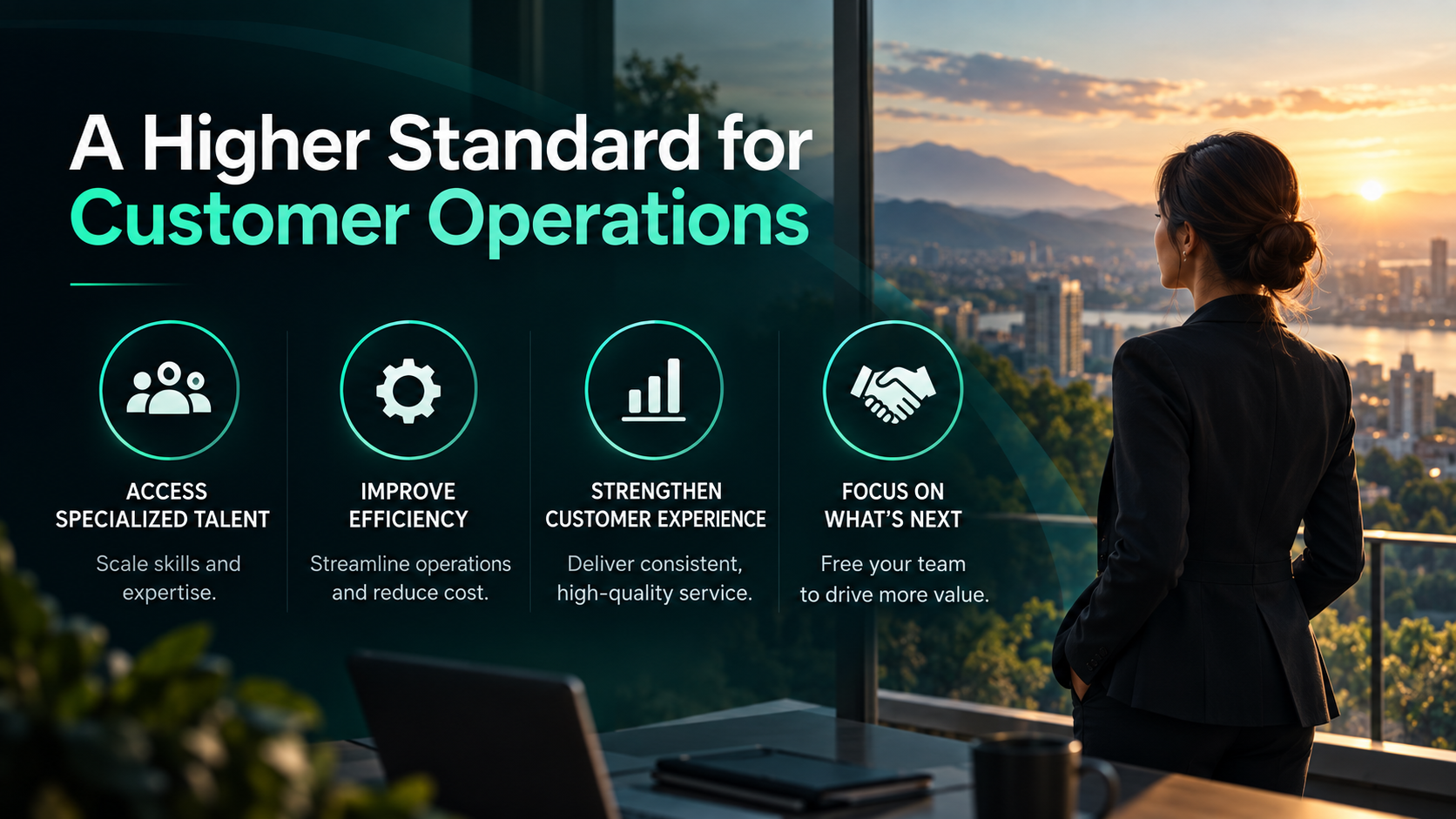
The hard part is not deciding to outsource. It is doing it well.
There are thousands of providers, and their strengths vary by geography, language, industry, channel, technology, workforce model, size, management style, and appetite for different deal types. A recognizable logo is not the same thing as a fit.
For many companies, especially smaller or leanly staffed teams, the real barrier is not access to providers. It is the work required to define the need, evaluate the market, negotiate terms, launch the operation, and manage it after go-live.
That is why the sourcing decision should be treated as operating design, not vendor shopping.
Five principles for leveling up
1. Select for fit, not just price
If your only question is “who is cheapest?”, you are optimizing the easiest variable to compare. Price matters, but so do leadership, workforce quality, operating maturity, cultural fit, geography, technology compatibility, compliance, training ability, and experience with the work you actually need performed.
A structured RFP or evaluation process should make those tradeoffs visible instead of hiding them behind a rate card.
2. Build an escape path before you need one
Every provider can underperform. Every site can fail. Every geography can be disrupted. The answer is not to force multiple vendors into every program, but to understand your dependencies and decide what an alternate path should look like.
For a larger operation, that may mean more than one approved provider or geography. For a smaller one, it may mean contractual portability, a pre-vetted alternative, cross-trained internal capacity, or a sourcing partner that can reopen the market quickly. Optionality has value even when you never exercise it.
3. Treat launch as a managed program
The contract is not the launch plan. Recruiting, systems access, knowledge transfer, training, quality calibration, forecasting, scheduling, reporting, escalation, and governance all have to come together before the first customer interaction.
The early operating rhythm matters disproportionately. Define the plan, owners, milestones, risks, and success criteria before go-live.
4. Manage the provider, not individual agents
One of the easiest mistakes for a first-time outsourcer is to recreate the internal management model at a distance. If you hire a BPO, you are also hiring its supervisors, QA leaders, workforce managers, trainers, and operating system.
Your job is to manage outcomes, standards, governance, and the relationship. Hold the provider accountable without bypassing the people you hired them to lead.
5. Build the knowledge system together
Do not wait for a perfect knowledge base before you begin. Most operations do not have one. Use the launch to identify what agents need to know, what should be documented, what should be searchable, what AI can help retrieve, and where expert escalation is required.
Knowledge transfer is not a one-time handoff. It is a living operating process.
The goal is capability without unnecessary complexity
Outsourcing can absolutely go wrong. A poor selection, vague scope, weak launch, misaligned incentives, or absentee governance can create more work than it removes.
But that is an argument for better design, not for doing everything yourself.
The modern customer-operations stack gives companies more ways to combine internal teams, BPOs, specialists, technology, automation, and AI than ever before. You do not need the biggest company’s org chart to benefit from sophisticated sourcing. You need a clear problem definition, a disciplined selection process, the right operating model, and a way to keep adapting after launch.
That is what “leveling up” means now: not outsourcing more for the sake of outsourcing, but gaining access to more capability - and keeping the freedom to use the right mix as the business changes.
Sources & References
- Deloitte, 2024. 2024 Global Outsourcing Survey — More than 500 executives; outsourcing is evolving toward multidimensional sourcing, with agility and skilled talent joining cost as drivers, while governance remains a common maturity gap.Reference 1
- ArenaCX. Current ArenaCX Website V2 positioning — BPO Sourcing & RFP Management, Managed Multi-Vendor Operations, Seasonal & Surge Operations, and Critical Response are equal solution paths; optionality does not mean forced vendor proliferation.Reference 2
- ArenaCX. Preserved ArenaCX-owned working source — Alan’s May 2023 Contact Center Pipeline guest article.Reference 3