Network Design & Orchestration
One Provider or Many? A Decision Framework for Customer Operations
The right provider model is not a philosophy. It is a design choice. Use this framework to decide when simplicity, diversification, specialization, flexibility, and governance matter most.

Start with the operating problem, not the provider count
Customer-operations teams often begin with a structural question: Should we consolidate with one provider or spread the work across several? That sounds like a sourcing question. It is really an operating-model question.
A single provider can simplify accountability, contracting, tooling, governance, and day-to-day coordination. Multiple providers can create additional capacity options, specialization, geographic diversity, competitive tension, and resilience. Both models can work. Both can also fail when they are chosen for the wrong reasons.
The useful question is not “Is multi-vendor better?” or “Is consolidation better?” It is: “What combination of control, flexibility, specialization, resilience, and economics does this operation actually need?”
The trade-off is real
Concentration can make supplier relationships easier to manage, but it can increase vulnerability when a critical supplier or location fails. Diversification can reduce some concentration risk and create backup capacity, but it adds coordination cost and does not automatically create resilience. A second provider that cannot absorb work, access systems, meet requirements, or activate quickly is not meaningful optionality.
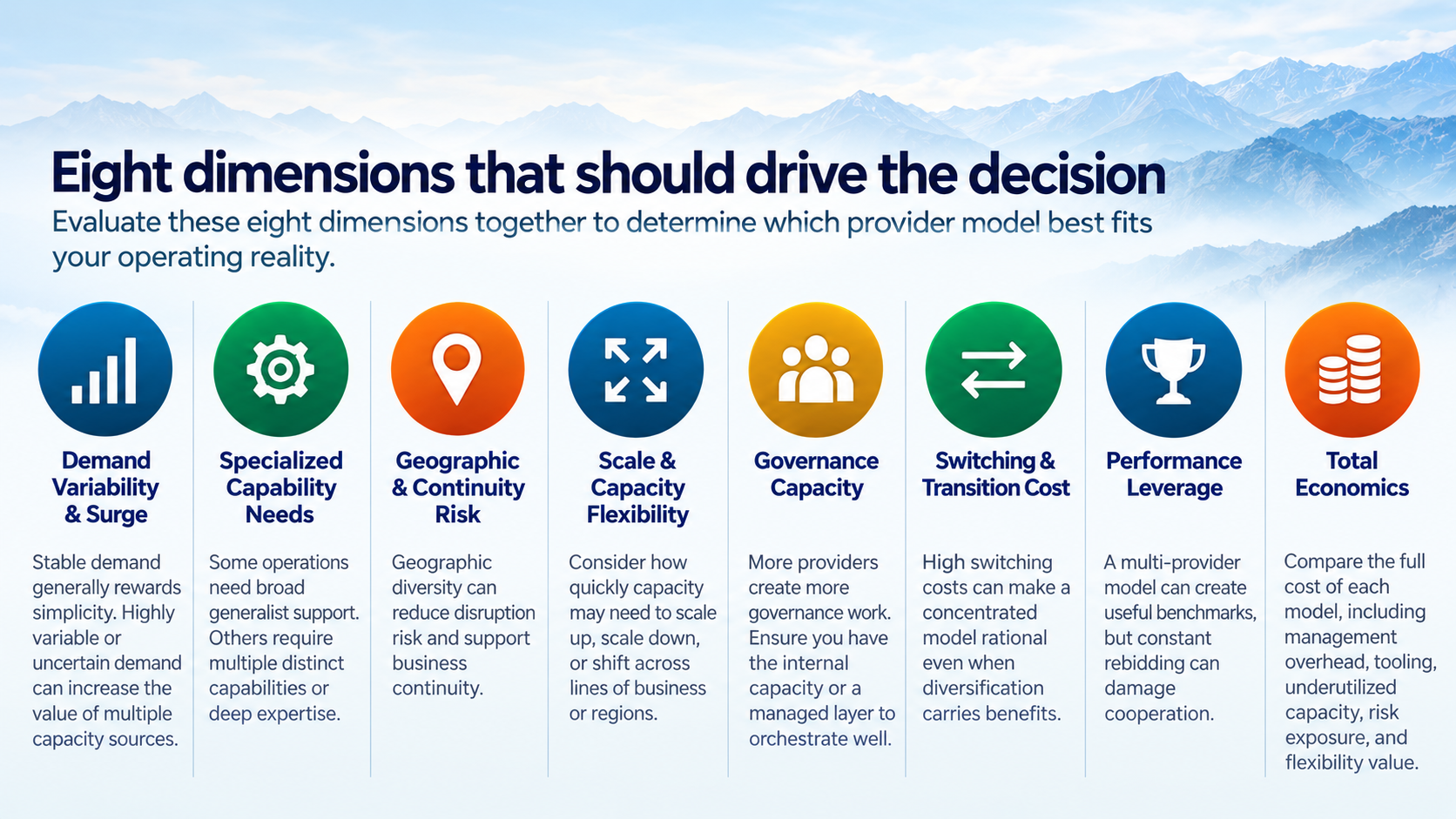
Provider count should follow the operating requirements. The framework evaluates eight dimensions that tend to change the answer.
Eight dimensions that should drive the decision
- Demand variability and surge. Stable demand generally rewards simplicity. Highly variable, seasonal, event-driven, or uncertain demand can increase the value of having more than one credible capacity source.
- Specialized capability needs. If one provider can deliver the required languages, channels, technical depth, regulatory capability, and workforce types well, fragmentation may add little. Distinct specialist needs can justify a portfolio.
- Geographic and continuity exposure. A provider strategy can be diversified on paper while still sharing the same geography, infrastructure, technology, subcontractors, or labor market. Look for independent failure modes, not just multiple logos.
- Scale and capacity flexibility. If the operation frequently needs to move work, add capacity, or change the mix of skills, a multi-provider or hybrid model may preserve more options.
- Governance capacity. Every additional relationship creates coordination work: forecasting, allocation, scorecards, escalations, commercial administration, process alignment, and change management. If the organization cannot govern the network, adding providers can make the system worse.
- Switching and transition cost. Changing providers is not free. Knowledge transfer, hiring, training, integrations, customer risk, and leadership attention all matter. High switching costs can make a concentrated model rational even when concentration carries risk.
- Performance leverage. A champion/challenger or allocation model can create useful benchmarks and preserve alternatives. But constant rebidding or artificial competition can damage cooperation. The commercial model should reward the behavior the operation actually needs.
- Total economics. Unit price is only one part of the answer. Compare management overhead, transition expense, duplicate tooling, underutilized capacity, risk exposure, resilience investments, and the value of flexibility.
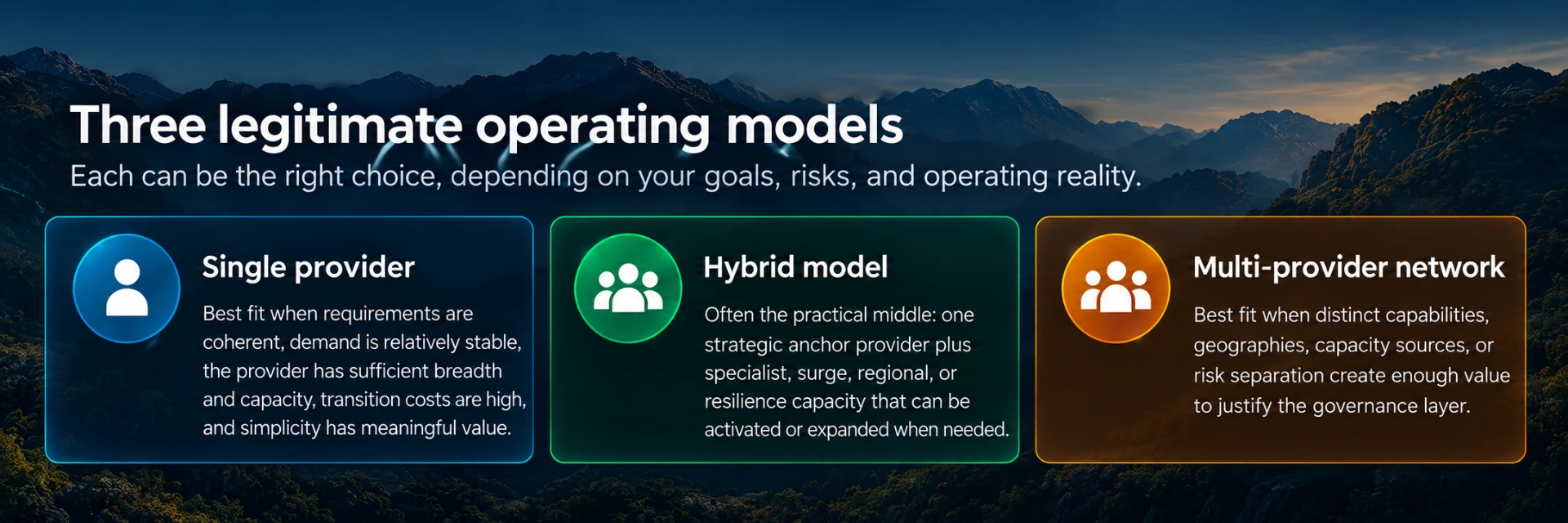
Three legitimate operating models
- Single provider. Best fit when requirements are coherent, demand is relatively stable, the provider has sufficient breadth and capacity, transition costs are high, and simplicity has meaningful value.
- Hybrid model. Often the practical middle: one strategic anchor provider plus specialist, surge, regional, or resilience capacity that can be activated or expanded when needed.
- Multi-provider network. Best fit when distinct capabilities, geographies, capacity sources, or risk separation create enough value to justify the governance layer.
How to use the decision framework
The downloadable framework turns the eight dimensions into a weighted decision aid. Score each dimension from 1 to 5, apply the suggested weight if useful, note any constraint that could override the arithmetic, and review the pattern rather than treating the final number as an automatic answer. Lower scores generally point toward the value of consolidation; higher scores toward diversification; mixed scores often suggest a hybrid. A material constraint can outweigh the composite score.
Pressure-test the model before you commit
Do not stop at the score. Pressure-test the preferred model against realistic operating scenarios. Representative questions include:
- What failure are we trying to protect against?
- Can alternative capacity be activated quickly enough to matter?
- If several providers are used, who owns allocation, forecasting, escalation, quality consistency, and commercial administration?
- What operating benefit justifies each additional relationship?
The full eight-question pressure test and response fields are in the downloadable decision framework.
Design for optionality, not complexity
A resilient network does not require the maximum number of providers. It requires enough credible options to match the risks and opportunities in the operation, with governance strong enough to make those options usable.
That is the practical distinction between diversification and fragmentation. Diversification creates choices you can actually exercise. Fragmentation creates relationships you have to manage.
ArenaCX can support either path. A customer may need one well-selected BPO and nothing more. Or the answer may involve several providers, specialist capabilities, geographies, or technologies coordinated through a common commercial and operating structure. The architecture should follow the need.
Sources & References
- McKinsey & Company, 2025. Taking a business-critical approach to supplier nth-party IT risk managementReference 1
- McKinsey Global Institute, 2020. Risk, resilience, and rebalancing in global value chainsReference 2
- McKinsey & Company, 2016. Cheaper, simpler, better for customers: Outsourcing without trade-offsReference 3