Seasonal & Surge Operations
Staying in Control Through the Chaos of Peak Season
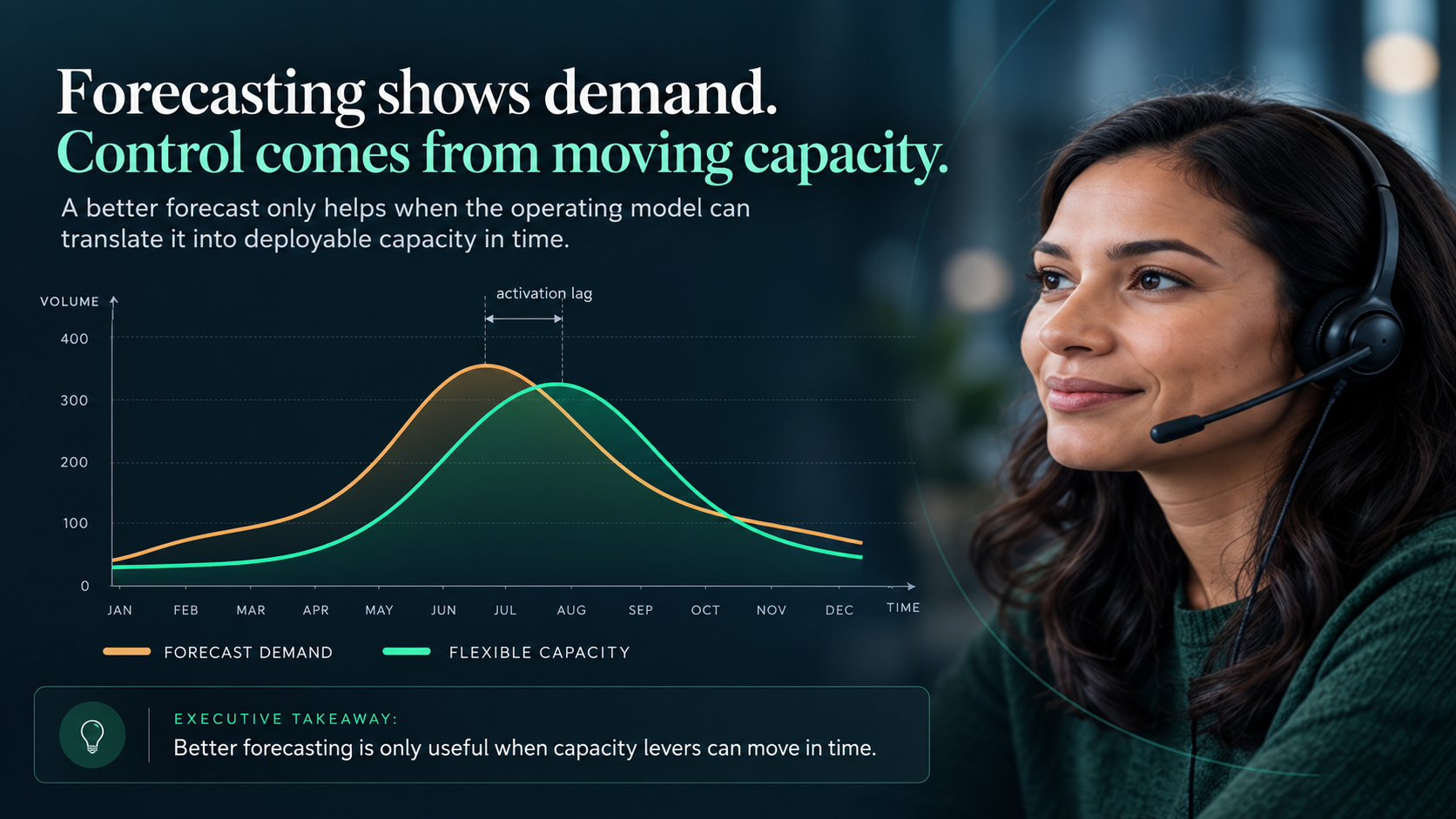
Forecasting helps you see the peak. Staying in control requires an operating model that can turn the forecast into capacity - fast enough to matter.
Peak season? Don't panic.
Easier said than done.
Anyone who has lived through a holiday rush, enrollment cycle, product launch, testing window, promotional event, backlog spike, or sudden period of rapid growth knows how quickly a customer-operations plan can get messy. Work arrives across channels. Schedules tighten. Queues grow. Managers start improvising. People who were comfortably staffed a week ago can suddenly feel underwater.
The frustrating part is that the peak is often not a surprise. The planning team may have seen it coming for weeks or months.
That is the first lesson: seeing demand and controlling demand are not the same thing.
Forecasting is visibility, not capacity
Workforce-management systems have become much better at helping teams forecast incoming work, translate volume into staffing requirements, and model what may happen across channels and time periods. AI can make parts of that process faster by detecting patterns, testing scenarios, and surfacing exceptions that deserve attention.
That visibility matters. You want to know when demand is likely to rise, how steep the increase may be, which channels are affected, and what staffing level is likely to be required.
But a forecast does not create a trained agent.
It does not open a new shift, complete a background check, provision system access, change a supplier agreement, train a supplemental team, or move work to a different delivery location. It does not make a temporary peak disappear simply because the planning model identified it accurately.
A forecast tells you what may be coming. Your operating model determines whether you can do anything about it.
The peak-season control problem
At a high level, peak-season planning has to answer three different questions:
- What demand is coming, and when?
- How much capacity will we need to handle it?
- Which operating levers can we actually move on the required timeline?
The first two questions are planning questions. The third is an execution question.
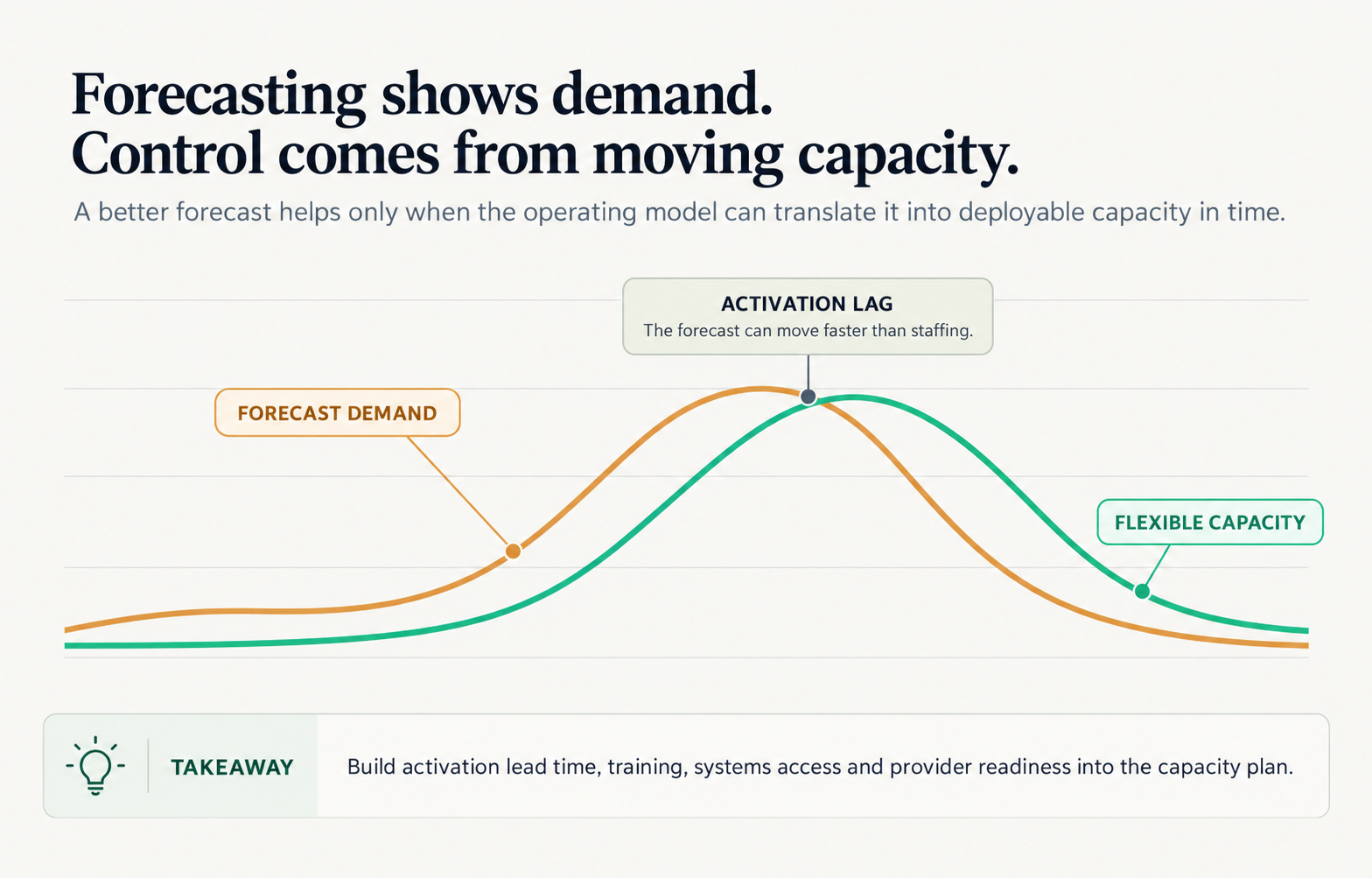
That distinction matters because customer-operations teams can have excellent forecasts and still miss service levels. The forecast can be right while the operation is too slow to react.
The dangerous assumption is that a better forecast automatically creates a better response. It doesn't. A forecast becomes valuable only when it connects to a capacity playbook.
Why staffing to the plan is so difficult
Hiring runs on a different clock than demand
Permanent hiring takes time. Recruiting, screening, onboarding, systems setup, training, nesting, quality calibration, and coaching all happen before a new employee becomes dependable production capacity.
That can work well when demand is durable and the organization has enough lead time. It is a much harder answer for a short seasonal spike or a demand window that may last only a few weeks.
By the time the organization completes the hiring cycle, the peak may already be passing.
Temporary demand is a poor match for permanent infrastructure
Most leaders are understandably reluctant to add permanent headcount for temporary volume. They are equally reluctant to remove trained people when the volume falls back toward normal.
That creates a familiar trap. Carry too much capacity through the low periods and the economics suffer. Carry too little, and the customer experience suffers when the peak arrives.
The result is often an uncomfortable compromise in which the operation is slightly overbuilt during normal periods and still not flexible enough during the moments that matter most.
The bottleneck is often organizational, not analytical
Even when additional talent is available somewhere, deployable capacity may still be constrained by procurement, contracting, security reviews, system access, training, knowledge transfer, scheduling, QA, equipment, management span, or governance.
Access to headcount is not the same thing as access to ready capacity.
That is why peak-season readiness has to be designed across the operating system, not delegated to forecasting alone.
Build a capacity playbook before you need it
A resilient peak-season model gives operators multiple ways to change capacity without assuming that every problem requires the same answer.
Some organizations may be able to cover a peak primarily through internal levers: shift changes, overtime, voluntary extra hours, part-time schedules, cross-training, temporary reassignment, asynchronous work, callbacks, or changes to backlog prioritization.
Others may need external capacity. That could mean expanding an incumbent BPO, adding one supplemental provider, using a specialized team for a specific work type, or coordinating multiple providers when the scale and complexity justify it.
Technology can also change the capacity equation. Better self-service, automation, routing, prioritization, knowledge tools, and agent-assist capabilities can reduce or reshape the work that reaches people. But those tools should be treated as operating levers, not magic erasers. They need to be tested, governed, and incorporated into the capacity plan just like labor.
The right answer is not “always add another provider.” It is to build enough options that the operation can choose the simplest effective response for the demand pattern in front of it.
The more important work happens before the peak: define the trigger points, decide which levers are available, establish lead times, pre-negotiate what can be pre-negotiated, prepare training content, validate systems access, define quality expectations, and create a governance rhythm for making changes quickly.
When the forecast moves, the team should already know what it can do next.
Plan, source, activate, orchestrate
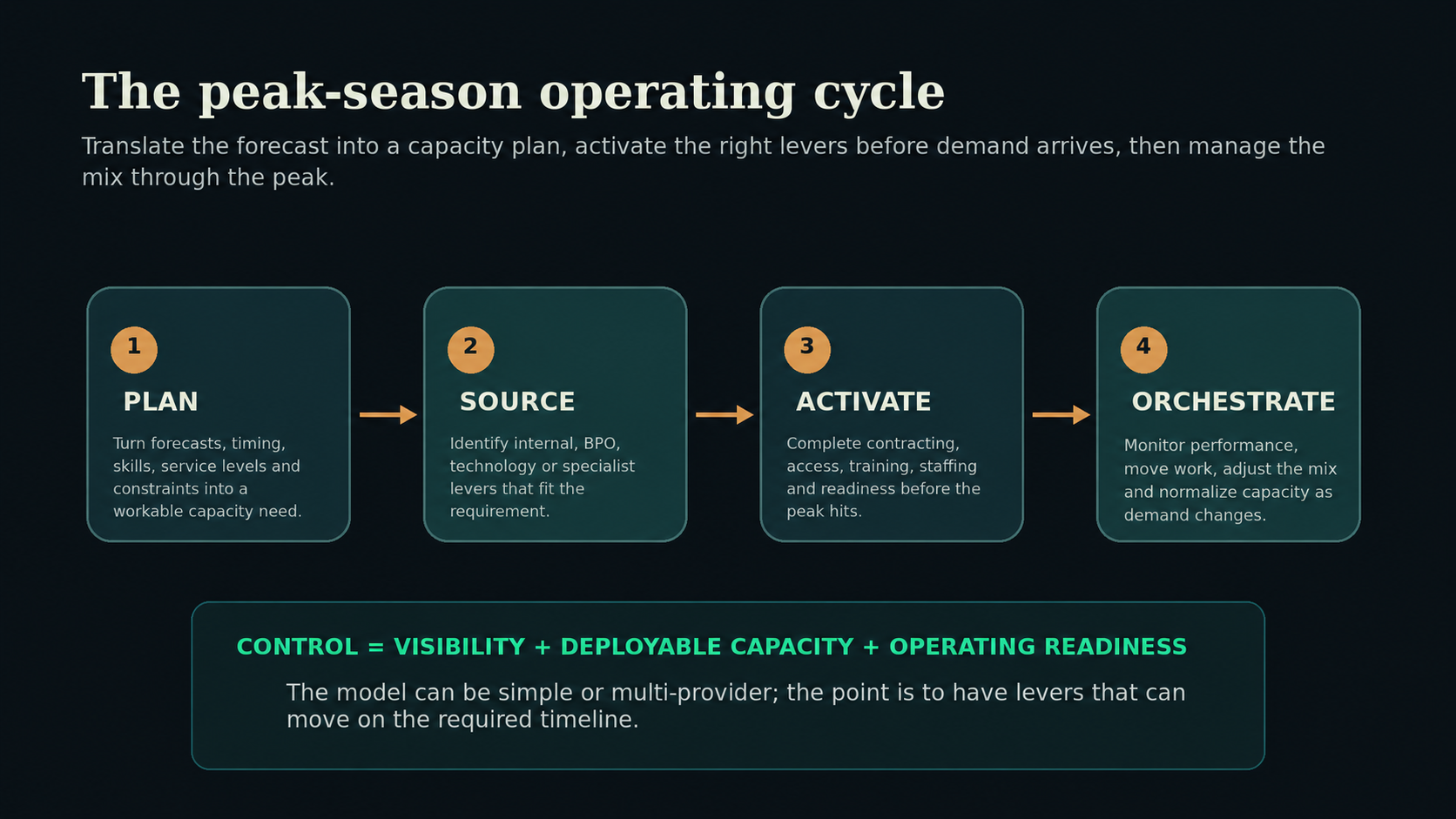
ArenaCX describes Seasonal & Surge Operations through a simple operating cycle: PLAN, SOURCE, ACTIVATE, ORCHESTRATE.
PLAN means translating the forecast into an operating requirement. How much capacity may be needed? For which channels, skills, languages, hours, service levels, and geographies? What are the economics and constraints? What assumptions would cause the plan to change?
SOURCE means identifying the capacity levers that fit the requirement. The answer might be internal workforce flexibility, an incumbent BPO, a supplemental provider, a specialist capability, a technology change, or a combination.
ACTIVATE is where many plans succeed or fail. Capacity has to become usable before the peak arrives. Contracting, staffing, onboarding, training, security, systems, QA, scheduling, and readiness all have to move from concept to production.
ORCHESTRATE means managing the mix as reality diverges from the forecast. Demand will rarely arrive exactly as modeled. The operation needs a way to monitor performance, adjust staffing, shift work, manage providers, change priorities, and then normalize capacity again when the peak passes.
The value of this cycle is not complexity. In many cases the right model may be quite simple. The value is having a repeatable method for turning a forecast into action.
What AI changes - and what it doesn't
AI will play an increasingly important role in this operating loop.
It can help teams track network health, detect developing pressure, compare actual demand with the plan, test optimization options, and recommend changes faster than a purely manual process. Over time, AI-powered control-tower capabilities should make it easier to connect forecasting, performance data, capacity options, and operating decisions.
But AI does not eliminate the need for options.
A control tower can tell you where pressure is building. It still needs somewhere to route the work. A recommendation to add capacity is useful only if that capacity can be activated. A better model cannot compensate for contracts that take weeks to change, training that has not been prepared, or a provider that has no room to grow.
The smarter the planning layer becomes, the more important it is to make the execution layer equally flexible.
Peak season should be repeatable, not heroic
The final discipline is to treat each peak as a learning cycle.
After the event, compare forecast to actual demand. Look at where the forecast was wrong, but also where the operating model was slow. Measure activation lead times. Review which levers were actually used. Examine service, quality, cost, employee experience, provider performance, and the points where governance became a bottleneck.
Then update the playbook.
The goal is not to survive peak season because a few heroic people worked nights and weekends and somehow kept the queues from exploding. The goal is to make variable demand a normal operating condition the system knows how to handle.
Peak season? Don't panic.
Forecast early. Build options. Prepare the capacity before you need it. And design the operating model so it can expand for the peak, then contract again when demand returns toward normal.
That is how forecasting becomes control.