Customer Operations Strategy
Stop Taking Mental Shortcuts: Improve Resource Allocation in Customer Service
Human judgment is valuable precisely because customer problems are messy. The operating system should do more of the mechanical matching so people can spend judgment where it matters.

Human judgment is valuable precisely because customer problems are messy. The operating system should do more of the mechanical matching so people can spend judgment where it matters.
Biology limits our information-processing capabilities. Working memory is useful precisely because it lets us hold and manipulate information for a decision, but its capacity is limited. That is one reason complex operating problems become difficult when too many variables have to be reconciled at once.
As a coping mechanism, we simplify hard problems by breaking them into smaller parts and applying rules of thumb, mental shortcuts, or decision trees. In data-processing language, these are heuristics: they trade some precision for speed and simplicity. The trade can be useful. It can also become a constraint when the shortcut outlives the reason we needed it.
Customer operations is a matching problem
Customer service networks are often complex. We may need to allocate resources across geography, business unit, product line, customer segment, support channel, case type, language, authority level, skill, resource type, and more. If you want to test the escape velocity of gray matter from a customer-service leader's cranium, ask them to draw every possible combination on a whiteboard as a decision tree.
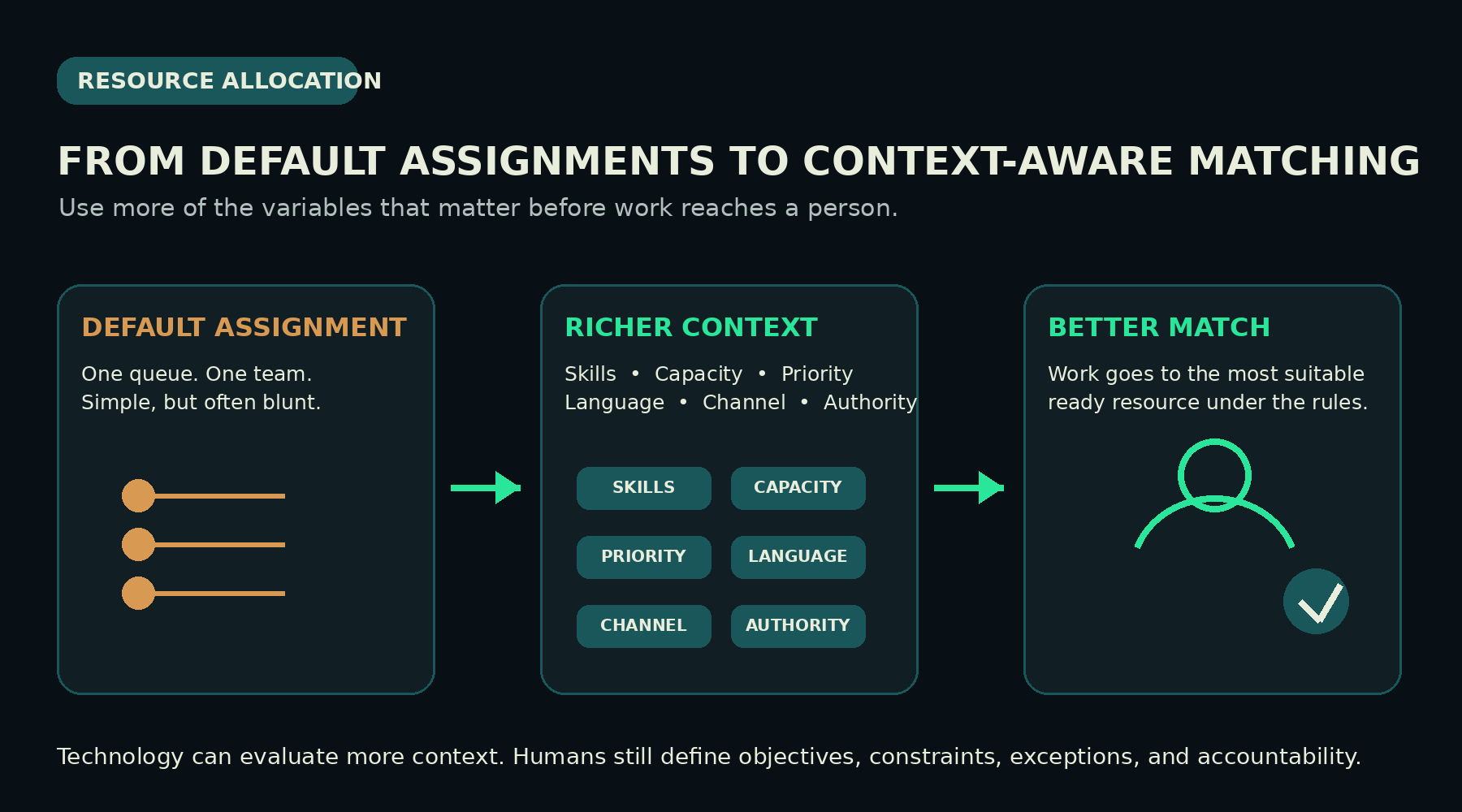
To map every possible workflow is daunting. So most companies simplify. The simplification often appears as a default assignment: one team handles billing, another technical issues, another customer advocacy. That structure may persist regardless of the additional context available, the current capacity on each team, or how well the assignment is performing.
Use more of the context
Modern workflow, optimization, and AI-assisted classification systems can face more of that complexity directly. They can consider more variables, update decisions as conditions change, and recommend a routing choice in near real time. The objective is not to optimize a single KPI blindly. It is to make the objectives, constraints, trade-offs, and exceptions explicit enough that the system can help.
Applied to customer operations, that means routing an interaction to the most suitable ready resource under the rules that actually matter: skills, capacity, priority, language, channel, permissions, relationship context, cost, service level, and other constraints. The workflow map may look less elegant than a simple org chart. The operating result can be much better aligned to the real work.
Technology does not eliminate the need for judgment. Humans still decide what should be optimized, which trade-offs are acceptable, when an exception should override the model, and who is accountable for the result. The opportunity is to stop wasting human attention on mechanical matching that the system can increasingly do for us.
Sources & References
- Klaus Oberauer, Simon Farrell, Christopher Jarrold, and Stephan Lewandowsky, 2016. What limits working memory capacity? — Psychological Bulletin, 142(7), 758–799.Reference 1