Resilience & Readiness
Taking a Punch: Improve Resiliency in Customer Service
Disruption will happen. The question is whether your customer-operations system can absorb the shock, reroute work, and keep serving customers.

Resiliency is the ability of your customer service network to take a punch.
That line was the heart of the original version of this article when I published it in 2021. It still is.
The specific punches change. A natural disaster can close a site. A carrier outage can isolate a team. A cyber incident can make critical systems unavailable. Absenteeism can remove capacity overnight. A provider can suffer its own operational failure. A sudden demand event can overwhelm a network that looked perfectly healthy the day before.
The common feature is not higher demand. It is the sudden loss, impairment, or inaccessibility of capacity you expected to have.
That is when resilience stops being a PowerPoint concept and becomes an operating property.
Resilience is tested when capacity disappears
Most customer-operations systems are designed for the expected day. Forecasts become schedules. Schedules become staffing plans. Staffing plans become queues, service levels, and budgets. When everything works, the model can look efficient.
But efficient is not the same thing as resilient.
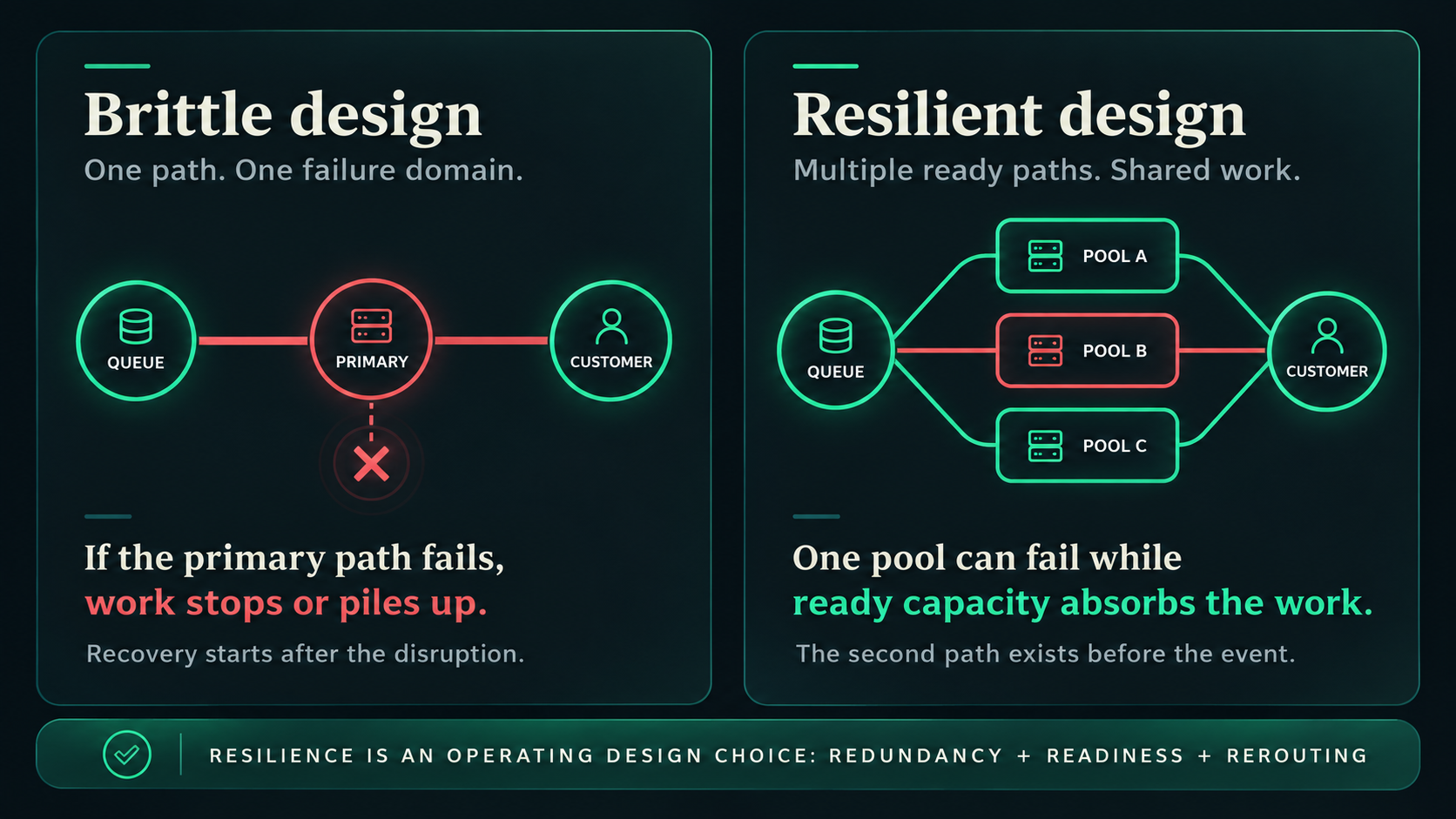
A brittle operation may perform beautifully right up until one dependency fails. One site. One network connection. One specialized team. One BPO. One system credential. One routing rule. One approval path. If the operating model has only one practical way to move work from demand to capacity, that path becomes a hidden single point of failure.
Resilience asks a different question: if this path stopped working tomorrow, what would we do with the work?
Redundancy is not waste
In IT and business continuity, backup and redundancy are ordinary design principles. We do not call a second data copy wasteful simply because the first copy is working today. We understand that the second path has value precisely because we may need it when the first path is impaired.
Customer operations deserves the same thinking.
A redundant resource pool might be a second delivery site, a second BPO, a cross-trained internal team, shared capacity in another business unit, an alternate channel, or a carefully governed automation layer that can absorb part of the work. The exact design depends on the program. The principle is that there is more than one ready way to serve the customer.
The word ready matters. A backup team that has no system access, no training, no permissions, no current knowledge, and no tested routing path is not backup capacity. It is a recruiting plan.
Multiple ready paths, not multiple logos
This is not an argument that every customer-service program should use multiple BPOs. The objective is not vendor count. The objective is independent, usable failover capacity.
Sometimes one provider can supply that through genuinely separate sites, networks, management structures, and workforce pools. Sometimes the right design combines an internal team with a provider. Sometimes it uses multiple providers because the failure domains are meaningfully different. Sometimes the work itself can be segmented so one pathway can absorb another during disruption.
The test is practical: if one important dependency fails, can work move somewhere else without beginning the operating design from zero?
That means the alternate path needs more than contractual availability. It needs trained people, current knowledge, approved access, compatible workflows, measurable performance expectations, routing rules, and somebody with the authority to activate it.
Readiness has to exist before the punch
The original version of this article included an example from my own operating experience: a delivery partner suffered a prolonged systems outage and suddenly lost a meaningful share of the customer-service capacity we expected to have. Because other approved capacity in the network was already trained and connected, work could be redirected instead of simply accumulating in a queue.
The lesson was not that one provider had failed. Every provider, internal team, software platform, carrier, and geography can fail in some way. The lesson was that the network had another path ready to use.
That distinction has become more important to me over time. Availability is not readiness. A company can have a long list of potential suppliers, backup sites, contractors, or technology options and still discover during an incident that none of them can actually take work.
Readiness is the work done before the disruption: access provisioned, training completed, data and privacy controls established, workflows validated, decision rights defined, routing tested, commercial terms understood, and escalation paths rehearsed.
Reroute the work, not the crisis
A resilient customer operation should be able to change the flow of work when part of the system is impaired.
That requires a shared understanding of the work itself. What can be moved? What cannot? Which interactions require specialized skills? Which queues can be merged? What customer data can alternate teams access? What technology dependencies follow the work? What should happen to quality controls and escalation paths when volume is rerouted?
The more of those answers are decided during the incident, the more the organization is improvising under pressure.
Technology can help. A good operating layer can track network health, surface exceptions, test routing options, and accelerate deployment of a chosen response. AI can increasingly assist with scenario testing, recommendation, and coordination. But no control tower can invent trained capacity, access rights, legal permissions, or operating relationships that were never prepared.
The intelligence layer matters. The underlying readiness matters more.
Resilience is not the same thing as overstaffing
There is an obvious objection to redundancy: it sounds expensive.
It can be, if the only idea is to duplicate everything and leave half the capacity idle. But resilience design is broader than permanent excess headcount.
Cross-training can create flexibility without doubling the workforce. Shared teams can provide optional capacity. Different providers may peak at different times. Some work can move between channels. Seasonal or surge capacity can be pre-positioned for activation windows. Technology can reduce the amount of manual work that must move. Commercial structures can separate readiness from full-time production.
The point is not to pay twice for every unit of capacity. The point is to know where the second path is, what it can absorb, what it costs to keep ready, and whether it will actually work when called.
Practice failure on purpose
Resilience gets stronger when it is tested before it is needed.
Tabletop exercises are useful, but customer operations can go further. Validate alternate logins. Move a small amount of work through a backup queue. Test manager escalation. Confirm that knowledge is current. Exercise routing rules. Measure how long it takes to detect a problem, decide on a response, shift work, and stabilize service.
Those exercises usually expose uncomfortable details: a password that expired, a roster that is stale, a workflow that exists only in one person’s head, a contract that does not cover the intended use, a training module that was never refreshed, a backup team whose capacity disappeared months ago.
Finding those things during a drill is cheap. Finding them during a real disruption is not.
Events consume readiness. They do not create it.
Build the system to take a punch
Customer-service resilience is not heroic incident response. It is architecture.
It comes from understanding the dependencies that can fail, creating alternate paths where the risk justifies them, preparing those paths before they are needed, and making it operationally easy to shift work when reality stops cooperating with the plan.
That is the modern version of the idea I was trying to express in 2021. The customer-service network should not be judged only by how efficiently it performs on a normal day. It should also be judged by how gracefully it degrades when something goes wrong.
The best time to build the second path is before the first one breaks.