BPO Sourcing & RFP Management
The Cheapest BPO Is Rarely the Cheapest BPO
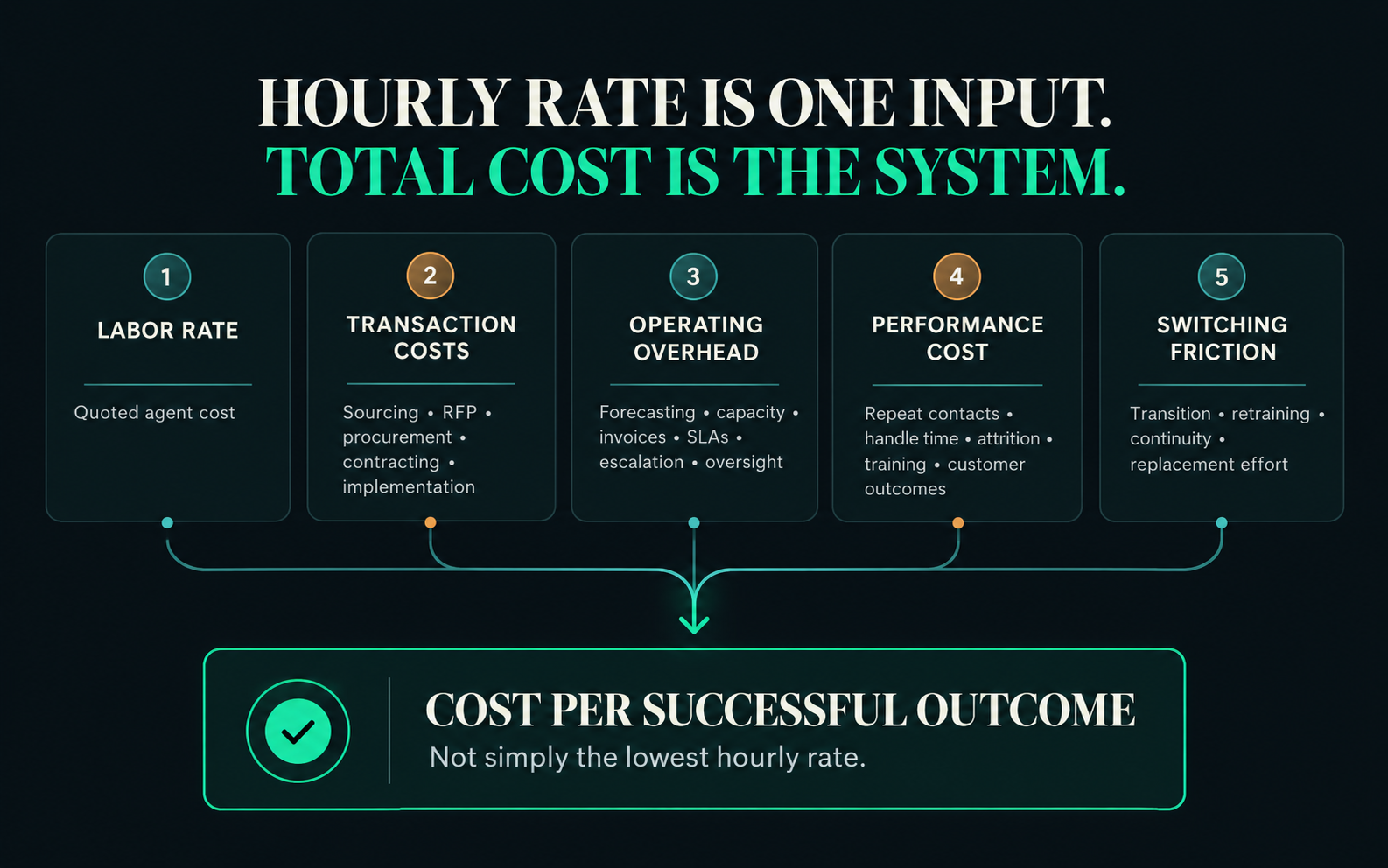
Hourly rate is one input. The real decision is total cost per successful outcome.

One of the stranger things about the BPO industry is how much time companies spend negotiating hourly rates while largely ignoring everything else they're paying for. If BPO A charges $12/hour and BPO B charges $14/hour, it's pretty easy to conclude that BPO A is cheaper. And it might be. But the hourly rate isn't the cost of outsourcing. It's one component of it.
The actual question companies should be asking is what it costs them to produce the business outcome they're trying to buy. That's a much more complicated calculation.
The $12/hour agent doesn't cost $12/hour
Start with the obvious stuff. Someone has to find the BPO. Someone has to determine which providers are actually capable of doing the work, run an RFP, evaluate proposals, negotiate pricing, work through procurement, negotiate an MSA, complete security reviews, build a SOW, implement the program, train the agents and manage the relationship. None of that shows up in the hourly rate.
Then the program launches. Now someone internally needs to forecast demand, manage capacity, review invoices, monitor SLAs, conduct business reviews, manage escalations, coordinate training, investigate performance issues and make sure the provider is actually delivering what everyone agreed to six months ago. Those costs don't show up in the hourly rate either.
And then there is probably the largest hidden cost of all: poor performance. Suppose one provider charges $12/hour and another charges $14. The $12 provider has lower first-contact resolution, which generates more repeat contacts. Attrition is higher, so you're constantly training replacements. Average handle time is worse. Forecasting is less accurate. Management requires more oversight. Customer satisfaction is lower.
Which one is cheaper? I have no idea. And neither does anyone else until we know the magnitude of those differences. That's the problem with evaluating outsourcing primarily through labor rates. We're optimizing the number that's easiest to measure instead of the number that actually matters.
Companies should think about BPOs more like a supply chain
I've always thought it's strange that companies apply fairly sophisticated supply-chain principles to physical goods and then frequently abandon them when purchasing outsourced services. If I were sourcing an important component for a product, I probably wouldn't select a supplier solely because they offered the lowest unit price. I'd care about quality. I'd care about capacity. I'd care about lead times. I'd care about reliability. I'd care about geographic concentration and business continuity. I'd care about how difficult it would be to switch suppliers if something went wrong. And I certainly wouldn't assume that the supplier that happens to be best for me today will necessarily still be the best supplier three years from now.
BPO really isn't that different. The problem is that the traditional outsourcing model makes applying those principles surprisingly difficult. Finding providers is expensive. Running an RFP is time consuming. Contracting takes forever. Implementations create switching costs. And once a company has invested all of that effort into a relationship, there's a pretty powerful incentive to tolerate mediocre performance rather than go through the entire process again. That's not necessarily because the incumbent is the best provider. Sometimes they're just the provider that's already there.
This is where marketplaces change the economics
Marketplaces have transformed plenty of industries, and one of the reasons is pretty straightforward: they reduce transaction costs. They make suppliers easier to discover. They create competition. They improve price transparency. They reduce the cost of switching. And, probably most importantly, they give buyers access to a much larger supply base without requiring them to independently build relationships with every potential supplier.
That's the part of the ArenaCX model that I think is frequently misunderstood. The value isn't simply "we know a lot of BPOs." Anyone can Google call centers. The value is reducing the friction associated with the entire lifecycle of buying outsourced services.
Instead of independently identifying and vetting providers, companies can access a marketplace of pre-vetted BPOs. Instead of spending months figuring out which providers might fit a particular geography, language, vertical, channel or use case, they can source against a much broader existing supply base. Instead of recreating an RFP process every time requirements change, they can create competition among qualified providers much more efficiently. Instead of starting the contracting process from scratch with every provider, much of that infrastructure can already exist. And instead of treating the BPO decision as something that happens once every five years, companies can manage their provider portfolio more dynamically. That last part matters more than I think people realize.
Competition shouldn't end when the contract gets signed
One of the biggest structural problems with traditional outsourcing is that competition is intense right up until the moment the buyer selects a provider. Then it largely disappears. Five BPOs might compete aggressively during an RFP. One wins. Eighteen months later, performance deteriorates. Now what?
Technically, the company can replace them. Practically, everyone knows what that means. Another sourcing exercise. Another RFP. Another procurement cycle. Another contract. Another implementation. Another training period. Another operational transition. So the buyer tolerates more than they otherwise would because changing suppliers is expensive. That's a market failure created by transaction costs.
A marketplace changes that equation by making alternatives continuously accessible. ArenaCX can help companies discover providers, run sourcing events, execute contracts and manage vendor relationships through an integrated operating model supported by its technology. Its marketplace also creates the ability to work with multiple providers rather than making every sourcing decision an all-or-nothing bet on a single BPO. That doesn't mean companies should constantly churn providers. Switching still has costs, and relationships still have value. But the credible ability to move business matters. A supplier behaves differently when poor performance means losing volume rather than having an uncomfortable quarterly business review followed by another three years of guaranteed revenue.
Total cost of ownership also changes how you think about quality
This is where the math gets particularly interesting. Imagine Provider A costs 15% less per agent. But Provider B resolves more issues on the first contact. Suddenly you don't need as many contacts. Maybe Provider B also has lower attrition. Now you're spending less time training replacement agents.
Maybe their agents are more experienced and require less internal management. Maybe customer satisfaction is higher. Maybe they identify problems faster. Maybe they sell more. Maybe customers churn less. At some point, asking which provider has the lower hourly rate becomes almost meaningless. What matters is cost per successful outcome.
This becomes even more important as AI changes the BPO industry. If automation removes a significant percentage of simple interactions, the remaining work will probably become more complex. In that world, paying the lowest possible hourly rate for human labor becomes an increasingly strange thing to optimize. The question becomes: Who can produce the best outcome at the lowest total cost? That's a marketplace question.
The cheapest provider should have to keep earning the business
There will always be companies that can find a BPO charging less. There are thousands of outsourcing providers around the world. Someone, somewhere, will almost always quote a lower hourly rate. But that's not really the point. The goal shouldn't be to find the cheapest labor. It should be to create the most efficient system for continuously finding, buying and managing the right labor, technology and expertise for the work that actually needs to be done.
Sometimes that will mean moving work offshore. Sometimes nearshore. Sometimes onshore. Sometimes it will mean using several providers. Increasingly, it will mean determining whether the work should be performed by a person at all. The optimal answer will change over time. And that's exactly why I think a marketplace-enabled operating model makes so much sense for BPO.
A traditional outsourcing strategy asks: Who should we hire? A marketplace asks a much better question: Given everything we know today, who should be doing this work right now? Those sound similar. Economically, they're very different.