Customer Operations Strategy
The Sociopathic System: Why Some Customer Service Programs Consistently Let Us Down
When bad service keeps repeating, the problem is often not the people. It is the system that constrains them.
I'll bet most customer-service leaders would agree that people have an advantage over machines in at least one important respect: we are actually people.
Years ago, I tested this proposition with a friend of mine who happened to run a customer contact center. I asked him, "Who is more empathetic, me or a chatbot?" After an uncomfortably long pause, he acknowledged that I, the human, was the winner.
The joke has aged better than the technology reference. Today, AI can sound remarkably warm, patient, and understanding. But sounding empathetic is not the same thing as caring, and being human does not guarantee that empathy will show up when a customer needs it.
That is the more interesting problem.
Bad service did not begin with bots
Customer service was disappointing people long before chatbots, call centers, or even telephones existed. One of the most famous surviving examples is a clay tablet from ancient Mesopotamia, dated to roughly 1750 B.C., in which a buyer named Nanni complains to a merchant named Ea-nasir about poor-quality copper and the way his messengers were treated.
Nearly four thousand years later, customers still complain about being ignored, bounced around, kept waiting, given bad information, or treated as though their problem does not matter.
So what causes people — who are capable of empathy — to behave in ways that feel profoundly unempathetic?
Sometimes, of course, an individual simply does a poor job. But when the same failure repeats across teams, locations, shifts, channels, or years, blaming the person on the other end of the interaction starts to miss the point.
The system behind the person
Most service failures appear to the customer as a lack of empathy:
- Long wait times: "They don't think my problem is important."
- Poorly prepared agents: "They aren't taking this seriously."
- Repeated handoffs: "They are trying to get rid of me."
- Unempowered agents: "They don't want to fix my problem."
- Overloaded agents: "They don't have time for me."
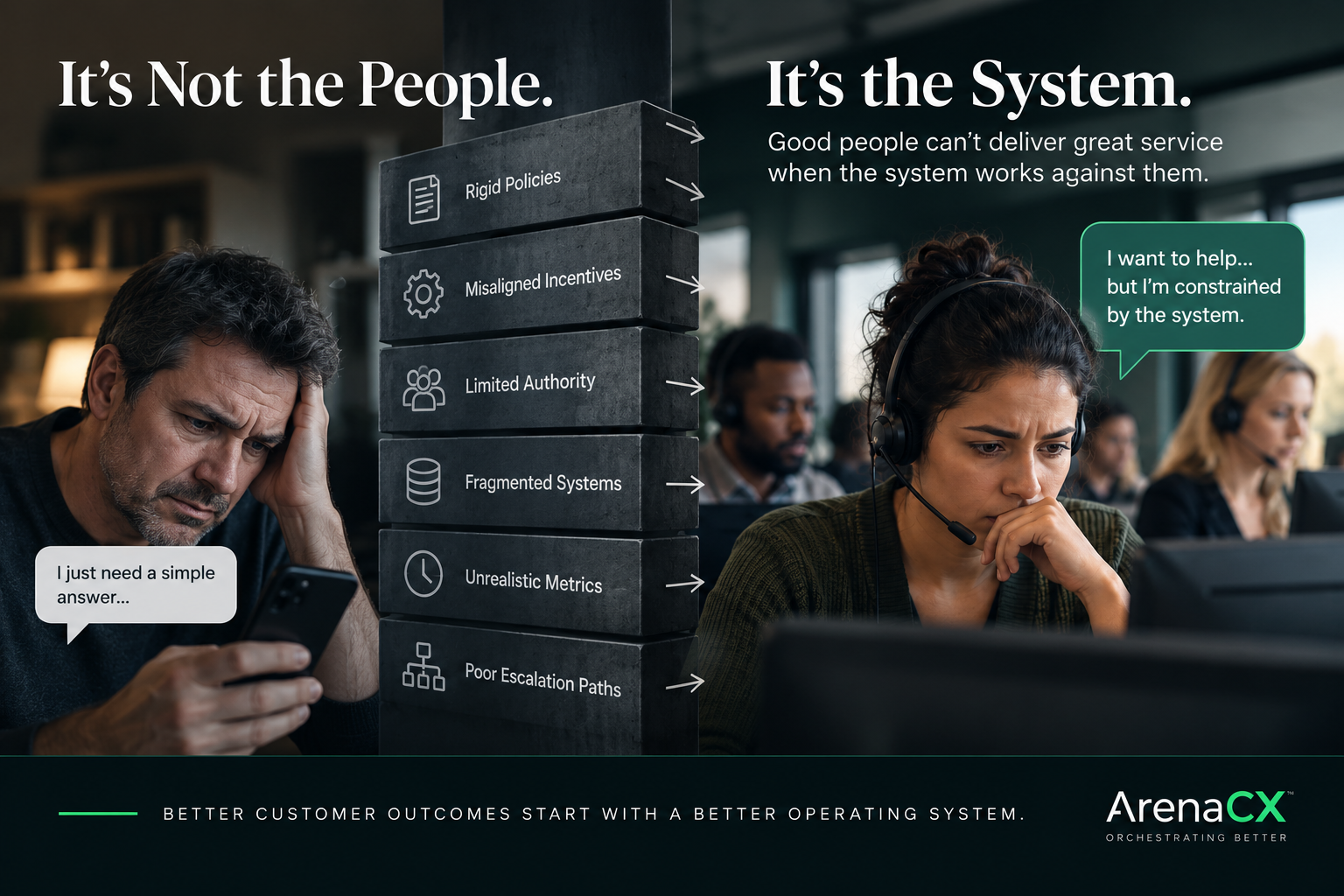
But each of those experiences can be produced by the system around the agent. Staffing models create queues. Training choices shape confidence. Policies determine discretion. Routing logic creates handoffs. Incentives influence what gets prioritized. Technology determines what the agent can see. Governance decides whether anyone fixes the pattern.
The environment into which a customer-service employee is placed has enormous influence over whether that person can succeed.
If a system is designed around the wrong objective — for example, cost reduction without an equally serious commitment to customer outcomes — it can routinely and predictably generate bad service even when the people inside it are trying to do good work.
That is what I mean by a “sociopathic system”: not a system populated by sociopaths, but an operating model that behaves as if the customer’s experience does not matter.
Stop treating systemic failures as coaching problems
When a business struggles with consistently poor customer satisfaction, the instinct is often tactical: retrain the agents, rewrite the script, adjust the schedule, add an incentive, coach the low performers, or install another tool.
Any one of those actions may help. But if the operating system itself makes empathy difficult, tactical remedies eventually run into the same design constraints.
An overly scripted playbook is a simple example. The company may believe the script creates consistency. The customer may experience it as indifference. The agent may know exactly what the customer needs but lack the authority to depart from the approved path.
The result can look like a bad employee when it is really a predictable output of policy.
The same pattern appears when staffing targets assume average demand instead of peaks; when handle-time incentives punish agents for solving complicated problems; when knowledge is fragmented; when escalation paths are slow; when different teams own pieces of the customer journey but nobody owns the outcome.
If the same failure keeps occurring, it deserves a system-level question: what in our design makes this result likely?
AI can scale the system — good or bad
This matters even more now because AI is being inserted into customer operations at nearly every layer: self-service, agent assistance, knowledge, quality, routing, forecasting, workflow, and decision support.
That technology can improve a well-designed system. It can also automate the contradictions of a poorly designed one.
An AI assistant cannot compensate for a policy that prevents a reasonable resolution. Better routing cannot create capacity that does not exist. A beautifully conversational bot cannot fix a business rule that sends the customer in circles. Automation can make an operating model faster without making it wiser.
The lesson is not “people good, bots bad.” It is that both people and technology perform inside systems.
Design the system so people can be their best selves
The encouraging part is that systems can be redesigned.
If customer operations is engineered around successful customer outcomes, the people inside it have a much better chance to behave the way we hoped they would when we hired them: attentive, resourceful, accountable, and human.
That means treating empathy not merely as a personality trait or a training module, but as something the operating environment either enables or suppresses.
Give people the information they need. Give them sensible priorities. Give them enough capacity. Give them authority where judgment matters. Design handoffs that preserve context. Measure outcomes that customers actually feel. Use technology to remove friction instead of simply adding another layer to it.
Humans bring judgment, emotion, context, and empathy. Machines bring consistency, speed, memory, and scale. The opportunity is not to choose one over the other. It is to build customer-operations systems that let each contribute what it does best.
When service repeatedly lets customers down, the most useful question may not be, “What is wrong with our people?”
It may be, “What have we designed them to succeed inside?”