BPO Sourcing & RFP Management
The Traditional Model of Outsourcing Is Flawed — Here's What to Do Instead
Outsourcing should make customer operations more adaptable, not lock the business into assumptions about labor, demand, technology, and provider roles that become expensive to change.

Outsourcing is not the problem. Rigidity is.
A lot of teams say they are frustrated with outsourcing when what they really mean is that they are frustrated with a model that became rigid the moment the ink dried. Forecasts change. Priorities change. Technologies change. Contact volumes change. Operating economics change. Yet many sourcing decisions still assume the opposite.
That is why the traditional model breaks down. It often asks the buyer to predict a future operating shape, convert that prediction into a labor plan, bake it into a contract, and then live with the consequences when the world behaves differently. The problem is not the existence of an external partner. The problem is the cost of changing course when the original assumptions stop being true.
A stronger outsourcing model starts with a different question: what capability does the business need, and how can that capability adapt as conditions change? That framing pushes the design away from static labor procurement and toward an operating model built for variation.
Forecasts are useful. They are not promises.
Most outsourcing relationships begin with a forecast. That is reasonable. Capacity has to be planned, trained, financed, and governed. But the forecast should be treated as a planning input, not as a binding description of reality.
In customer operations, reality rarely sits still. A product launch performs differently than expected. A policy change drives new contacts. A weather event changes demand. A billing mistake creates a surge. A self-service improvement removes easy work and leaves a harder mix behind. Good sourcing design assumes some version of this will happen.
That is why the better approach is scenario-based. What happens if volume lands below plan? What happens if it spikes? Which work can move? Which work cannot? What can be absorbed by people, what can be supported by automation, and what needs a different specialist capability? Those are more useful questions than pretending a single forecast will survive unchanged.
Commercial models should align with outcomes, not preserve unnecessary labor.
Traditional outsourcing debates often get trapped in pricing-model ideology. Hourly models, transaction models, committed-capacity models, hybrid models, and gainshare structures all have legitimate uses. The real question is whether the commercial logic reinforces the customer's operating goal or works against it.
If the model quietly rewards the preservation of avoidable labor, the buyer ends up paying to protect yesterday's workflow. If the model punishes sensible volume swings, the relationship becomes brittle. If the provider has no practical way to participate in process redesign, automation, or AI-enabled changes without restarting the deal, the contract is already lagging the business.
The answer is not to search for one magic pricing structure. It is to design a commercial model that can evolve as the work evolves. That usually means clarity on outcomes, transparent change mechanisms, and governance that allows both sides to improve the operating design instead of defending the original assumption set.
Contracts should create change paths, not just commitments.
Long-term agreements are not inherently bad. Sometimes stability is exactly what the program needs. The issue is whether the agreement makes sensible change easy or expensive.
A modern outsourcing model should make room for changes in scope, geography, channels, skill mix, technology participation, service levels, security needs, and provider responsibilities. It should be clear how the parties evaluate changes, approve them, price them, and govern them. Change should be a managed path, not a crisis.
This is where many sourcing efforts underperform. The buying process spends enormous energy getting to signature and too little energy designing what happens after signature. But the quality of the operating model is determined over time, not at the kickoff meeting.
Make room for AI before you know exactly how you will use it.
Any current outsourcing article in this topic needs to deal honestly with AI. Not because "AI" is a mandatory buzzword, but because the human-and-machine boundary inside customer operations is moving. An outsourcing design built around fixed labor assumptions can become obsolete even when the provider is doing everything it promised to do.
Some work will be automated end to end. Some work will be accelerated by AI assistance. Some interactions will become more complex because automation removes the simple ones. Skill requirements will shift. Data requirements will shift. Quality oversight will shift. The operating model must be able to absorb those changes without forcing a full re-sourcing exercise every time the workflow changes.
That does not mean "buy AI instead of BPO." It means preserving enough flexibility in the commercial model, workflow design, data access, governance, and provider responsibilities that work can move intelligently among people, automation, AI-assisted workflows, and specialized capabilities as the economics and the service need evolve.
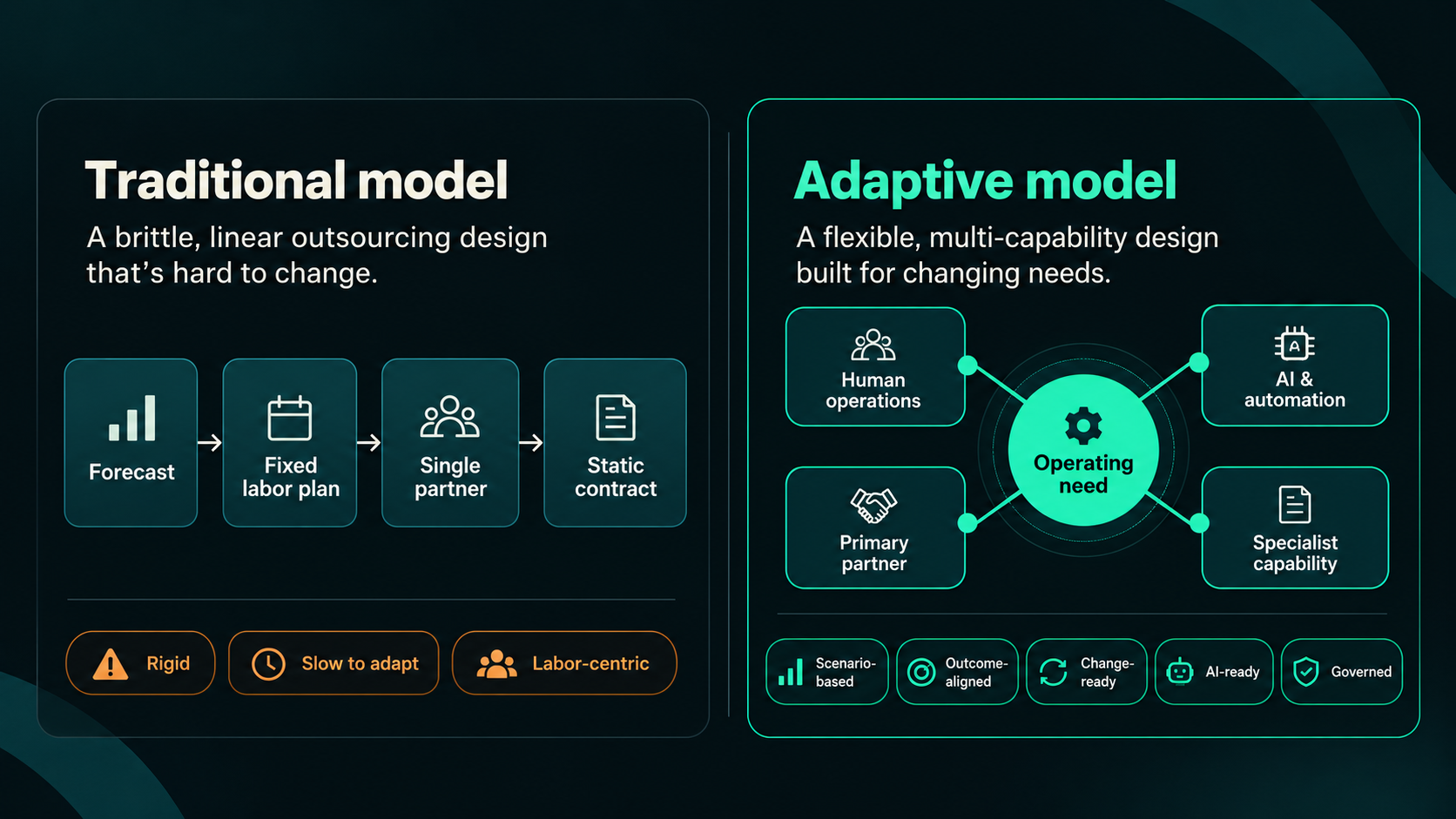
Scalability is now multi-capability, not just more people.
When leaders talk about scale, they often picture headcount. But a more durable model treats scale as a set of levers. Internal teams may help. A primary partner may help. A specialist provider may help. Self-service may help. Automation may help. AI may help. Different combinations make sense for different types of work.
The important point is that these levers should already be visible in the design. If the only scale answer is "add more labor to the existing structure," the model is fragile. If the operating design has multiple ready paths, the business can respond more intelligently to variation in demand and complexity.
The RFP should test the future, not just the present.
Many outsourcing programs still run a long RFP process and emerge with a carefully documented answer to yesterday's problem. The provider may be strong, the scoring may be disciplined, and the procurement process may be thorough, yet the result can still be a bad fit if the process does not test how the model will behave under changing conditions.
A modern sourcing process should test operating reality. How will volume shifts be handled? How will changes in channel mix be managed? What happens when AI changes the labor mix? How are workflow redesign ideas evaluated? What data, permissions, and governance are required? What can change cleanly, and what still requires contract surgery?
That kind of RFP is more useful because it evaluates the future operating model, not only the provider's current sales narrative.
Design for change.
The flaw is not outsourcing. The flaw is designing an outsourcing model around assumptions about demand, labor, technology, and provider roles that you then make expensive to change.
The better model starts from the operating need and preserves room for adaptation. It treats forecasts as scenarios. It aligns commercial logic with outcomes. It builds change paths into the contract. It makes room for AI. It tests operating reality in the sourcing process. And it treats outsourcing as a living operating design rather than a one-time vendor selection event.
Outsourcing should make customer operations more capable, not less adaptable. If the model cannot evolve as the work changes, the problem is not the partner. It is the design.