AI + Human Operations
Using Software to Be More Human: 5 Ways Computational Thinking Will Revolutionize Human-Powered Customer Service
AI is getting better at acting human. The bigger opportunity may be using computational thinking to design the system around people so customer operations become more focused, adaptive, scalable, resilient, and intelligent.

The wrong lesson to take from AI
When I first wrote about human-bot relations, the customer-service industry was already captivated by chatbots. That fascination has only intensified. The bots are better now. They can summarize long histories, retrieve knowledge, draft responses, classify intent, recommend next steps, and increasingly take action across workflows.
The question is no longer whether software can participate meaningfully in service. It can. The harder question is what we should learn from that software about the way we design the human-powered part of customer operations.
The two earlier essays in this series made a simple case. First, we were investing enormous energy in making machines act more human while paying less attention to the operating environment around actual humans. Second, repeated bad service is often a systems problem, not a character flaw in the person answering the phone or chat. If those two ideas are roughly right, then installing smarter AI on top of a poorly designed human system does not solve the foundation problem. It can just make the system run faster.
That premise has aged surprisingly well. In 2026, Gartner reported that 85% of service and support leaders were expanding human-agent responsibilities as AI changed the mix of work, while a separate Gartner customer survey found that 87% of customers considered access to a human agent essential when companies use generative AI. AI is changing the work. It is not eliminating the need to design the human system well.
What computational thinking has to do with customer service
Software is not human, and that is not a defect. We do not ask programmers to make algorithms more lazy, gossipy, moody, obstinate, passive-aggressive, tardy, prone to rabbit holes, or overly sensitive to criticism. Personally, I love humanity’s glorious messiness and diversity. But just how much of that messiness do we want to encode into the system around our people?
Jeannette Wing popularized the term computational thinking as a broadly useful way to solve problems, design systems, and understand behavior using concepts from computer science. In a later definition, Wing and colleagues emphasized formulating problems and solutions so they can be carried out by an information-processing agent - a human, a machine, or a combination of the two.
Customer operations is exactly that kind of environment. People and machines jointly process information, make decisions, allocate scarce capacity, respond to exceptions, and try to produce an outcome under real constraints. Computational thinking gives us a useful lens for designing that environment without asking people to become robots.
I originally highlighted five areas where this lens can materially improve human-powered customer service: focus, resource allocation, scalability, resiliency, and decision optimization. Those five ideas still hold. AI simply gives us more powerful tools for executing them.
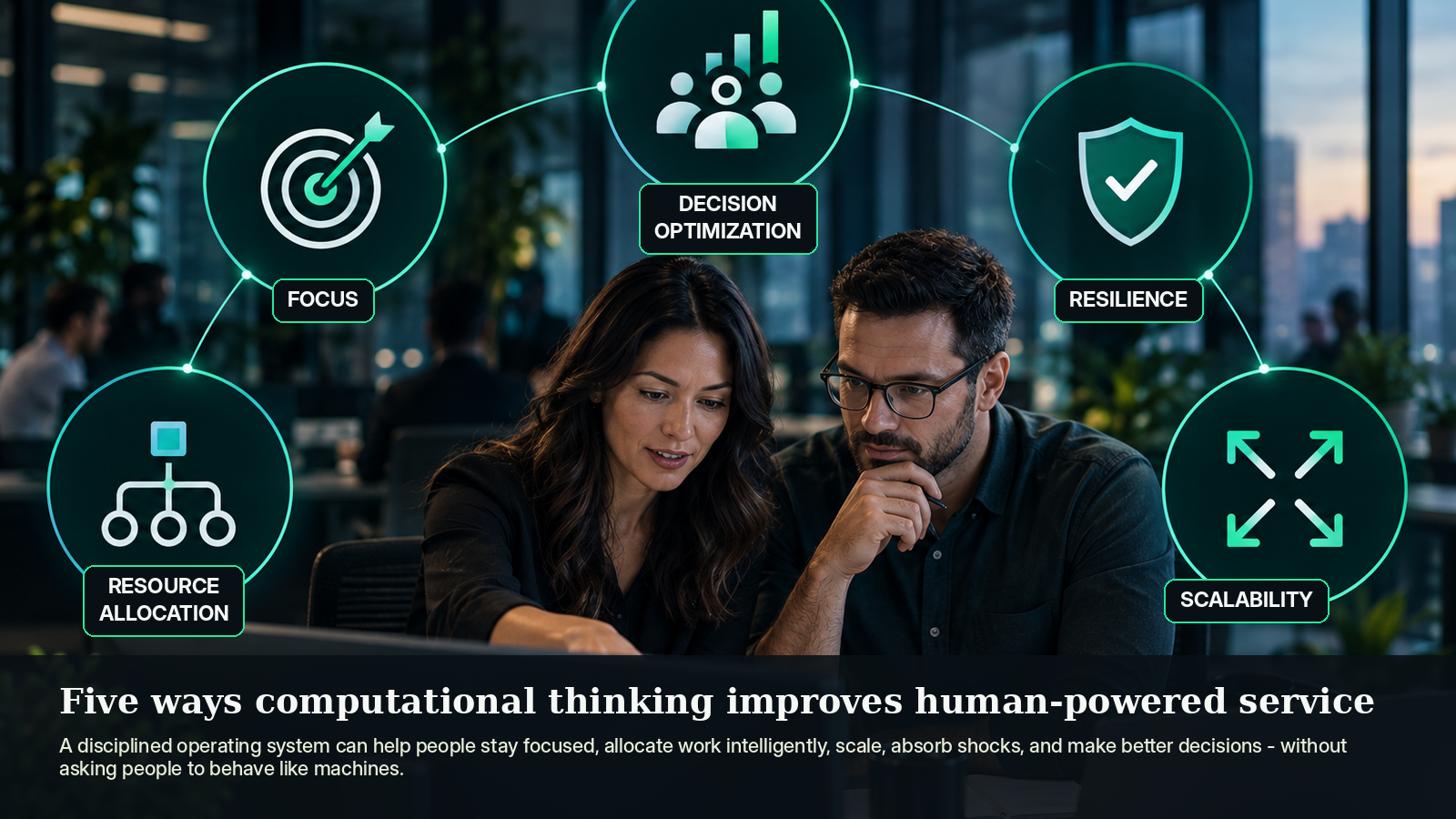
1. Focus: encode priorities into the operating system
Humans get distracted. Organizations do too. A service team can begin the morning focused on first-contact resolution and end the afternoon chasing whichever metric, escalation, executive request, queue, or anecdote is loudest.
Software is better at relentless focus because priorities are encoded. It follows the rule set it has been given. The lesson is not that people should behave like software. It is that organizations should stop expecting people to remember and reconcile every priority in real time.
Put the priorities into the system. Reflect them in routing, queue design, quality scoring, knowledge, permissions, escalation paths, workforce rules, incentives, dashboards, and management cadence. AI can now help surface context, summarize a case, recommend a next action, or flag a conflict between the requested action and policy. But the operating design still has to define what 'best' means.
The more clearly the system encodes the real priorities, the more freedom a human has to use judgment where judgment actually adds value.
2. Resource allocation: stop relying on convenient shortcuts
Customer operations has always been a resource-allocation problem disguised as a queue. Which customer should be helped next? Which person or team is best equipped to help? Which language, skill, product expertise, geography, channel, authority level, or relationship context matters? What should happen when the ideal resource is unavailable?
We often simplify those questions because the full problem is too complicated for a manager to solve repeatedly in real time. We route by queue. We assign work by geography. We dedicate a team because the org chart already exists. We use a familiar staffing ratio because it is easier than continuously recalculating what the work actually requires.
Computational thinking asks us to model the problem instead of hiding from its complexity. With better data, workflow logic, optimization, and AI-assisted classification, we can make routing and allocation decisions using more of the variables that actually matter. That does not mean blindly optimizing a single metric. It means being explicit about objectives, constraints, tradeoffs, and exceptions.
The result should feel more human to the customer because the system is doing more of the mechanical work required to get the right problem to the right capability.
3. Scalability: treat capacity as a set of levers
Traditional service organizations often treat capacity as headcount: hire, schedule, add overtime, or ask everyone to work harder. Those levers still matter, but they are slow and sometimes painful.
A more computational view treats capacity as a configurable system. In-house teams, BPO partners, shared pools, specialized providers, remote capacity, temporary teams, extended hours, automation, self-service, and AI can all change the amount or type of capacity available. The operating challenge is to know which lever to pull, how quickly it can move, what constraints apply, and how to reverse the change when demand falls.
AI can reduce repetitive work and increase the throughput of a human team, but it does not eliminate capacity planning. In fact, successful automation can shift demand toward harder work, raise customer expectations, or create new exception patterns. Elasticity comes from having multiple usable options and the mechanisms to activate them, not from assuming one technology will absorb every spike.
4. Resiliency: design for failure before failure arrives
Scalable computer systems assume that components fail. They use redundancy, failover, replication, monitoring, and alternate paths because reliability does not come from believing every component will remain healthy forever.
Customer operations should be designed with the same humility. A delivery site can lose power. A provider can underperform. A system can go down. A cyber incident can restrict access. Absenteeism can spike. A new AI tool can fail at exactly the moment everyone has come to depend on it.
Resilience means having a practical way to keep serving customers when a part of the system disappears or degrades. That may involve cross-training, geographic redundancy, multiple providers, alternative channels, backup connectivity, documented fallback workflows, or the ability to move work quickly across a network. It also means preserving a human path when automation is uncertain or unavailable.
The important distinction is between owning a continuity plan and owning a continuity capability. One sits in a document. The other has been designed, tested, and can actually be activated.
5. Decision optimization: move judgment closer to the problem
Centralization is often an information problem. We centralize decisions because the edge of the organization does not have enough context, authority, consistency, or confidence to make them safely.
Software systems solve a similar problem with rules, permissions, local processing, feedback loops, and escalation. Not every decision has to travel to a central controller. The system can push some decisions closer to where the information is richest while reserving unusual, high-risk, or ambiguous cases for higher levels of judgment.
That is increasingly possible in customer operations. Agents can be given better context and bounded authority. AI assistants can retrieve policy, compare options, highlight risk, or recommend actions. Automated workflows can execute low-risk steps. Supervisors can concentrate on exceptions rather than approving routine work one case at a time.
The principle is not 'let AI decide.' The principle is to design decision rights deliberately: what can be automated, what can be recommended, what requires human judgment, what requires escalation, and how the system learns from outcomes. NIST's human-centered AI work makes a similar point: AI should be understood in terms of the human goals and outcomes it supports, not merely the technique being used.
The opportunity is a better human + AI operating model
The conversation about AI in service often collapses into a false choice: humans or machines. The more useful design question is which parts of the operating system each is best suited to perform.
Machines are good at consistency, speed, recall, classification, pattern detection, repetitive execution, simulation, and applying rules at scale. Humans are good at context, empathy, judgment, negotiation, relationship, accountability, and handling situations that are genuinely new or emotionally complex.
The operating model around them has a third job: define the goals, constraints, data, permissions, escalation paths, capacity, incentives, governance, and measures that let both sides work well together.
That is why 'using software to be more human' is not really about making people more machine-like. It is about making the system around people more deliberate, so they do not have to waste their humanity compensating for bad design.
Give people clear priorities. Route work intelligently. Build real capacity options. Design redundancy. Push decisions to the edge with appropriate guardrails. Use AI to reduce friction and extend capability. Keep human judgment where it matters.
At the individual level, customer service is still people helping people, with all our differences, personalities, strengths, and imperfections. The better the surrounding system becomes, the more room those strengths have to matter.
Computational thinking does not make us better people. But it can help us build customer-operations systems in which our people can be better at what only people can do.
Sources & References
- Jeannette M. Wing, March 2006. Computational Thinking (Communications of the ACM) — Foundational framing for computational thinking as a broadly useful approach to problem solving and system design.Reference 1
- Jeannette M. Wing, 2010. Computational Thinking: What and Why? — Definition emphasizing problem formulation for solutions executable by humans, machines, or combinations of both.Reference 2
- Gartner, April 28, 2026. 85% of Service and Support Leaders Are Expanding Human Agent Responsibilities — Supports the current workforce-redesign statement.Reference 3
- Gartner, August 4, 2026. 87% of Customers Say GenAI Service Must Provide Access to a Human Agent — Supports the current customer-expectation statement.Reference 4
- NIST, March 26, 2024. AI Use Taxonomy: A Human-Centered Approach — Supports human-goal/outcome framing for human-AI tasks.Reference 5