Impact & Business for Good
From Good Intentions to Measurable Impact in Customer Operations
Good intentions matter, but trustworthy impact language requires an evidence chain. Start with the claim, define the indicator, name the source and owner, and let the evidence set the limits of what you say.

A practical guide for turning an impact intention into supportable claims, indicators, evidence and reporting language in customer operations. The accompanying Impact Measurement Charter helps teams define what they want to measure, who owns the evidence, how often it should be reviewed, and what the data does - and does not - prove.
Good intentions are not yet evidence
Impact language gets slippery when the measurement plan begins after the story has already been written. A program may have a credible impact-oriented provider, a thoughtful mission, or a workforce model designed to broaden access to opportunity. Those facts can matter, but they do not automatically establish what changed, for whom, by how much, or because of what.
The practical answer is not to measure everything. It is to decide, before reporting, what claim you actually need to support and then build the evidence chain underneath it. That discipline protects the integrity of the impact story while keeping measurement proportional to the operating decision.
Start with the claim, not the dashboard
A dashboard is useful only after the organization agrees on what it is trying to know. In customer operations, the first measurement question should therefore be: what would we want to be able to say about this program six or twelve months from now, and what evidence would make that statement responsible?
That question separates measurement from marketing. It also forces a useful distinction among several levels of evidence that are often collapsed into one another.
Five levels of evidence that should not be confused
A sound measurement approach distinguishes the type of statement being made. The levels below are not a maturity score; they are different kinds of evidence, and a program may legitimately stop at any level that matches its purpose and data reality.
| Evidence level | Question | Illustrative evidence |
|---|---|---|
| Provider characteristic | What is true about the provider or delivery model? | Verified ownership status; defined delivery location; documented mission; defined employment model. |
| Program commitment | What has the program agreed to do? | Contractual allocation, hiring or workforce commitment, reporting requirement, governance action. |
| Program activity | What actually happened in delivery? | Spend, paid hours, active workers, roles, training participation, or other defined activity tied to the program. |
| Observed outcome | What changed over time for a defined population or context? | Retention, progression, earnings, access, or another outcome only where the definition and data source are reliable. |
| Attributed impact | What changed because of the program? | Requires a stronger design than simple before/after observation; use causal language only when the evidence genuinely supports it. |
Use the four Impact lenses to define what matters
Operating fit remains the gate. A provider or provider mix still has to meet the capability, quality, scale, economics, geography, technology, resilience, and implementation requirements of the program. Impact measurement should make the additional decision dimension clearer, not obscure operational tradeoffs.
| Lens | Measurement question | Illustrative program evidence | Boundary |
|---|---|---|---|
| Ownership | Is the ownership classification accurate and supportable? | Verification source; program spend or work allocated to the verified provider, where relevant. | Classification does not automatically transfer to ArenaCX or the customer. |
| Location | Where is the work actually performed, and how is the geography defined? | Defined site/geography; roles, paid hours or capacity delivered there. | Location alone does not prove economic benefit. |
| Employment | Who gets access to the work, and how is eligibility defined? | Defined population; hires, active workers, paid hours, retention or progression where data is appropriate and reliable. | Minimize sensitive data; do not turn participation into an unsupported outcome claim. |
| Mission | What mission-linked practice or benefit is actually part of the operating model? | Documented program practice, participation, service or resource tied to the mission. | Mission language or affiliation alone is not evidence of impact or operating fit. |
Build the evidence chain before you choose the metric
A useful indicator has a job. It should help support a defined claim, use an agreed definition, rely on a source the organization can actually obtain, have an accountable owner, and be reviewed on a cadence that fits the decision. Without those elements, a number can be precise and still be weak evidence.
The ArenaCX measurement evidence chain is simple: Intent -> Claim -> Indicator -> Evidence -> Language. The last step matters as much as the first. The available evidence should determine how confidently the organization describes the result, not the other way around.
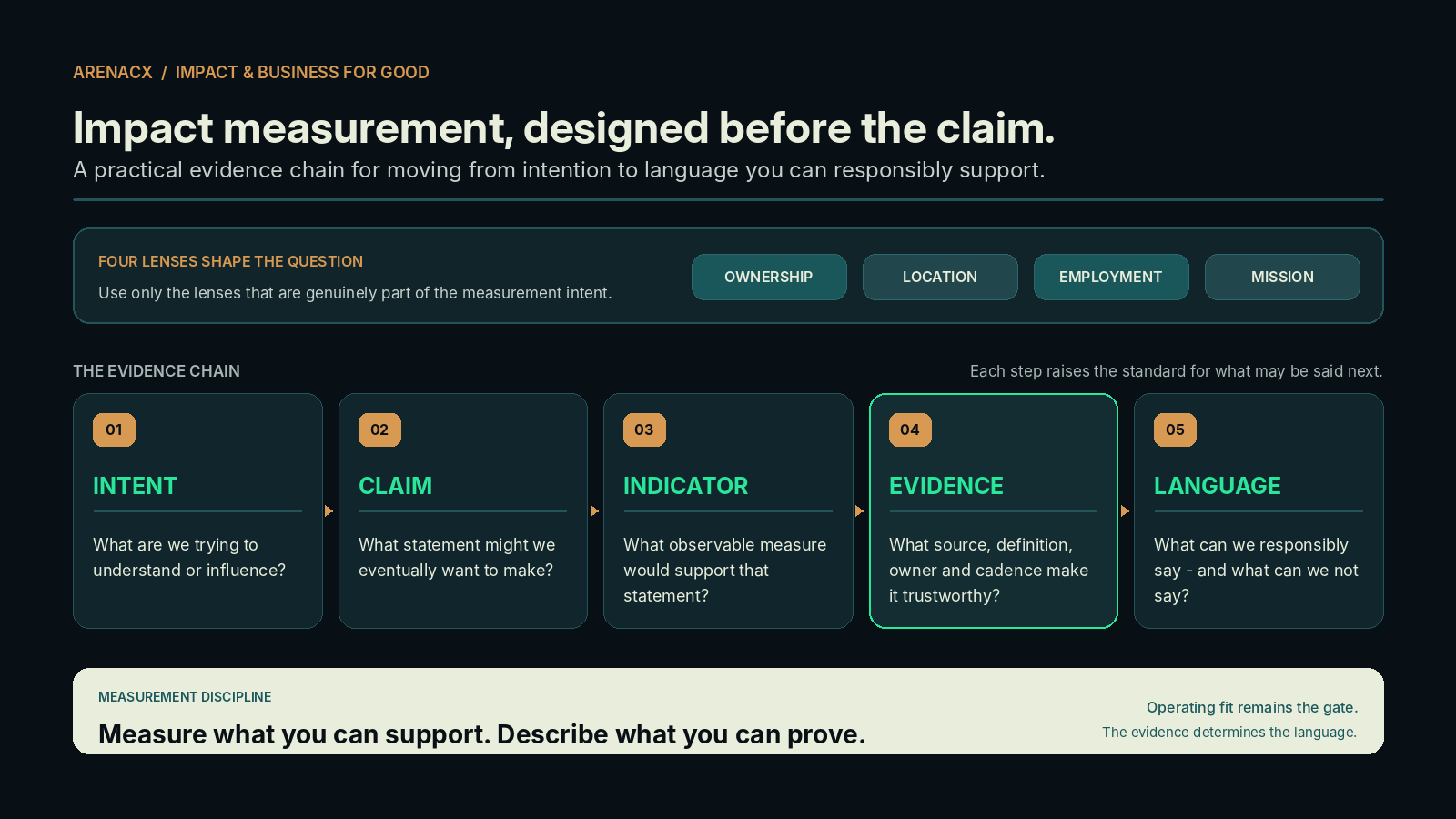
| Step | Design question |
|---|---|
| Intent | Define the decision or question the measurement is meant to inform. |
| Claim | Draft the statement you may want to make, including scope and population. |
| Indicator | Choose the observable measure that would support that statement. |
| Evidence | Define unit, source, owner, cadence, baseline/target if useful, and evidence quality. |
| Language | State only what the evidence supports; record what it does not establish. |
Measure participation before you claim outcomes
Many customer-operations programs can reliably measure participation or activity sooner than they can measure broader social or economic outcomes. That is not a failure. It is often better to report a smaller, well-defined fact than to attach a sweeping impact claim to data that cannot support it.
For example, a program may be able to verify that work was performed in a defined geography, that a specified number of paid hours were delivered by an eligible workforce population, or that spend was directed to a provider with a verified ownership characteristic. Those are meaningful program facts when the definitions and source records are clear. They are not, by themselves, evidence that household income increased, a community changed economically, or a customer caused a long-term employment outcome.
Baseline, target and attribution are different disciplines
A baseline tells you where the program started. A target states an intended future level. An observed outcome tells you what happened. Attribution asks the harder question of what happened because of the program rather than because of other factors. Those are different claims and should be treated differently.
Most operating programs do not need a research-grade causal study. They do need language that respects the evidence available. If the program has no credible comparison or design for causal inference, describe observed participation and outcomes without implying that the program alone produced them.
Put data governance inside the measurement design
Impact data can create its own operational and privacy burden, especially when measurement touches workforce identity, location, disability, veteran status, second-chance populations, or other sensitive characteristics. The measurement plan should therefore specify what data is truly necessary, who is allowed to access it, whether reporting can be aggregated, how definitions will be maintained, and how long evidence needs to be retained.
Create a reporting rhythm tied to decisions
The right cadence is the cadence at which someone can act. Some indicators may belong in monthly operating reviews; others may make sense quarterly or at a sourcing, renewal, or annual-stewardship checkpoint. The important design choice is to name the owner, the review forum, the expected evidence, and the decision that follows when the number changes.
That keeps measurement connected to operations. It also reduces the temptation to accumulate a large inventory of metrics that look impressive but do not change a sourcing, workforce, governance, or communications decision.
Common measurement traps
Measurement becomes less credible when the program asks the data to do more than it can. Several traps recur often enough to deserve an explicit check before reporting.
- Counting a provider label as the impact outcome.
- Using a mission statement as proof without validating the operating practice behind it.
- Mixing provider-level data with program-level data so the reader cannot tell what actually belongs to the customer program.
- Reporting a number without a written definition, source, owner, or time period.
- Using a target as though it were a result.
- Describing an observed change as though the program caused it when attribution has not been established.
- Collecting sensitive workforce data simply because it might be interesting, rather than because it is necessary and appropriately governed.
Use the Impact Measurement Charter
The accompanying Impact Measurement Charter turns the concepts in this guide into a reusable working document. It is designed to help sourcing, operations, procurement, workforce, legal/compliance, and impact stakeholders agree on the intended claim, selected lens, indicator definition, data source, owner, cadence, evidence status, and limits on what the evidence proves.
The goal is not to make every program look more impactful. The goal is to make the program's impact language more trustworthy because the measurement design is explicit before the claim is made.
Sources & References
- International Organization for Standardization. ISO 20400:2017 - Sustainable procurement - Guidance — Guidance for integrating sustainability into procurement; ISO confirms the 2017 edition remained current after its 2023 review.Reference 1
- OECD. OECD Due Diligence Guidance for Responsible Business Conduct — Guidance for risk-based due diligence across operations, supply chains and business relationships.Reference 2
- International Labour Organization, 2025. Disability-inclusive supply chains — Practical guidance on disability inclusion in supply chains and commercial relationships.Reference 3
- U.S. Small Business Administration. SBA business certifications — Official information on distinct federal small-business contracting certifications and eligibility requirements.Reference 4
Related Resources
Impact & Business for Good
Business for Good in Customer Operations: Four Lenses for Impact
Customer-operations spend can do more than buy capacity. When impact is defined clearly and evaluated alongside performance, sourcing can widen opportunity without turning purpose into a substitute for operating fit.
Network Design & Orchestration
Why Customer Operations Needs Supply-Chain Thinking
Customer operations has become a network of providers, technologies, workforce models and geographies. We should start managing it like one.