Network Design & Orchestration
Designing a Customer-Operations Network for Optionality
Optionality is not the same as having more vendors. It is the ability to move work, capacity, or capability to another credible path without rebuilding the operating model when conditions change.

Optionality is a design property, not a vendor count
Customer-operations leaders are often told to diversify. That can sound like a simple procurement instruction: add another provider, geography, workforce model, or technology. But adding another name to the vendor list does not automatically create a usable option. If the alternate cannot receive the work, access the right data, operate the workflow, meet the controls, or scale when the trigger arrives, the organization has diversification on paper rather than optionality in practice.
ArenaCX uses optionality in a narrower and more operational sense: preserve credible paths that can actually be activated. Sometimes that means two providers. Sometimes it means one provider plus an internal reserve, a specialist, a different geography, a technology path, or a surge model. And sometimes the right answer is still one provider because the complexity and cost of maintaining an alternative are greater than the value of the option. The design should follow the need, not an ideological preference for more vendors.
Start with the work that must remain movable
The first question is not "How many providers should we have?" It is "What must remain changeable?" A customer-operations network can be designed around different kinds of optionality: the ability to shift volume, introduce a specialty, add language or geographic coverage, change a technology component, create surge capacity, or preserve continuity when a primary path is disrupted. Those are different problems, and they should not be collapsed into one generic redundancy goal.
Pick a workstream that matters and define the operating promise around it. What outcome has to continue? What service level, skill, compliance requirement, operating hour, customer experience, or economic constraint cannot be compromised? Then identify which part of the system you want to keep movable. This prevents optionality from becoming expensive duplication without a specific job to do.
Six layers of usable optionality
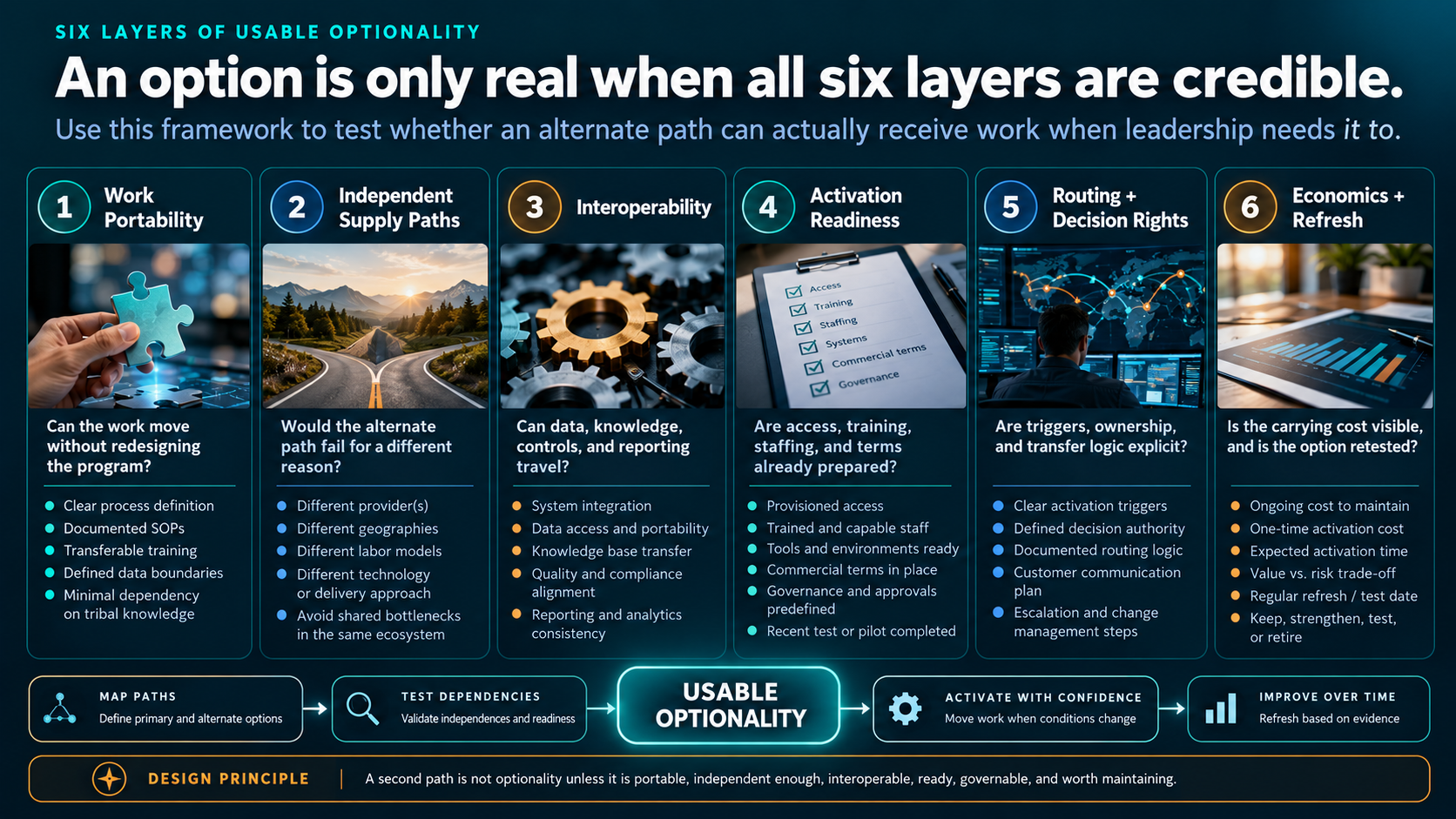
A practical way to test whether an option is real is to inspect six layers. The layers are deliberately operational. They force the conversation away from vendor-counting and toward the mechanics that determine whether work can move when leadership decides that it should.
1. Work portability
Can the work be transferred without redesigning the program? Portability depends on clear process definitions, accessible knowledge, understandable policies, transferable training, sensible data boundaries, and enough standardization that another path can take over. Not every activity should be standardized, but critical work should not depend on unwritten tribal knowledge that lives inside one team or one provider.
Portability also has a people dimension. If a program depends on a few individuals who hold all the context, the organization may have nominally diversified supply while retaining a single point of operational failure. The goal is not to eliminate expertise; it is to make the operating model legible enough that expertise can be extended rather than trapped.
2. Independent supply paths
An alternate path only reduces concentration when it is meaningfully independent of the primary one. Two providers in the same labor market, dependent on the same telecom carrier, sharing the same customer identity service, or constrained by the same approval bottleneck may fail together. The same is true of technologies that look different at the interface but depend on one upstream platform or data source.
External supply-chain guidance makes a similar distinction. NIST's current supply-chain risk guidance discusses planning for alternative suppliers and delivery routes as part of contingency planning, while ISO's supply-chain continuity guidance emphasizes preparation for disruptions that affect suppliers of products, services, and resources. Customer operations is not identical to cybersecurity or physical supply chains, but the design lesson carries over: alternatives are more useful when leaders understand the dependencies that could make them fail at the same time.
3. Interoperability
A second path may be capable and still be unusable because the interfaces do not travel with the work. Can the alternate receive the required customer context? Does it have the right systems access? Can quality, workforce, security, and reporting controls be applied consistently? Can knowledge content and workflow changes propagate to both paths? If not, activation becomes a systems project instead of an operating decision.
Interoperability does not require every provider or technology to look identical. It requires deliberate interfaces. The more clearly data, knowledge, workflow, access, measurement, and escalation are defined, the less the organization has to reconstruct during a handoff.
4. Activation readiness
A name on a contract is not readiness. The alternate path needs enough prework to be credible: commercial terms, access, training, staffing assumptions, operating procedures, security requirements, escalation paths, and a test of the mechanism that would move the work. McKinsey has noted in the physical supply-chain context that identifying, prequalifying, and onboarding backup suppliers carries a cost but can create needed capacity when disruption occurs. The same tradeoff is useful to make explicit in customer operations.
The test should match the option. A continuity path may need a periodic activation exercise. A surge path may need a capacity commitment and a launch drill. A specialist path may need a small live-work pilot. The objective is evidence that the option can be used, not confidence based on a slide or an old project plan.
5. Routing and decision rights
Optionality becomes valuable only when someone can use it. Define what signal triggers a move, who is allowed to make the decision, how customer risk will be assessed, what work moves first, and how the primary and alternate paths coordinate during transition. Without decision rights, organizations can spend valuable time debating whether conditions are "bad enough" while the option they paid to preserve sits idle.
This does not mean every signal should automate a transfer. Some changes should remain human decisions because the tradeoffs are contextual. The important point is to make the decision process explicit before the pressure arrives.
6. Economics, triggers, and refresh
Options have carrying costs. Maintaining alternate capacity, duplicate access, backup tooling, training, testing, governance, or minimum commercial commitments can be rational, but the cost should be visible. Leaders should know what they are paying to preserve the option, what risk or opportunity it addresses, and what evidence would justify expanding, shrinking, or retiring it.
Optionality also decays. People leave, processes change, integrations drift, knowledge goes stale, pricing changes, and business priorities move. Every meaningful option should therefore have a refresh date. A backup that worked eighteen months ago is not automatically a backup today.
Design against shared dependencies
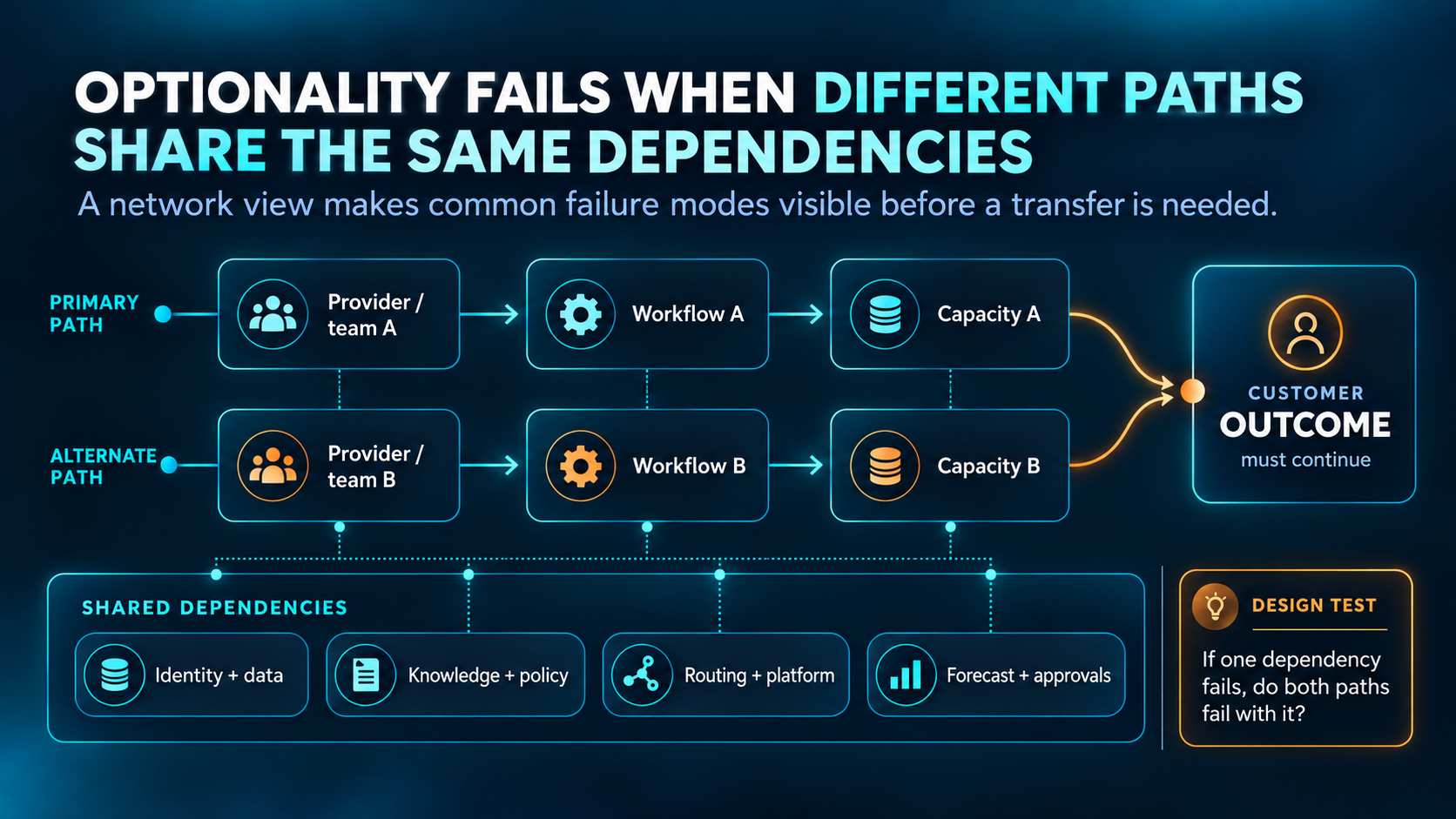
The most common mistake in network design is to diversify the visible layer while leaving the hidden dependency structure unchanged. A company can have two BPOs and still depend on one platform, one forecast, one policy owner, one identity system, one geographic labor pool, one subject-matter expert, or one approval path. The network looks broader, but the failure mode has simply moved upstream.
Map the primary path and alternate path side by side, then ask what both still depend on. Shared dependencies are not automatically bad; many are efficient and appropriate. They become a design concern when their failure would disable every path that leadership assumed was independent. The objective is visibility, not indiscriminate duplication.
Make transfer friction visible
Every option has a switching cost. That cost may be time, training, lost productivity, customer disruption, integration work, legal review, minimum staffing, or management attention. The transfer cost is part of the design and should be estimated before the option is needed. A theoretically excellent alternative with a twelve-week activation path is not a useful answer to a three-day capacity problem.
This is where the network view is more useful than a vendor view. Leaders can compare options based on what they enable and how hard they are to activate, instead of assuming that a larger provider roster automatically creates resilience or leverage.
Preserve simplicity when simplicity wins
Optionality should not become an excuse to build unnecessary complexity. A single provider can be the best architecture when the work is stable, the supplier is strong, the switching risk is acceptable, and the cost of maintaining alternatives would not earn its keep. ArenaCX's diversification position is explicitly about preserving options and reducing unnecessary dependence, not multiplying vendors for its own sake.
The same principle applies inside a multi-provider model. Some workstreams benefit from specialization or geographic diversity; others benefit from concentration and standardization. The network should be deliberately uneven when the economics and operating requirements are uneven.
Use the Optionality Design Canvas
The accompanying Optionality Design Canvas turns the framework into a planning aid. Use it on one meaningful workstream rather than trying to map the entire enterprise at once. The canvas asks what must stay movable, what the primary and alternate paths are, which dependencies are shared, what would block transfer, what evidence proves readiness, who owns activation, and what should happen in the next 90 days.
The most useful output is not a perfect diagram. It is a short list of option gaps that can be acted on: an access dependency that needs to be separated, a backup provider that needs a pilot, a knowledge base that needs to become portable, a commercial term that needs to be pre-negotiated, or a routing decision that needs an owner.
A 90-day way to start
Optionality can be designed incrementally. Start with one workstream whose failure, volatility, or strategic importance makes the exercise worthwhile. Define the promise, map the paths and dependencies, identify the largest activation blocker, and choose a small proof that would reduce uncertainty. Then assign an owner and a retest date.
The objective over 90 days is not to construct a perfectly diversified customer-operations network. It is to turn one assumed option into a tested option, or to decide with evidence that the option is not worth maintaining. Either result improves the architecture because the organization is replacing assumption with design.
Design options before you need them
Customer operations will keep changing: demand moves, technology changes, providers evolve, customer expectations shift, and disruption occasionally arrives without an invitation. A network cannot remove that uncertainty. It can decide how much of the response has to be invented under pressure.
That is the value of optionality. It gives leadership more credible moves. The goal is not to predict every future state or keep every possible path open. It is to preserve the paths that matter, make their dependencies visible, and keep enough of them ready that changing direction is an operating decision rather than a reconstruction project.
Sources & References
- National Institute of Standards and Technology, 2024 update. NIST SP 800-161 Rev. 1 Update 1 — Cybersecurity Supply Chain Risk Management Practices for Systems and Organizations — Used for the general risk-management principle of identifying, assessing, and mitigating supply-chain risks and for contingency-planning references to alternative suppliers/services/routes.Reference 1
- International Organization for Standardization, 2021. ISO/TS 22318:2021 — Security and resilience — Business continuity management systems — Guidelines for supply chain continuity management — Used for the general continuity principle that organizations should prepare for disruption affecting suppliers of products, services, and resources.Reference 2
- McKinsey Global Institute, 2020. Risk, resilience, and rebalancing in global value chains — Used for the observation that backup suppliers require identification, prequalification, and onboarding, which carries cost but can create capacity during disruption.Reference 3
Related Resources
Network Design & Orchestration
Why Customer Operations Needs Supply-Chain Thinking
Customer operations has become a network of providers, technologies, workforce models and geographies. We should start managing it like one.
Network Design & Orchestration
Are We Missing a Layer in the Customer Journey? — The Experience Chain Behind Customer Operations
Customer journeys show what customers experience. They do not always show the chain of people, providers, systems, rules, data, and capacity that has to work behind each moment. That hidden chain is often where the experience succeeds or fails.
Resilience & Readiness
Taking a Punch: Improve Resiliency in Customer Service
Disruption will happen. The question is whether your customer-operations system can absorb the shock, reroute work, and keep serving customers.