Impact & Business for Good
The Impact Design Checklist for Customer Operations
A practical checklist for building Ownership, Location, Employment, and Mission considerations into customer-operations sourcing without losing sight of operating fit. Use it to define the goal, source relevant providers, evaluate evidence, structure the decision, and measure only what the program can support.

Turn intent into an operating decision
Impact goals become useful when they change the way a sourcing decision is designed. That means defining what matters, deciding what evidence is required, evaluating impact alongside operating requirements, and being precise about what will be measured after launch.
Download the checklist
Download the Impact Design Checklist for Customer Operations as a fillable PDF or editable Word document. Both formats contain the same substantive checklist.

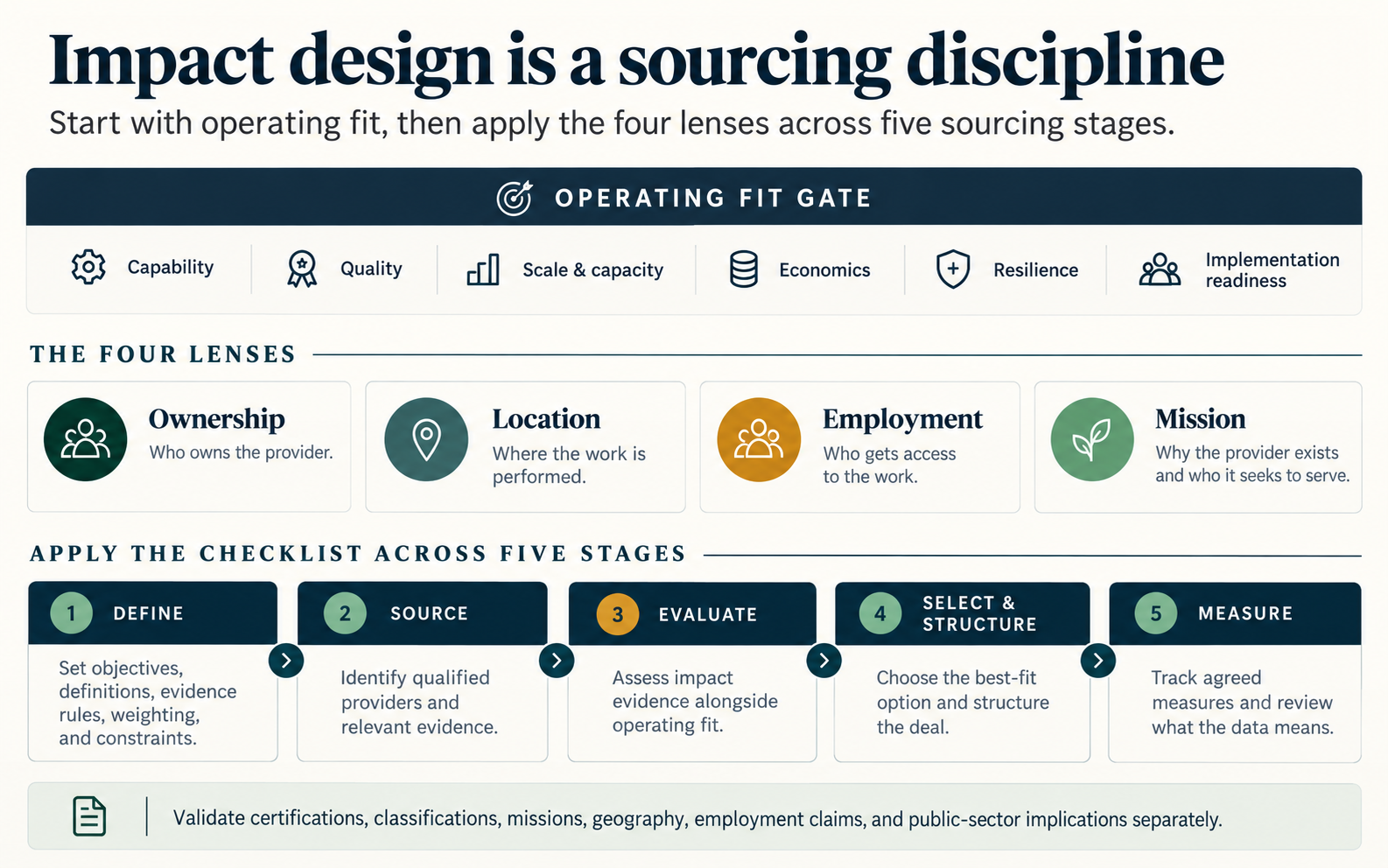
Start with four lenses, not one label
| Lens | What to establish |
|---|---|
| Ownership | Who owns the provider. Use classifications only where they are accurate and supportable. |
| Location | Where the work is performed. Consider the economic context of the geography without assuming that location alone proves impact. |
| Employment | Who gets access to the work. Define the population precisely and verify the employment model rather than relying on broad claims. |
| Mission | Why the provider exists and which communities it seeks to serve. Mission or affiliation alone is not evidence of operating fit or impact. |
Use the checklist across five stages
| Stage | Decision discipline |
|---|---|
| DEFINE | Agree on impact goals, definitions, evidence expectations, weighting, and the operating requirements that cannot be compromised. |
| SOURCE | Look for capable providers with relevant characteristics and request the evidence needed to validate those characteristics. |
| EVALUATE | Assess impact evidence beside capability, delivery model, commercials, risk, and implementation fit so tradeoffs stay visible. |
| SELECT & STRUCTURE | Choose the provider or provider mix that fits the complete need, then document commitments, governance, and any impact requirements. |
| MEASURE | Track agreed indicators only where definitions, data sources, ownership, and reporting cadence are sufficiently reliable. |
Download the editable checklist to work through these questions with sourcing, operations, procurement, workforce, legal/compliance, and other stakeholders as appropriate.
Five failure modes the checklist is designed to prevent
- Adding an impact label after the sourcing decision instead of translating the goal into decision criteria.
- Treating ownership, geography, affiliation, or mission language as proof without validating the relevant evidence.
- Combining operating and impact criteria so tightly that tradeoffs disappear instead of remaining explicit.
- Promising employment, customer, economic, certification, set-aside, or compliance outcomes that the underlying program does not establish.
- Measuring indicators that lack a clear definition, reliable data source, accountable owner, or useful reporting cadence.
A note for public-sector and supplier-diversity use cases
Impact characteristics can be relevant to public-sector, subcontracting, workforce, geographic, or supplier-participation strategies, but they do not automatically satisfy statutory, certification, set-aside, subcontracting-plan, or diversity requirements. Validate the applicable program rules and provider eligibility separately.
Download
Download the Impact Design Checklist for Customer Operations as a fillable PDF or editable Word document. Both formats contain the same substantive checklist.
Sources & References
- International Organization for Standardization. ISO 20400:2017 - Sustainable procurement - Guidance — Provides general guidance for integrating sustainability into procurement; confirmed current by ISO after its 2023 review.Reference 1
- OECD. OECD Due Diligence Guidance for Responsible Business Conduct — Risk-based due-diligence guidance for operations, supply chains, and business relationships.Reference 2
- International Labour Organization, 2025. Disability-inclusive supply chains — Practical guidance on disability inclusion in supply chains.Reference 3
- U.S. Small Business Administration. SBA Certifications — Confirms that contracting programs have distinct eligibility and certification requirements.Reference 4
Related Resources
Impact & Business for Good
Business for Good in Customer Operations: Four Lenses for Impact
Customer-operations spend can do more than buy capacity. When impact is defined clearly and evaluated alongside performance, sourcing can widen opportunity without turning purpose into a substitute for operating fit.
BPO Sourcing & RFP Management
The ArenaCX BPO RFP Template
A practical framework for defining your requirements, standardizing provider responses, and making a BPO selection process easier to compare and defend.
Network Design & Orchestration
Why Customer Operations Needs Supply-Chain Thinking
Customer operations has become a network of providers, technologies, workforce models and geographies. We should start managing it like one.