Resilience & Readiness
When Cyber Incidents Hit, Customer Operations Still Have to Run
A continuity playbook for keeping customers supported when ransomware, outages, compromised vendors, or inaccessible systems take normal operations offline.

Cybersecurity teams have a clear job during an incident: contain the threat, protect data, investigate what happened, and recover systems safely. Customer-operations leaders have a parallel problem that starts at the same moment: while that work is happening, who answers customers? Which channels can still be trusted? What work is safe to continue? Where can volume go if a primary site, provider, identity service, CRM, telephony platform, or knowledge system is suddenly unavailable?
That is the operating-continuity layer of cyber resilience. It does not replace cybersecurity, incident response, forensics, legal counsel, or breach-notification obligations. It exists alongside them so the organization can keep serving customers through a controlled, security-approved operating mode instead of inventing one during the incident.
Current NIST guidance increasingly treats incident response as an enterprise risk-management discipline rather than an isolated technical procedure. NIST's 2025 incident-response guidance ties preparation, response, and recovery to the full Cybersecurity Framework 2.0 lifecycle, while its 2026 ransomware profile explicitly emphasizes readiness for both the attack and its consequences. CISA's ransomware guidance similarly calls for tested recovery plans, clear communications, prioritization of critical services, and offline copies of key plans and data. The implication for customer operations is straightforward: continuity has to be designed before normal systems become unavailable.
A cyber incident becomes an operating incident fast
Ransomware is the obvious example, but the continuity problem is broader than one attack type. An identity provider can be disabled. A CRM or order system can be taken offline intentionally while security teams investigate. A contact-center platform can become inaccessible. A BPO, cloud provider, payments partner, or other critical vendor can be compromised. Employees may lose approved remote access. Customers may flood every surviving channel looking for answers at exactly the moment normal routing, data, or staffing assumptions stop working.
Some of those constraints are not failures. They are protective decisions. CISA's ransomware response guidance, for example, tells organizations to isolate affected systems and prioritize critical services. A good continuity design therefore cannot assume that the fastest path back to normal is always the safest path. Customer operations need a degraded mode that works inside security boundaries, not around them.
The objective is controlled continuity, not pretending nothing happened
No responsible plan should promise uninterrupted service through every cyber event. Some workflows may need to stop. Some channels may need to close. Some customer actions may be too risky to perform until identity, data integrity, or system access is restored. The practical goal is narrower and more useful: know what must continue, what can continue safely at a reduced level, what must pause, and how to move the remaining work through approved people, channels, providers, and systems.
That usually means designing a minimum viable service for the incident. Instead of trying to reproduce the entire normal operation, identify the customer outcomes that matter most: urgent safety or access issues, critical account support, status communication, case capture, callbacks, service restoration, or whatever the business cannot afford to leave unanswered. Then design the smallest safe operating model that can deliver those outcomes while the technical incident is being contained and recovered.
Six operating moves to build before the incident
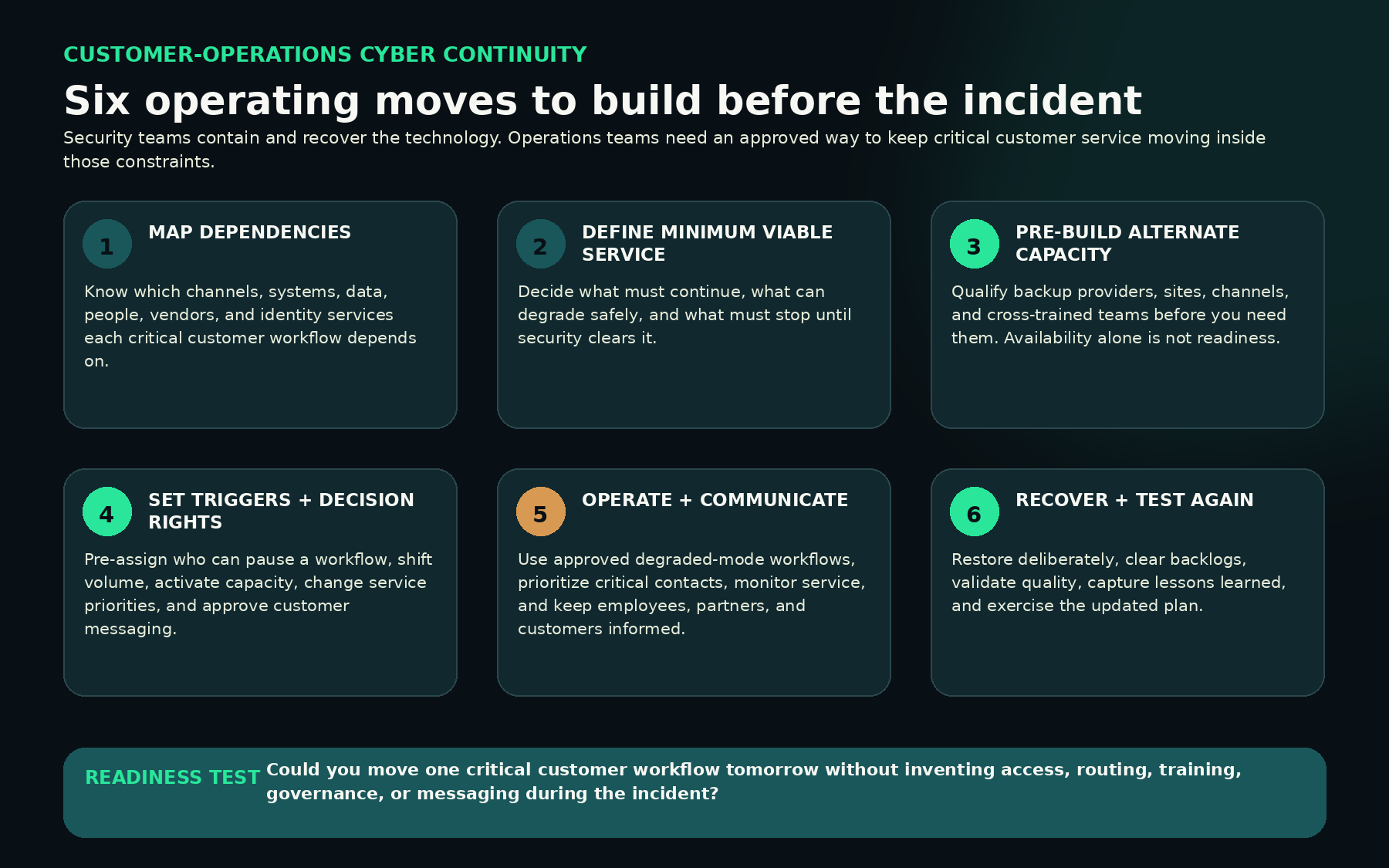
1. Map the customer workflows and dependencies that actually matter
Start with customer outcomes, not technology inventory. For each critical interaction, map the systems, identity services, data, knowledge, telephony or messaging channels, workforce groups, facilities, providers, and upstream business processes required to complete it. The useful question is not merely 'Is the CRM available?' It is 'Can we safely complete this customer outcome if the CRM, SSO, telephony platform, or one provider is unavailable?'
This dependency view is where hidden single points of failure usually appear. A company may have two contact-center sites but one identity system. Two BPOs may still rely on the same telephony tenant. An alternate channel may exist but depend on the same customer database. Redundancy only matters when the alternate path is independently usable enough to carry the work.
2. Define the minimum viable service and approved degraded-mode workflows
For each critical workflow, decide in advance what can continue under cyber constraints. Some interactions may be fully supported. Others may become read-only, capture-and-callback, status-only, or restricted to a narrow set of verified actions. High-risk activities may pause entirely until the security team clears them.
The important word is approved. A continuity plan should never encourage agents to improvise around controls with personal email, consumer messaging apps, uncontrolled spreadsheets, copied customer data, or ad hoc credentials. If a fallback workflow requires different tools or data, those tools and rules should be reviewed before the incident by security, privacy, legal, operations, and the relevant business owners.
3. Pre-build alternate capacity instead of sourcing it during the emergency
A backup provider, secondary site, internal reserve team, cross-trained workforce, or alternate channel can create real optionality, but only if it can activate under the incident conditions you care about. Capacity that has never been trained, provisioned, tested, or given an approved workflow is not response capacity. It is a phone number.
The right design may use one provider with genuinely independent sites, several providers, a blended internal and external model, or a temporary specialist workforce. The number of vendors is not the point. The point is having at least one credible alternate path that has been qualified, commercialized, trained, and operationally rehearsed enough to take real work.
4. Set activation triggers and decision rights before normal governance gets stressed
Cyber incidents create simultaneous technical, legal, operational, customer, and executive decisions. If every operating change has to climb a fresh approval chain, the organization can lose hours while demand compounds. Define who can activate alternate capacity, reroute contacts, pause a workflow, change service priorities, approve a customer script, move to a backup channel, or stand down the contingency model.
Security should retain authority over security boundaries and system access. Legal and privacy should retain their required roles. Customer operations should own service-continuity execution inside those guardrails. The handoffs should be explicit enough that nobody has to debate them while the incident is unfolding.
5. Treat communication as part of the operating capacity
During a cyber incident, communication demand often rises at the same time normal service capacity falls. Customers ask whether they are affected, whether a service is available, what they should do, and when normal operations will resume. Employees and partners need equally clear instructions about what is known, what is approved, and what must not be said.
CISA's current ransomware guidance calls for regular updates to leadership and relevant stakeholders and for coordinated public communications where appropriate. For customer operations, that translates into pre-approved message frameworks, a clear update cadence, a single source of truth, frontline escalation rules, and a mechanism for changing scripts quickly without creating contradictory answers across channels.
6. Recover deliberately, then test the revised plan
Recovery is not a switch flip. Restored systems need to be validated, access needs to be re-established safely, backlogs need to be triaged, temporary providers or channels need to be ramped down, and customers need consistent expectations while normal service is rebuilt. NIST's Cybersecurity Framework 2.0 explicitly treats recovery as a coordinated operating phase that includes restoration priorities, verification, and communication with internal and external stakeholders.
After the incident, capture what failed, what worked, and which assumptions were wrong. Then test the revised model. Tabletop exercises are useful, but the highest-value exercises force the operating system to make real decisions: the primary identity service is down, one BPO is inaccessible, the CRM is read-only, telephony still works, and customer demand has doubled. How long does it take to activate the backup path? What cannot be done? Who decides? Those are the gaps to close before the next event.
What good cyber-continuity readiness looks like in customer operations
- At least one approved way for customers to reach the company when the primary channel or platform is unavailable.
- A documented minimum viable service for critical customer outcomes, including which activities must pause under security constraints.
- Alternate capacity that has been trained, provisioned, and tested - not merely identified.
- Clear activation triggers, decision rights, and cross-functional handoffs among security, legal/privacy, communications, operations, and external providers.
- Pre-approved communication patterns for employees, partners, customers, and public updates, with one authoritative source of truth.
- A recovery plan that addresses backlog, staffing, quality, routing, customer follow-up, and return from contingency mode - not only system restoration.
- Exercises that validate the operating model under realistic loss-of-system, loss-of-provider, or loss-of-access conditions.
Where ArenaCX fits - and where it does not
ArenaCX is not a cybersecurity technology provider, incident-response forensics firm, managed security service provider, breach coach, or substitute for an organization's CISO, legal counsel, insurers, or regulators. Those disciplines should lead the security investigation, containment, evidence handling, legal analysis, and technical recovery.
ArenaCX's role is the customer-operations side of readiness: helping design and maintain response capacity before disruption, source and qualify backup delivery options, assemble multi-provider or multi-site structures when useful, coordinate launch and training, define operational activation and governance, and help orchestrate customer-response capacity when an incident creates a sudden operating gap. That is the logic behind Critical Response: customer response capacity ready before the event, so activation starts from readiness rather than from scratch.
The final test is simple
Pick one critical customer workflow and assume its primary system, primary provider, or normal workforce access disappears tomorrow. Could you move that work through an approved alternate path without inventing access, routing, training, governance, or customer messaging during the incident? If the answer is no, you do not yet have continuity. You have a plan to start building continuity after the disruption.
Cyber incidents are security events, but their consequences do not stay inside the security organization. The goal is not to make customer operations invulnerable. It is to make them ready: clear on what matters, disciplined about what can continue safely, and equipped with enough optionality to keep serving customers while the organization recovers.
These sources support the article's current cybersecurity-risk, incident-response, recovery, communications, and ransomware-readiness statements. The operating-model recommendations are ArenaCX editorial guidance.
Sources & References
- National Institute of Standards and Technology, February 26, 2024. NIST Cybersecurity Framework (CSF) 2.0Reference 1
- National Institute of Standards and Technology, April 2025. SP 800-61 Rev. 3: Incident Response Recommendations and Considerations for Cybersecurity Risk ManagementReference 2
- National Institute of Standards and Technology, June 11, 2026. NIST IR 8374r1: Ransomware Risk Management - A Cybersecurity Framework 2.0 Community ProfileReference 3
- Cybersecurity and Infrastructure Security Agency; joint guidance with MS-ISAC, NSA and FBI. #StopRansomware GuideReference 4
Related Resources
Resilience & Readiness
Taking a Punch: Improve Resiliency in Customer Service
Disruption will happen. The question is whether your customer-operations system can absorb the shock, reroute work, and keep serving customers.
Resilience & Readiness
Availability Is Not Readiness
A backup provider, alternate site, or reserve workforce can exist on paper and still be unable to take live customer work. Readiness begins when the dependencies are proven.
Resilience & Readiness
When an Incident Hits, Execution Should Start — Not Planning
The first minutes after disruption are the wrong time to begin sourcing capacity, negotiating terms, provisioning access, or deciding who is in charge. Good readiness moves that work upstream.
Resilience & Readiness
Customer Operations Resilience Readiness Check
Use this assessment to evaluate your current state, identify gaps, and strengthen your readiness for disruption in customer operations.