BPO Sourcing & RFP Management
Are Your Tickets Really Too Technical to Outsource?
Most teams that say their support is too technical to outsource are describing a real operating risk - but often not the one they think.

Executive summary
Technical support is often difficult, specialized, regulated, and full of tacit knowledge. None of those traits automatically makes outsourcing a bad idea. The better test is whether the work can be decomposed, taught through live knowledge, accessed safely, escalated cleanly, observed through meaningful measures, and improved through the work itself.
The objection is more common than the exception
"Our tickets are too technical to outsource." Variations on that sentence show up everywhere: too specialized, too regulated, too fast-changing, too dependent on tribal knowledge, too close to the product, or simply too important to trust to people outside the building. The concern is understandable because support is where product complexity, customer emotion, policy, systems, and brand promises collide.
But the sentence often bundles several different questions into one. Is the work genuinely non-delegable? Is it difficult but teachable? Is the knowledge undocumented? Are the systems and permissions badly designed for external access? Is the organization uncomfortable giving up direct control? Or has a prior outsourcing experience taught the team to equate "external" with "lower quality"? Those are different operating problems, and they deserve different answers.
This distinction matters because difficulty alone is a poor test for outsourcing. The international ISO 18295 contact-center standard applies to both in-house and outsourced customer contact centers, across sectors and interaction channels. The existence of an outsourced model does not make the work simple; it changes how capability, accountability, controls, training, and performance have to be designed.
Why smart teams say "too technical"
Teams usually arrive at this conclusion for good reasons. Their best internal agents have accumulated years of product context. They know the undocumented exception, the workaround after a certain release, which engineer to ask, what a particular customer really means, and when the official troubleshooting tree is wrong. Leaders see that expertise and reasonably worry that a new team will not be able to reproduce it.
Technical support also carries asymmetric consequences. A routine answer that is wrong may create rework; a wrong answer involving account access, payments, health information, security, or production systems can create far more serious harm. When risk is high, leaders often respond by pulling the work closer to the core. That instinct can be healthy. The mistake is assuming that "keep it internal" is itself a control.
Internal teams can be undocumented, over-permissioned, inconsistently trained, and dependent on a handful of experts too. Outsourcing does not create those weaknesses so much as expose them. Externalizing work forces the organization to decide what the correct answer is, who is allowed to do what, how exceptions are escalated, and how quality will be observed. That can feel like an outsourcing burden when it is actually an operating-model maturity test.
Regulated does not automatically mean internal
Regulation is one of the most legitimate reasons to slow down, but it is not usually a universal prohibition on third-party work. The relevant question is what the regulation requires of the company and its service providers. Under HIPAA, for example, covered entities may use business associates for functions involving protected health information when the required assurances and agreements are in place, and business associates have direct obligations under portions of the HIPAA Rules. In securities, FINRA likewise reminds member firms that outsourcing certain functions does not remove the firm's supervisory responsibility for the outsourced activity.
The operating implication is important: responsibility can stay with the buyer even when execution moves to a provider. That means sourcing for regulated or sensitive work has to include controls that ordinary volume staffing might not need - due diligence, contractual obligations, training, role-based access, monitoring, auditability, escalation rules, business continuity, and clear ownership. In some cases, licensing or legal restrictions may still make particular tasks unsuitable for outsourcing. But "regulated" should begin a requirements analysis, not end it.
The better question: is the work externalizable?
Instead of asking whether the tickets are technical, ask whether the work can be externalized without losing control of the outcome. That turns an emotional yes-or-no debate into a design problem. A technically difficult queue can be a strong outsourcing candidate when the knowledge is accessible, permissions are controlled, exceptions are bounded, and performance is visible; a supposedly simple queue can be a bad candidate when none of those things are true.
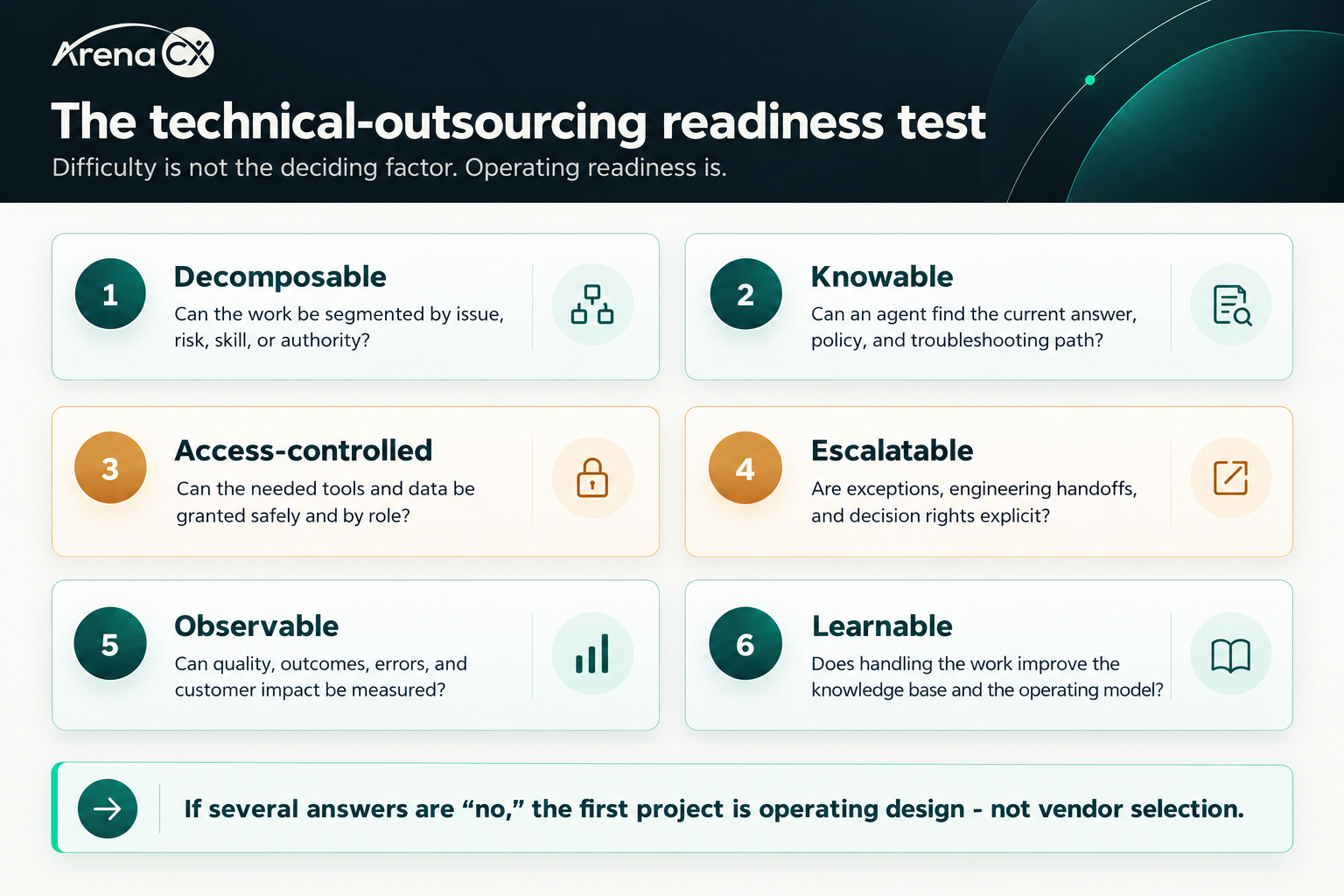
A useful readiness test has six parts. Can the work be decomposed into sensible issue, risk, skill, or authority levels? Can an agent find the current knowledge needed to solve the issue? Can the required systems and data be granted with appropriate role-based controls? Are exception paths and decision rights explicit? Can quality and customer outcomes be observed? And does the operating model learn from the work instead of forcing the same discoveries to happen repeatedly?
If several of those answers are "no," the first project is probably not vendor selection. It is operating design. The encouraging part is that the same work makes the internal team stronger, too.
Knowledge is usually the hinge
Most "too technical" objections become knowledge problems on inspection. The expertise exists, but it lives in people rather than in the workflow. That is fragile whether the people sit inside the company or at a partner. A durable technical-support model makes the best available answer easy to find, gives people a controlled way to improve it, and captures new knowledge as part of resolving real cases.
That is one reason Knowledge-Centered Service remains useful. The Consortium for Service Innovation describes the KCS Solve Loop around reusing, improving, capturing, and structuring knowledge in the workflow. The point is not to create a giant static manual before outsourcing begins. It is to make knowledge creation and maintenance part of the operating system so the documentation gets better because work is being done.
This also changes how teams should think about training. Technical programs do need structured onboarding, but the goal is not memorization. Strong programs teach product fundamentals, troubleshooting logic, information sources, security and compliance boundaries, customer communication, and escalation judgment. They then certify agents on representative scenarios, provide supported nesting, calibrate quality, and keep the training system connected to what the queue is actually teaching.
Access should be designed, not feared
"They would need access to our systems" is another common reason technical work stays internal. Sometimes that is decisive. More often it means the access model has not been designed for the role. NIST defines least privilege as limiting users or processes to the minimum system resources and authorizations needed to perform assigned tasks. That principle applies whether the user is an employee or a contractor.
A mature technical-support program separates support access from engineering or administrative privilege wherever practical. It uses named accounts, appropriate authentication, role-based permissions, logging, environment separation, and rapid offboarding. Sensitive actions may stay with an internal escalation team even when diagnosis and customer communication are handled externally. This is not a workaround for security; it is security architecture applied to the operating model.
Build an escalation system, not an illusion of universal expertise
No support organization - internal or external - should expect every agent to solve every problem. World-class technical support is tiered because the work itself is tiered. The design goal is to put as much work as possible at the lowest level of expertise that can handle it correctly while creating fast, reliable paths to higher expertise when necessary.
That means defining the boundary between routine, advanced, and truly exceptional work. A partner may handle broad Tier 1 and Tier 2 diagnosis, reproduce defects, collect logs, execute approved fixes, explain product behavior, and maintain customer communication while an internal engineering or specialist team owns code changes, privileged actions, root-cause analysis, or policy exceptions. The exact boundary differs by company. What matters is that it is explicit, trainable, measurable, and fast.
Technical outsourcing fails when escalation is treated as evidence the provider is weak. Escalation is part of the architecture. The right question is whether the agent recognized the boundary, gathered the right evidence, routed the case correctly, preserved the customer context, and enabled the specialist to act without starting over.
Start narrow, then earn scope
Companies do not need to move their hardest cases on day one. In fact, a bounded launch is often the better test. Segment a portfolio where the work is representative but the risk is manageable, establish a baseline, train and certify the provider, and compare outcomes using the measures that actually matter: resolution quality, customer experience, rework, escalation accuracy, compliance, cycle time, and knowledge contribution.
If the provider performs, expand the scope deliberately. Add product families, issue types, channels, languages, hours, or higher-complexity tiers as evidence accumulates. If performance breaks at a particular boundary, learn from it before increasing exposure. This is a more useful model than making a one-time philosophical decision that “we outsource” or “we do not outsource.”
The same principle applies to brand representation. Brand is not transferred through osmosis because someone is on payroll. It is transferred through hiring profiles, training, examples, knowledge, coaching, decision rights, QA, calibration, incentives, and leadership attention. External agents can fail at that; internal agents can fail at it too. The operating system is what makes the behavior repeatable.
AI makes the boundary more interesting - not less important
AI is changing technical support quickly. It can make product knowledge easier to retrieve, summarize long histories, recommend troubleshooting steps, translate complex material, classify issues, draft responses, and help agents navigate large bodies of documentation. Those capabilities can reduce the amount of information any individual agent has to memorize and can make expertise more portable across teams.
But AI does not make the sourcing decision disappear. Somebody still has to own the knowledge, decide what the model may see, control system permissions, define escalation boundaries, validate outputs, measure quality, and respond when the technology is wrong or unavailable. In practice, AI can make externalization easier while increasing the importance of governance. The future operating model is likely to be less about where every answer is stored in a person's head and more about how people, knowledge, automation, and decision rights are assembled around the work.
When “too technical” is actually true
Some work really should remain internal, at least for now. That may be because a law, license, contract, customer commitment, security boundary, or data restriction prevents delegation; because the work requires privileged engineering access that should not be broadened; because the product changes faster than the organization can maintain a safe operating model; or because the volume and specialization make a dedicated external capability uneconomic.
There is also a transitional category: work that is theoretically outsourceable but not yet ready. If nobody can define the correct process, the knowledge base is badly stale, access cannot be segmented safely, exceptions depend on personal relationships, and quality cannot be measured, outsourcing will amplify confusion. Fix those things first. The objective is not to prove that every ticket belongs outside the company. It is to make a deliberate choice based on the work rather than on a reflexive belief about where expertise can live.
The real advantage is not cheaper labor. It is a stronger operating system.
The best outcome from technical outsourcing is not simply moving people from one payroll to another. It is creating a support system that can recruit for the right skills, transfer knowledge faster, add capacity when needed, extend coverage, introduce specialized expertise, and hold performance to explicit standards while the company keeps control of the customer outcome.
So the next time someone says, “our tickets are way too technical to outsource,” take the concern seriously - and then unpack it. Which part is truly non-delegable? Which part is undocumented? Which part is a security design problem? Which part needs a stronger escalation path? Which part simply has never been tested with a capable partner? Most companies discover that the answer is not all-or-nothing. Their support may be complex. That does not mean the only people capable of mastering it already work there.
External sources are included to establish that outsourced contact-center work can be governed under formal operating, regulatory, knowledge, and access-control frameworks. They do not imply that any specific regulated activity is outsourceable without its own legal/compliance review.
Editor's note
This article is a substantive ArenaCX modernization of an earlier ArenaCX discussion of the same question, originally written by Amanda Malach Quinn. The current version preserves the useful core objection while replacing dated examples, third-party quotation dependence, historical customer proof, and obsolete ArenaCX product mechanics with a current operating framework.
Sources & References
- International Organization for Standardization. ISO 18295-1:2017 - Customer contact centres - Part 1 — Applies to both in-house and outsourced customer contact centres across sectors and channels; currently published and under revision.Reference 1
- International Organization for Standardization. ISO 18295-2:2017 - Requirements for clients using customer contact centres — Addresses organizations using customer-contact-centre services; currently published and under revision.Reference 2
- U.S. Department of Health and Human Services. Business Associates — Explains use of business associates and required safeguards/agreements under HIPAA.Reference 3
- FINRA. Regulatory Notice 21-29 - Vendor Management and Outsourcing — Outsourcing covered activities does not remove member firms' supervisory obligations.Reference 4
- Consortium for Service Innovation. KCS Solve Loop — Describes reuse, improve, capture, and structure as knowledge-in-workflow practices.Reference 5
- National Institute of Standards and Technology. Least Privilege glossary — Defines limiting resources and authorizations to those needed for assigned tasks.Reference 6
Related Resources
BPO Sourcing & RFP Management
How to Select the Right Contact Center Partner
The right BPO is not the company with the best pitch. It is the provider whose operating model fits your work, clears your risk constraints, can prove the fit with evidence, and can keep adapting as demand, technology, and AI change the job.
BPO Sourcing & RFP Management
BPO Sourcing Is Not Vendor Shopping
The real job is not to gather familiar provider names. It is to define the operating requirement, create a meaningful option set, expose the tradeoffs, and choose a structure that can adapt as the business changes.
BPO Sourcing & RFP Management
It’s Time to Level Up With Outsourcing
Outsourcing is no longer just a labor-cost decision. Done well, it is a way to add capability, optionality, operating discipline, and resilience without building everything yourself.