BPO Sourcing & RFP Management
Integrating Your Outsourced Team: From Contract Signature to Stable Production
The contract may be signed and the people may be hired. That does not mean the operation is ready. A BPO launch works when knowledge, access, training, workforce, quality, and decision rights all arrive at the same place at the same time.

One of the stranger things about outsourcing is how much attention we pay to selecting a provider and how quickly everyone wants to declare victory after the statement of work is signed. Procurement has a finish line. Customers do not. From their point of view, the transition is successful only when the new team can take real work, make good decisions, recover from exceptions, and do it again tomorrow.
Technically, a provider can have agents hired, a training calendar completed, and a go-live date on the project plan. Practically, if those agents are missing permissions, current knowledge, queue routing, calibrated quality standards, or a clear escalation owner, you do not have a launch. You have an expensive rehearsal.
The handoff is really an operating-system transfer
When a company outsources customer operations, it is not merely transferring a list of tasks. It is transferring part of an operating system: what good looks like, how work enters the system, who can make which decisions, what happens when the normal path fails, how capacity is planned, how quality is judged, and how changes get communicated. The people matter enormously, but the system around the people determines whether they can actually perform.
That is why I think integration is a better frame than onboarding. Onboarding sounds like something you do to people. Integration forces you to ask whether the processes, tools, information, management layers, and decision rights connect well enough for the work to flow. COPC's Customer Experience Standard uses a similarly broad management frame across leadership and planning, processes, people, and performance. A launch that trains the people while ignoring the other three is incomplete.
The legacy ArenaCX article behind this piece got an important point right: outsourced agents perform better when they are connected to the brand and the internal team instead of being treated like a vendor in another universe. I would keep that principle, but add an operating boundary. Give the outsourced team the context, communication, access, recognition, and feedback they need. At the same time, manage the BPO through its supervisors and leaders rather than quietly turning the provider's employees into an unmanaged extension of your org chart.
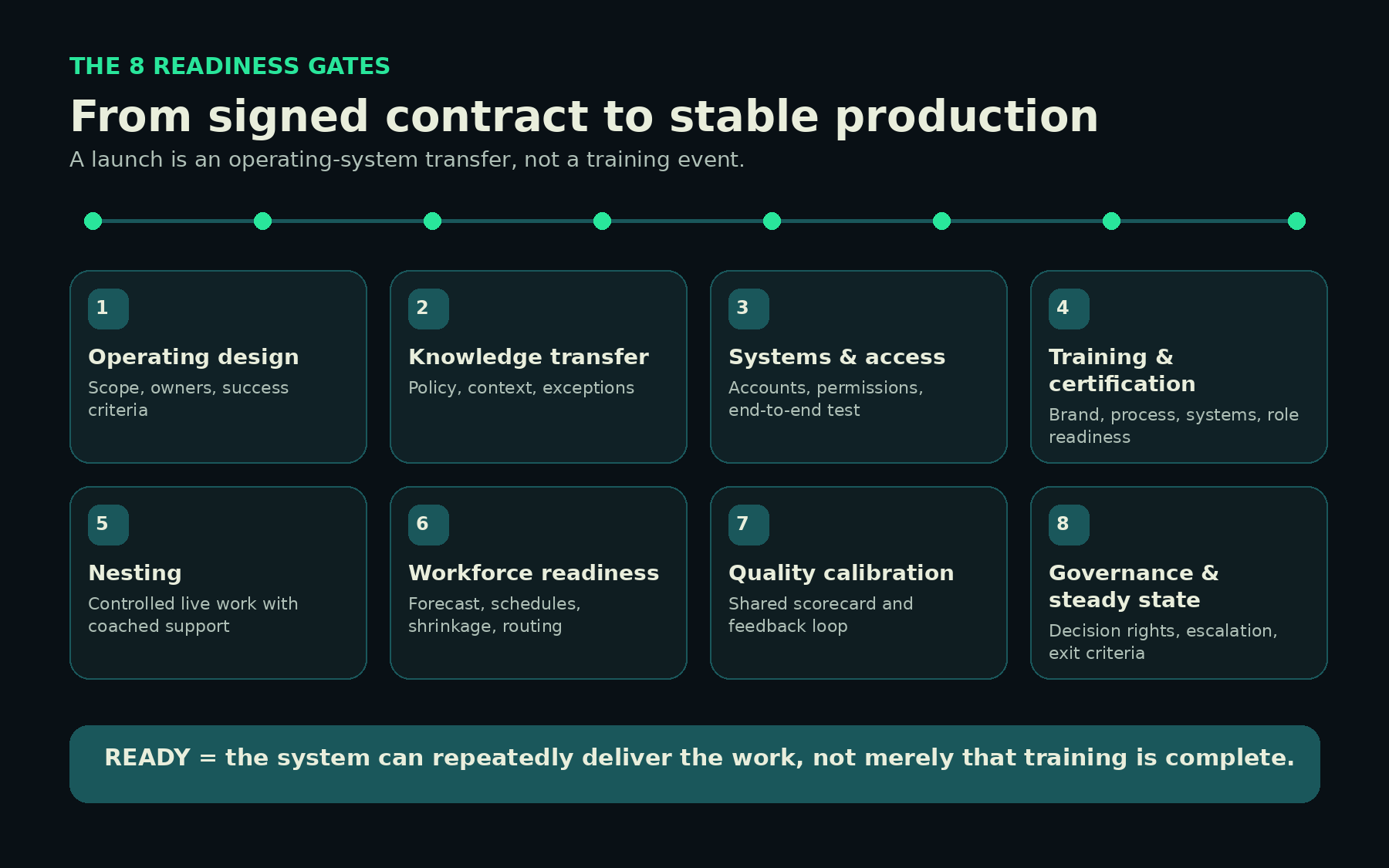
1. Operating design: agree on what ready means
Before knowledge transfer starts, define the operating model in plain English. Which queues and work types are moving? Which channels are included? What hours and service commitments apply? Which decisions can agents make, which require a supervisor, and which must come back to the client? Who owns routing, workforce planning, quality, knowledge, and change control? A surprising amount of launch pain is simply two organizations using the word ready to mean different things.
I like to make the launch criteria explicit before anyone starts counting training completions. The buyer and provider should be able to point to the same set of operational acceptance conditions and say what evidence will demonstrate readiness. The goal is not to create a 90-page governance binder. It is to remove ambiguity before the ambiguity becomes production work.
2. Knowledge transfer: move context, not just documents
Most knowledge-transfer plans are very good at moving files. That is not the same thing as moving knowledge. A policy deck can tell an agent what the normal rule is; it rarely tells them why the rule exists, which exceptions matter, how competing policies are prioritized, or what to do when the customer presents a situation nobody put in the training example.
The most useful transfer therefore has several layers. You need the current source of truth for policy and process, real examples of the work, known exceptions and failure modes, product and customer context, and a clear mechanism for asking questions that the documentation does not answer. Just as important, somebody must own keeping that material current after launch. A perfect knowledge base on day one can be dangerously wrong by day sixty if nobody owns the change process.
3. Systems and access: make the real work possible
Access is one of those launch tasks that looks administrative until it is late. Then it becomes the launch. Create role-based access requirements early, provision named identities, test authentication and device constraints, validate every critical system from the provider environment, and run at least one end-to-end transaction before production. If an agent needs three systems to resolve a case, testing two of them is not 67 percent ready. It is not ready.
The pressure to hit a date can also create the wrong security response: give broad access now and clean it up later. That trades a schedule problem for a control problem. NIST SP 800-207's zero-trust guidance emphasizes granular, least-privilege access rather than broad implicit trust. That is a useful launch principle even if you are not implementing a formal zero-trust program: give each role the access it actually needs, verify it works, and make exceptions deliberate rather than accidental.
4. Training and certification: prove readiness, not attendance
Training should answer a different question than, Did the agent sit through the class? The useful question is, Can this person perform the work under realistic conditions? That means training has to connect brand and customer context with policy, systems, communication skills, security requirements, and the actual decision paths agents will use in production.
The buyer should be visibly involved, especially with the first cohort. Internal subject-matter experts can explain the customer context and edge cases that a provider trainer cannot infer from a document. But the long-run model cannot depend on the buyer personally teaching every new-hire class. Provider trainers, supervisors, QA staff, and workforce leaders need enough understanding to operate the program after launch, and certification criteria should be clear enough that both organizations recognize the same definition of ready.
5. Nesting: use live work as a controlled learning system
Nesting is not the ceremonial week between training and production. It is controlled production. Start with an intentional mix of work, manage concurrency and risk, keep experienced support close, and make it easy for agents to escalate uncertainty before uncertainty becomes a customer problem. The ramp should expand because observed performance supports expansion, not simply because the calendar says week two is over.
The most valuable thing about nesting is the speed of the feedback loop. When something goes wrong, classify the reason. Was it a knowledge gap, a training gap, a permissions problem, a routing defect, a policy ambiguity, a product issue, or an individual performance problem? If every miss becomes agent coaching, the system learns nothing and the same failure keeps reappearing with different agents.
6. Workforce readiness: connect the forecast to the actual queue
You can launch with excellent people and still fail customers if those people are not available when the work arrives. Translate the demand forecast into interval-level staffing assumptions, schedules, shrinkage, training time, meetings, channel concurrency, and routing rules. Then test the operational handoffs around the schedule: who sees an intra-day miss, who can move capacity, what happens when a channel spikes, and when does the provider escalate a forecast assumption that no longer looks credible?
This is where the outsourcing relationship stops being a staffing transaction and becomes a managed service. Deloitte's 2025 Global Business Services Survey identifies effective governance and digital technologies as important elements in realizing value from service-delivery models. That is the same operating point in a different vocabulary: the roster of people is only one component. The control system around the roster is what turns labor into reliable service.
7. Quality calibration: make sure the score means the same thing
A quality scorecard is useful only if the people using it are measuring the same thing. Before go-live, have internal QA, provider QA, and subject-matter experts independently score a common set of production-like interactions. Compare the results, discuss the disagreements, tighten ambiguous criteria, and repeat until the variance is understandable. If one side thinks an interaction is excellent and the other thinks it is a failure, the problem is not the decimal point in the score. It is the operating definition underneath it.
Calibration should continue after launch because products, policies, channels, and customer behavior change. The QA process also needs an appeal path and a way to convert repeated findings into knowledge or training changes. Otherwise quality becomes a grading system instead of a learning system.
8. Governance and steady state: know when the launch is actually over
The launch room should not become the permanent operating model. Before the implementation team disperses, define the ongoing cadence: intra-day operations, weekly performance, monthly business review, issue ownership, change control, escalation severity, decision rights, and the path for unresolved problems. The important question is not how many meetings you schedule. It is whether every recurring decision has an owner and whether the people closest to the problem know how to get a decision quickly.
Stable production should also have explicit exit criteria. Depending on the program, that may include sustained service and quality performance, reliable access, a functioning forecast and scheduling cadence, a controlled knowledge-change process, provider leadership owning normal coaching and performance management, and an escalation mechanism that works without heroic intervention from the launch team. When those conditions are true, the transition has become an operation.
Manage the BPO, not every individual agent
There is a subtle trap in the phrase extension of your team. The phrase is useful because outsourced people should receive the context, information, respect, and customer connection they need to represent the brand well. It becomes less useful if it convinces the buyer to bypass the BPO's management layer and directly supervise every agent.
You hired a BPO partly because it has operating capabilities you do not want to recreate: supervisors, workforce management, recruiting, coaching, QA, scheduling, and performance management. Use them. The client should own the outcomes, customer promises, policy, product context, and the governance of the relationship. The provider should manage its people and day-to-day delivery inside those guardrails. When those responsibilities blur, accountability usually blurs with them.
What I would watch in the first weeks
Early production data is useful because it tells you where the system is still fragile. I would not bury the team under a launch dashboard with fifty measures. I would watch a small set of signals that reveal whether the operating model is becoming self-sustaining:
- Certification failures and retest reasons - what agents are consistently not ready to do.
- Access and tooling defects - where the work is blocked before an agent can even attempt it.
- Quality findings by work type - especially repeat errors that point to a system issue rather than an isolated miss.
- Escalations and recontacts - where the first operating path is not resolving the customer's need.
- Forecast, schedule, and routing misses - where demand and capacity are not meeting as designed.
- Knowledge defects and change latency - how quickly the operation incorporates new product, policy, and issue information.
- Open issue aging and ownership - whether problems have accountable owners or simply remain on a launch tracker.
The better question
After a contract is signed, the easiest question to ask is whether the provider is ready. The better question is whether the system is ready. Can work move to the new team without heroics? Can agents get the information and access they need? Can both sides recognize quality the same way? Can the provider respond when volume changes? Can a frontline question reach the right decision-maker before it becomes a backlog?
If the answer is yes, you have integrated an outsourced team. If the answer is no, the go-live date is just a date. The work after selection is not administrative cleanup. It is the part that converts a sourcing decision into an operating outcome.
Sources & References
- COPC Inc.. COPC Customer Experience Standard — CX operations framework spanning leadership/planning, processes, people, and performance.Reference 1
- National Institute of Standards and Technology. NIST SP 800-207, Zero Trust Architecture — Primary source for least-privilege, granular access-control principles cited in the systems/access section.Reference 2
- Deloitte. 2025 Global Business Services Survey — Current professional research on service-delivery models; supports the governance/digital-capability point.Reference 3
Related Resources
BPO Sourcing & RFP Management
The Cheapest BPO Is Rarely the Cheapest BPO
Hourly rate is one input. The real decision is total cost per successful outcome.
BPO Sourcing & RFP Management
How to Select the Right Contact Center Partner
The right BPO is not the company with the best pitch. It is the provider whose operating model fits your work, clears your risk constraints, can prove the fit with evidence, and can keep adapting as demand, technology, and AI change the job.
BPO Sourcing & RFP Management
BPO Sourcing Is Not Vendor Shopping
The real job is not to gather familiar provider names. It is to define the operating requirement, create a meaningful option set, expose the tradeoffs, and choose a structure that can adapt as the business changes.