Resilience & Readiness
Planning for Uncertainty: Use the T.E.A.M. Approach to Make Your Customer Service Operations Resilient
A practical way to map customer-operations dependencies, prioritize the risks that matter, choose a response, and turn the choice into tested readiness.

What resilience actually means
I first built the T.E.A.M. framework in 2020, when customer-service leaders were being handed a master class in uncertainty. The pandemic made the point dramatically, but the underlying problem was never specific to a pandemic. Customer operations has always lived inside a system that can be disrupted by demand spikes, outages, cyber events, talent shortages, provider failures, policy changes, product launches, new channels, and strategic pivots. The names of the shocks change. The design problem does not.
The wrong objective is to predict every bad thing that might happen. You cannot. The better objective is to build an operating system that can absorb change without forcing people to invent the response from scratch. I think of resilience as the ability of customer operations to keep delivering an acceptable customer outcome while the conditions around the work change - and then to recover deliberately rather than heroically.
That definition is broader than disaster recovery. It includes classic continuity questions, but it also includes the everyday shocks that can make a service organization brittle: a sudden campaign that doubles demand, a technology dependency that goes dark, a provider that loses capacity, a regulatory change that makes a workflow unusable, or a business strategy that suddenly changes which customers and outcomes matter most. Resilience is the operating property that lets the network respond, adapt, and continue serving customers when reality stops cooperating with the plan.
A supply-chain way to think about customer operations
My own instinct here comes from supply chains. I spent part of my career in international trade and logistics, and later received APICS training that included supply-chain resilience. One of the enduring lessons is that the visible transaction is only the last step in a much larger system of suppliers, inputs, constraints, handoffs, information, and capacity. Customer operations works the same way.
A support interaction may look like one agent and one customer, but that moment depends on a network: demand forecasts, recruiting, training, knowledge, authentication, telecom, software, data, workforce management, supervisors, third-party providers, payment and commercial arrangements, escalation paths, and decision rights. When we map only the queue, we miss the system that makes the queue possible.
That is why the first version of this guide borrowed a process-mapping lens. The idea still holds. If you want to manage operational risk, first make the operating system visible enough that you can see what might fail, what depends on what, and where there is only one practical path from demand to capacity.
The T.E.A.M. method
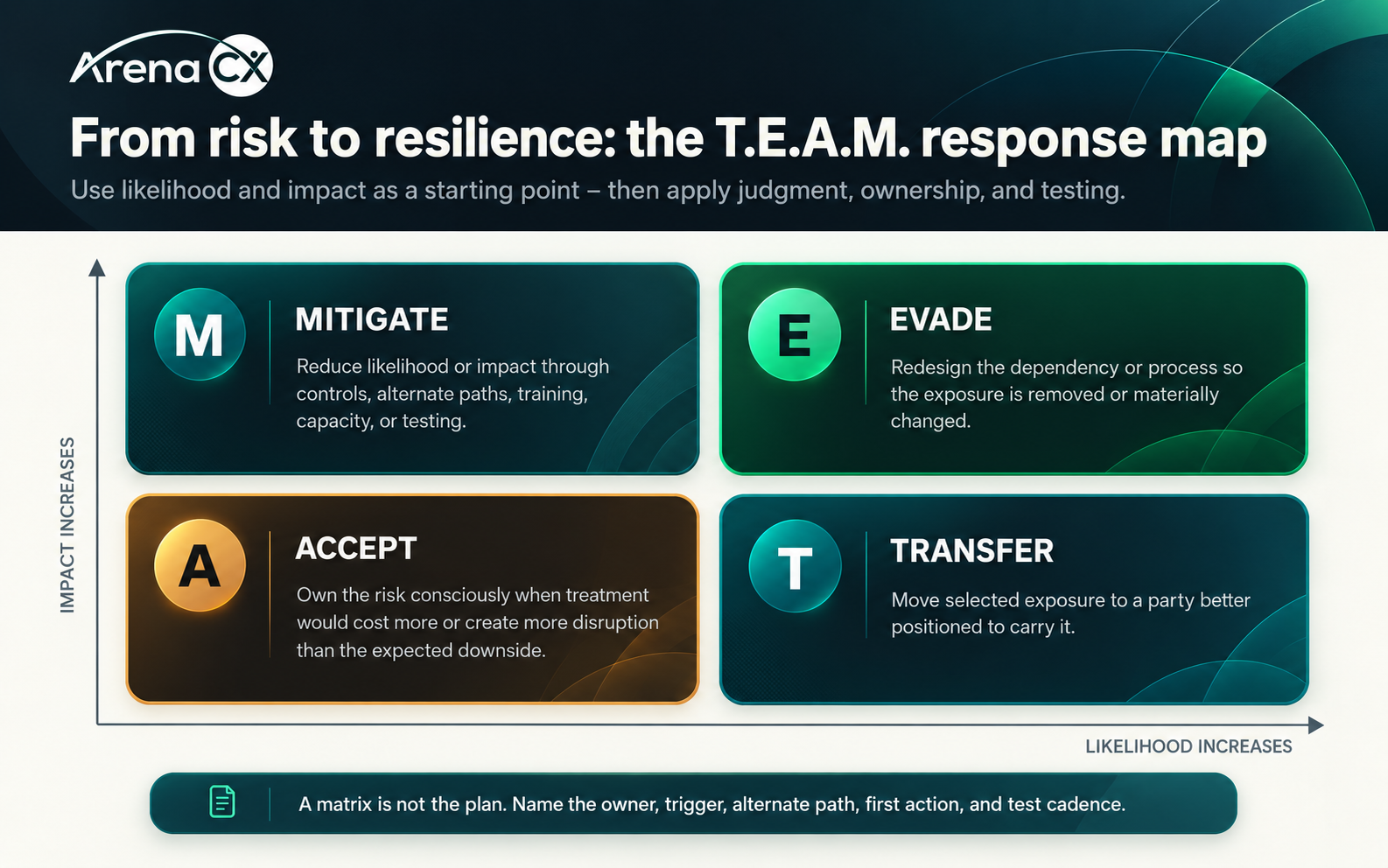
T.E.A.M. is a simple way to move from a vague fear of disruption to an explicit operating choice. The acronym describes four risk responses - Transfer, Evade, Accept, and Mitigate - but choosing the response is only one step. In practice, I use a five-step workflow: map the system, identify the risks, assess what deserves attention, choose the T.E.A.M. response, and turn the response into an owned and tested plan.
The method is intentionally practical. It is not an enterprise-risk taxonomy, and a two-by-two matrix will never capture every nuance of probability, velocity, regulatory exposure, customer harm, or correlated failure. The point is to create enough structure to make the right risks discussable and to force an explicit decision about what the organization intends to do.
- Map the customer-operations system and its dependencies.
- Identify the risks that could materially impair customer outcomes.
- Assess enough to prioritize what deserves attention.
- Choose a T.E.A.M. response: Transfer, Evade, Accept, or Mitigate.
- Turn the choice into an owned plan and test it before the incident.
1. Map the customer-operations system
Start with a whiteboard, not a disaster scenario. Map the major components and dependencies that keep service moving. At a high level, you can borrow the logic of SIPOC - suppliers, inputs, process, outputs, and customers - without turning the exercise into a six-month process-engineering project.
Include the pieces that sit before and around the interaction itself. Who supplies capacity? Which internal teams, BPOs, specialists, contractors, or technology services are required? What inputs have to exist before work can be performed - people, training, credentials, knowledge, forecasts, data, systems access, commercial terms? How does work enter, get triaged, routed, solved, escalated, quality-checked, and measured? What outcomes are customers and the business actually depending on?
The important question is not whether the diagram is elegant. It is whether it reveals dependencies. A workflow that appears redundant may still share one identity provider, one carrier, one knowledge source, one approval path, or one specialized team. Two logos do not necessarily create two failure domains.
2. Identify the risks
Once the system is visible, walk it with the people who actually operate it. Ask what could impair each component, what upstream failure would starve it, and what downstream consequence would matter. This is where operators, BPO partners, IT, security, legal, product, finance, and workforce leaders often see different parts of the same risk.
Useful categories include people and capacity, third-party providers, technology and data, facilities and geography, process and knowledge, external or regulatory dependencies, demand volatility, and strategic change. The categories are prompts, not boxes. A ransomware event, for example, may simultaneously remove technology, location, access, and capacity. A product launch may look like a demand risk until it exposes a training and knowledge dependency.
Current risk frameworks make a similar point at a broader level. NIST's Cybersecurity Framework 2.0 emphasizes governance, identification, response, and recovery as connected parts of risk management, while NIST's supply-chain guidance stresses the visibility problem created by dependencies outside the enterprise. Customer operations should borrow that discipline without pretending every operational risk is a cyber risk.
3. Assess enough to prioritize
Risk lists grow quickly. If every item is urgent, nothing is prioritized. A simple starting point is to rate likelihood and impact on a consistent scale - for example 1 to 5 - and use the combined view to decide what deserves leadership attention first.
Do not confuse a score with precision. The purpose is not to prove that one risk is mathematically a 16 and another is a 15. The purpose is to expose differences in judgment and focus the conversation. When it matters, add a third dimension such as velocity, detectability, customer harm, regulatory consequence, or current readiness. The worksheet accompanying this guide keeps the first pass intentionally simple and leaves room for notes where the context matters more than the number.
The most useful question at this stage is often: if this happens, how much of the customer promise disappears, and how quickly would we know? That forces the conversation toward the operating outcome rather than toward abstract fear.
4. Choose a T.E.A.M. response
Once a risk is important enough to manage, choose what you intend to do about it. The four T.E.A.M. responses are deliberately plain-English operating choices.
Transfer
Transfer means moving selected financial or operating exposure to another party that is better positioned to carry it. Insurance is the obvious example, but customer operations also transfers responsibilities through managed services, outsourcing, contractual protections, specialist partners, and other commercial arrangements. Transfer does not transfer accountability for the customer outcome. It changes who is carrying a defined part of the risk and under what terms.
Evade
Evade means changing the design so the exposure no longer exists in the same form. Sometimes the best resilience investment is not a backup plan; it is removing a brittle dependency. That might mean retiring a single-purpose workflow, avoiding a geography or technology concentration that no longer fits the risk profile, simplifying an over-specialized queue, or redesigning a launch plan so one team is not the only team capable of serving a critical interaction. The word is a little unusual, but the concept is useful: if the risk is both consequential and sufficiently likely, ask whether you should stop accepting the architecture that creates it.
Accept
Accept means owning the risk consciously. Some risks are small, remote, expensive to eliminate, or simply part of doing business. The mistake is not accepting them; the mistake is accepting them accidentally. A documented acceptance should identify the owner, the rationale, the signal that would cause the decision to be revisited, and what happens if the risk materializes.
Mitigate
Mitigate means reducing the likelihood or the impact. In customer operations, this is where much of the practical resilience work happens: cross-training, alternate sites, diversified providers, pre-positioned surge capacity, redundant connectivity, improved knowledge, security controls, tested routing, alternate channels, stronger forecasting, and decision rules that let work move when conditions change.
Mitigation is also where 'availability' is most easily confused with 'readiness.' A provider on a sourcing list is not backup capacity. A second site without current training and credentials is not backup capacity. A workflow that can theoretically be routed elsewhere is not a failover path until the people, systems, data, permissions, commercial terms, and governance have been prepared and tested. Events consume readiness. They do not create it.
5. Turn the response into an operating plan
A risk response becomes real only when somebody can execute it. For each important risk, name the owner, the trigger, the first action, the alternate path, the required access and dependencies, the communication path, the customer promise you are protecting, and the measure that tells you the response worked.
Then test it. Business-continuity practice has long emphasized exercising plans, and CISA's continuity and tabletop resources make the same operational point: plans improve when organizations practice roles, decisions, recovery actions, and handoffs before an incident. Start with a tabletop if that is what the organization can support. Progress toward partial failover or controlled live tests where the risk and customer impact allow it.
The test does not need to be dramatic to be valuable. Move a small amount of work through an alternate queue. Confirm backup credentials. Exercise an escalation tree. Ask a secondary team to solve a representative case. Verify that a manager actually has the authority to activate the response. Measure time to detect, decide, redirect, and stabilize. Small tests often reveal the same weaknesses that would become expensive during a real disruption.
AI belongs in the map - on both sides of the equation
AI makes this framework more useful, not less. It can help summarize incidents, detect patterns, model demand, surface dependencies, draft response options, accelerate knowledge work, and support faster decisions. It can also create new dependencies: model availability, data access, integration points, policy controls, human review, vendor concentration, and failure modes that did not exist in the old operating model.
The sensible posture is neither 'AI will make us resilient' nor 'AI is another thing to fear.' Put it on the map. Decide what work it can absorb, what failure would mean, what human judgment must remain available, and what alternate path exists if the technology is unavailable or wrong. Software can make the operating system around people more adaptive. It cannot create contractual readiness, trained capacity, decision rights, or trust after the incident has already started.
Resilience is a management system, not a binder
ISO 22301 describes business continuity as a management system that is implemented, maintained, reviewed, and continually improved. That framing matters because customer-operations resilience is not a one-time continuity document. The dependencies change. Providers change. People leave. Systems are replaced. Demand moves. AI changes workflows. A response plan that was credible eighteen months ago can quietly become fiction.
Revisit the map when the operating model changes materially, and revisit the highest-priority risks on a regular cadence. Use incidents and exercises as data. If the organization discovers that a supposedly independent backup shares the same failure mode, update the design. If a mitigation becomes cheaper or more reliable, reconsider an accepted risk. If a previously low-impact dependency becomes essential, move it up the list.
The point of T.E.A.M. is not to make uncertainty disappear. It is to make uncertainty manageable enough that people can act with judgment instead of improvising under pressure. You do not need to predict the next punch. You need to understand the system, choose which risks deserve action, prepare the response, and keep enough optionality that customer service can continue when the plan meets reality.
Download the worksheet
Use the T.E.A.M. Risk Planning Worksheet to map dependencies, build a prioritized risk register, choose a response, assign owners, and create a practical test cadence. Primary and only format: fillable ArenaCX-branded PDF.
Sources & References
- National Institute of Standards and Technology, Published February 26, 2024. NIST Cybersecurity Framework (CSF) 2.0 — Used for the general concept of integrated governance, identification, response, and recovery; not as an endorsement of T.E.A.M.Reference 1
- National Institute of Standards and Technology, Updated November 1, 2024. NIST SP 800-161 Rev. 1, Update 1 — Used for the importance of identifying, assessing, and mitigating supply-chain dependencies and risk.Reference 2
- International Organization for Standardization. ISO 22301:2019 — Current published international business-continuity-management standard; used for the management-system / continual-improvement framing. A newer edition is under development as of 2026, so do not represent the committee draft as the current published standard.Reference 3
- Cybersecurity and Infrastructure Security Agency. CISA Tabletop Exercise Package documentation — Used for the practical value of planned exercises, defined roles, after-action review, and updates to recovery plans.Reference 4
- Cybersecurity and Infrastructure Security Agency. CISA CRR Supplemental Resource Guide - Service Continuity — Used for the progression from tabletop exercises to partial and full recovery testing.Reference 5
Related Resources
Resilience & Readiness
Taking a Punch: Improve Resiliency in Customer Service
Disruption will happen. The question is whether your customer-operations system can absorb the shock, reroute work, and keep serving customers.
Resilience & Readiness
Availability Is Not Readiness
A backup provider, alternate site, or reserve workforce can exist on paper and still be unable to take live customer work. Readiness begins when the dependencies are proven.
Resilience & Readiness
Customer Operations Resilience Readiness Check
Use this assessment to evaluate your current state, identify gaps, and strengthen your readiness for disruption in customer operations.
Network Design & Orchestration
Designing a Customer-Operations Network for Optionality
Optionality is not the same as having more vendors. It is the ability to move work, capacity, or capability to another credible path without rebuilding the operating model when conditions change.