Seasonal & Surge Operations
The Customer-Operations Capacity Playbook
A practical operating guide to forecast demand, design elastic capacity, prepare alternate paths, and activate the right supply without losing control of service, cost, or quality.

Capacity is a system, not a headcount number
Most capacity plans start with a forecast and end with a staffing number. That is necessary, but it is not sufficient. In customer operations, usable capacity depends on whether the right people can handle the right work, in the right systems, under the right commercial and governance rules, at the moment demand actually arrives.
A team can look fully staffed on paper and still be capacity-constrained because skills are concentrated in the wrong queues, schedules do not match arrival patterns, providers cannot access the required systems, or alternate teams have not been trained recently enough to take work. The practical goal is therefore not maximum headcount. It is enough ready capacity, with enough optionality, to protect the customer experience while keeping cost and operational complexity under control.
1. Forecast demand as a range, not a single answer
Forecasting is the beginning of capacity planning, not the end of it. Build a base case, then define plausible upside, downside, event, launch, outage, and seasonal scenarios that could materially change volume, handle time, channel mix, or skill mix. The objective is not to predict every future state. It is to make the consequences of forecast error visible early enough that the operating team can choose a response.
For synchronous work such as voice or live chat, do not treat workload hours alone as a service-level staffing model. Queueing effects, arrival patterns, concurrency, abandonment, and the timing of peaks matter. Research on call-center staffing has shown that simple independent period-by-period methods can understate staffing needs around fast-moving peaks because system congestion may lag demand. Use the forecasting and queueing capabilities in your WFM stack, then use the Capacity Workbook to compare scenarios and supply options rather than pretending a spreadsheet can replace the queueing model.
2. Design the work before you staff it
Capacity gets easier to manage when work is decomposed into meaningful queues, skills, channels, customer segments, languages, risk classes, or product families. The right level of segmentation is not the maximum possible. It is the smallest structure that preserves important differences in skill, customer experience, compliance, economics, or escalation risk.
Over-segmentation creates tiny pools that are hard to schedule and easy to strand. Under-segmentation hides scarce skills and encourages planners to count capacity that cannot actually handle the work. The design question is simple: what distinctions materially change who can serve the customer, how work should be routed, or how performance should be governed?
3. Build a portfolio of capacity sources
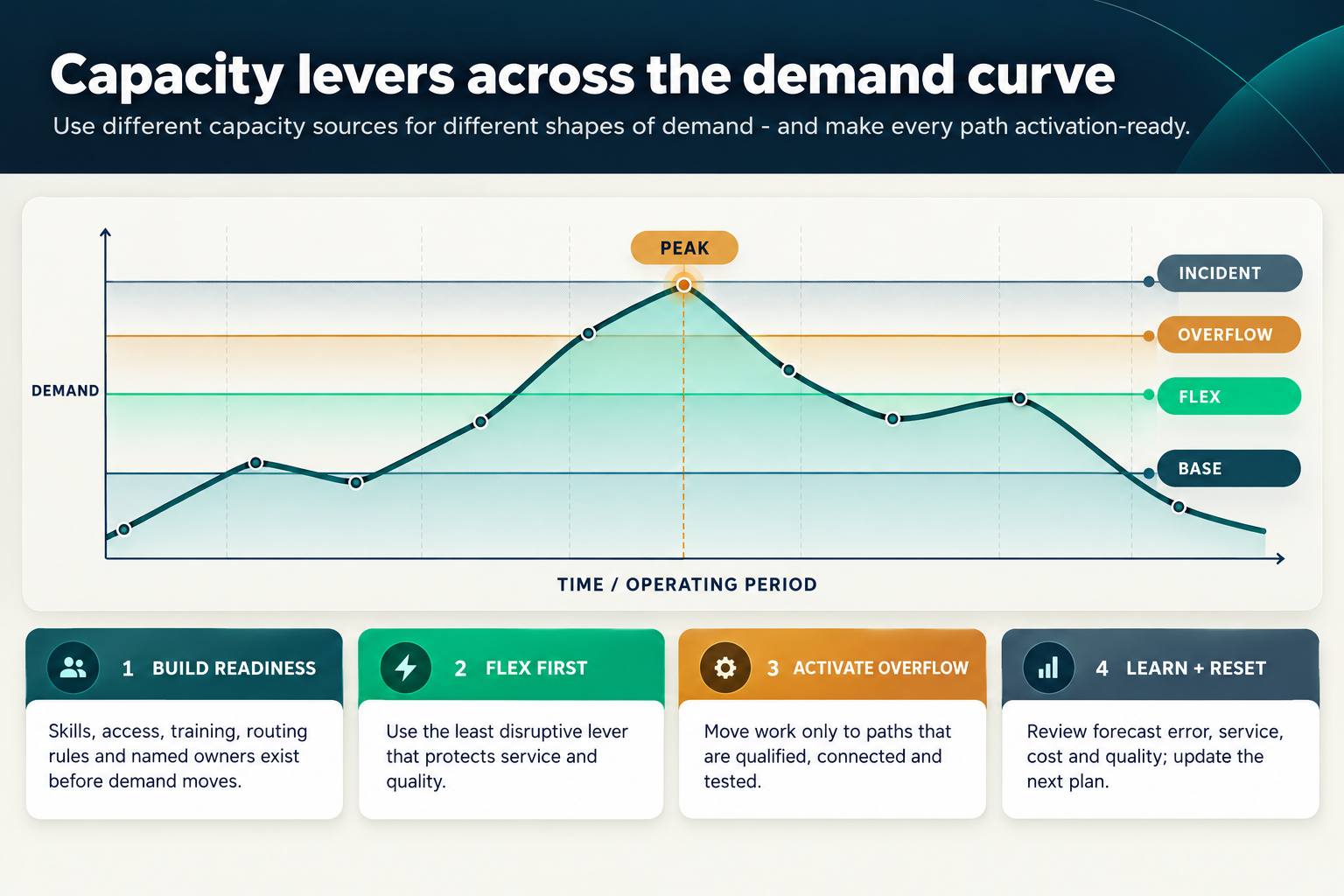
Elasticity rarely comes from one lever. A practical capacity portfolio can include a core internal team, committed BPO capacity, cross-trained adjacent teams, part-time or seasonal labor, qualified overflow providers, geographically diverse delivery, and pre-arranged critical-response capacity. Each source has a different cost curve, lead time, quality profile, minimum commitment, and activation burden.
The portfolio should be intentional. A second provider that cannot access the same systems, work the same queues, or meet the same security requirements is not equivalent capacity. Likewise, a theoretically flexible labor pool is not useful if training takes six weeks and the peak starts next Monday. Map every source by what it can actually do today, what it could do with lead time, and what must happen before it becomes ready.
4. Cross-train for selective flexibility
Cross-training creates pooling value, but the goal is not to make every person capable of handling every interaction. Research on multiskill call centers has shown that limited, well-designed flexibility can capture a large share of the modeled benefit of full flexibility under certain conditions. That is useful because full cross-training is often expensive, cognitively burdensome, and unnecessary.
Prioritize bridge skills: the queues that become bottlenecks, the products most exposed to spikes, and the adjacent work that can be learned without degrading quality. Track certification recency, not just historical training completion. A skill that has not been exercised, tested, or supported by current knowledge is weaker capacity than the roster suggests.
5. Route work to protect scarce capacity
Routing is a capacity decision. If every qualified resource receives work in the same way, scarce expertise can be consumed by routine interactions while simpler capacity sits idle. Good routing preserves specialist capacity for the work that requires it and lets broadly trained resources absorb the work that does not.
Use routing rules deliberately: priority queues, skill requirements, proficiency, customer value, risk, language, channel, cost, location, and provider commitments may all matter. The right mix is specific to the operating model. The governance requirement is that the team can explain why work moves where it does, observe the result, and change the rules without creating an uncontrolled customer or compliance risk.
6. Design overflow before you need overflow
Overflow is most valuable when it is boring. The alternate provider or team is already contracted, security-approved, connected, trained, measured, and included in the routing and communications plan. At that point, overflow becomes an operating lever rather than an emergency procurement project.
Define the activation trigger in advance. It may be forecast variance, backlog age, service-level deterioration, occupancy pressure, site impairment, a product launch, or another condition that matters to your business. Also define the deactivation rule. Capacity that turns on easily but never turns off can solve a service problem and quietly create a cost problem.
7. Separate availability from activation readiness
Capacity is not ready merely because a provider says people are available. Readiness spans people, process, technology, commercial terms, and governance. The more urgent the use case, the more important it is to test the actual path rather than rely on a document saying the path exists.
For each capacity source, confirm the basics before counting it as ready: trained and recently validated people; current knowledge and escalation procedures; systems access; security and compliance approvals; routing and telephony configuration; reporting; performance expectations; commercial authority; named activation owners; and a tested communications path. NIST contingency-planning guidance makes the broader point well: continuity can depend on alternate equipment, alternate processing, or alternate locations, but those alternatives must be part of a coordinated recovery strategy rather than improvised after disruption.
- People: skills, staffing, training recency, supervisors and language coverage.
- Process: SOPs, knowledge, QA, escalation and handoffs.
- Technology: identity, access, telephony, CRM, routing, security and reporting.
- Commercial: rates, minimums, approvals, scope, change authority and invoicing.
- Governance: activation trigger, named decision owner, communications, metrics and deactivation rule.
8. Govern the tradeoffs instead of hiding them
Every capacity decision trades among service, quality, cost, employee experience, customer effort, risk, and optionality. A plan that optimizes only one variable tends to push the cost somewhere else. The useful governance question is not whether a lever is universally good. It is which tradeoff the business is deliberately choosing for this scenario.
Make the decision rights explicit. Who may add overtime? Who may activate an alternate provider? What service degradation is tolerable before a more expensive lever is used? Which queues can move across geographies? Which work must remain with a specialized team? Governance turns a menu of capacity options into an executable operating system.
9. Run a capacity cadence, not an annual exercise
Capacity plans decay as forecasts, product mix, attrition, provider staffing, training status, technology, and business priorities change. Use a recurring operating cadence that connects forecast accuracy, staffing gaps, readiness status, performance, cost, and upcoming events. The cadence can be weekly, monthly, or seasonal depending on volatility, but it should be frequent enough that the organization sees the gap before the customer does.
The workbook accompanying this guide is designed for that cadence. Use it to maintain demand scenarios, inventory capacity sources, identify skill coverage, assess activation readiness, compare required versus ready capacity, and record governance thresholds. Treat the workbook as a decision aid, not as a substitute for a WFM platform or queueing model.
The capacity operating model
A resilient capacity system connects eight disciplines rather than optimizing any one in isolation. Forecast demand. Design work and skill pools. Source a portfolio of supply. Prepare people through hiring, training, and selective cross-training. Route work to the best qualified capacity. Activate flex and overflow through predefined triggers. Monitor service, quality, cost, and forecast error. Govern the tradeoffs and feed what you learn into the next plan.
The order matters less than the feedback loop. Forecasts should change sourcing and training decisions; routing data should expose skill bottlenecks; activation tests should change what you count as ready; performance should change where work is sent; and post-peak reviews should change the next forecast assumptions. The result is not a bigger buffer. It is a capacity system that can move.
Sources & References
- Amazon Web Services. Forecasting, capacity planning, and schedulingReference 1
- Amazon Web Services. Capacity planningReference 2
- Green, Kolesar & Soares (2003). An Improved Heuristic for Staffing Telephone Call Centers with Limited Operating HoursReference 3
- Wallace & Whitt (2005). A Staffing Algorithm for Call Centers with Skill-Based RoutingReference 4
- Iravani et al. (2007). A Structural Approach to Flexibility in Multiskill Call CentersReference 5
- National Institute of Standards and Technology. Contingency PlanningReference 6
- International Organization for Standardization. ISO 18295-2:2017Reference 7
Related Resources
Seasonal & Surge Operations
How to Build a Customer Support Forecast
A useful forecast is not a monthly ticket guess. It is an operating model that connects business drivers to contact propensity, channel volume, handle time, workload, coverage, and risk - then learns from what actually happened.
Seasonal & Surge Operations
How to Manage Fluctuating Customer Support Demand
Forecasting matters. But the operating advantage comes from detecting the gap between demand and effective capacity early, then activating the right lever before service degrades.
Seasonal & Surge Operations
Building an Elastic Workforce: Planning, Systems, and Execution
Workforce management is not only a forecasting problem. The harder challenge is building the operating levers to add, shift, and release capacity when demand moves differently than planned.
Resilience & Readiness
Availability Is Not Readiness
A backup provider, alternate site, or reserve workforce can exist on paper and still be unable to take live customer work. Readiness begins when the dependencies are proven.