AI + Human Operations
The Agent Role Is Changing: Training Customer Service for AI-Enabled Operations
AI changes more than the tools agents use. It changes the mix of work, the judgment humans are expected to apply, and the systems that help frontline teams learn while the operation is live.

AI changes more than the tools agents use. It changes the mix of work, the judgment humans are expected to apply, and the systems that help frontline teams learn while the operation is live.
The training problem has changed
For years, customer-service training was built around a reasonably stable assumption: teach the product, teach the policy, teach the systems, practice the common interactions, and then improve proficiency through coaching. AI does not make those fundamentals disappear. It does change the job they are preparing people to do.
As more routine questions are resolved through self-service, automated workflows, and AI assistance, the cases that reach a human agent tend to be the ones where context, ambiguity, emotion, exception handling, or judgment matter more. At the same time, agents increasingly have AI-generated suggestions, summaries, next-best actions, or knowledge recommendations in the flow of work. Training therefore has to prepare people not only to know the answer, but to decide when the system is right, when it is incomplete, and what to do next.
That is already visible in the market. Gartner reported in February 2026 that 84% of surveyed customer-service leaders planned to add new skills to frontline roles, while 58% aimed to upskill agents into knowledge-management responsibilities. A second Gartner release in April 2026 reported that 85% of service leaders were expanding human-agent responsibilities as AI changed the work mix. [1][2] The implication is straightforward: an “AI class” added to the existing curriculum is not enough. The role itself is moving.
Start with role design, not tool training
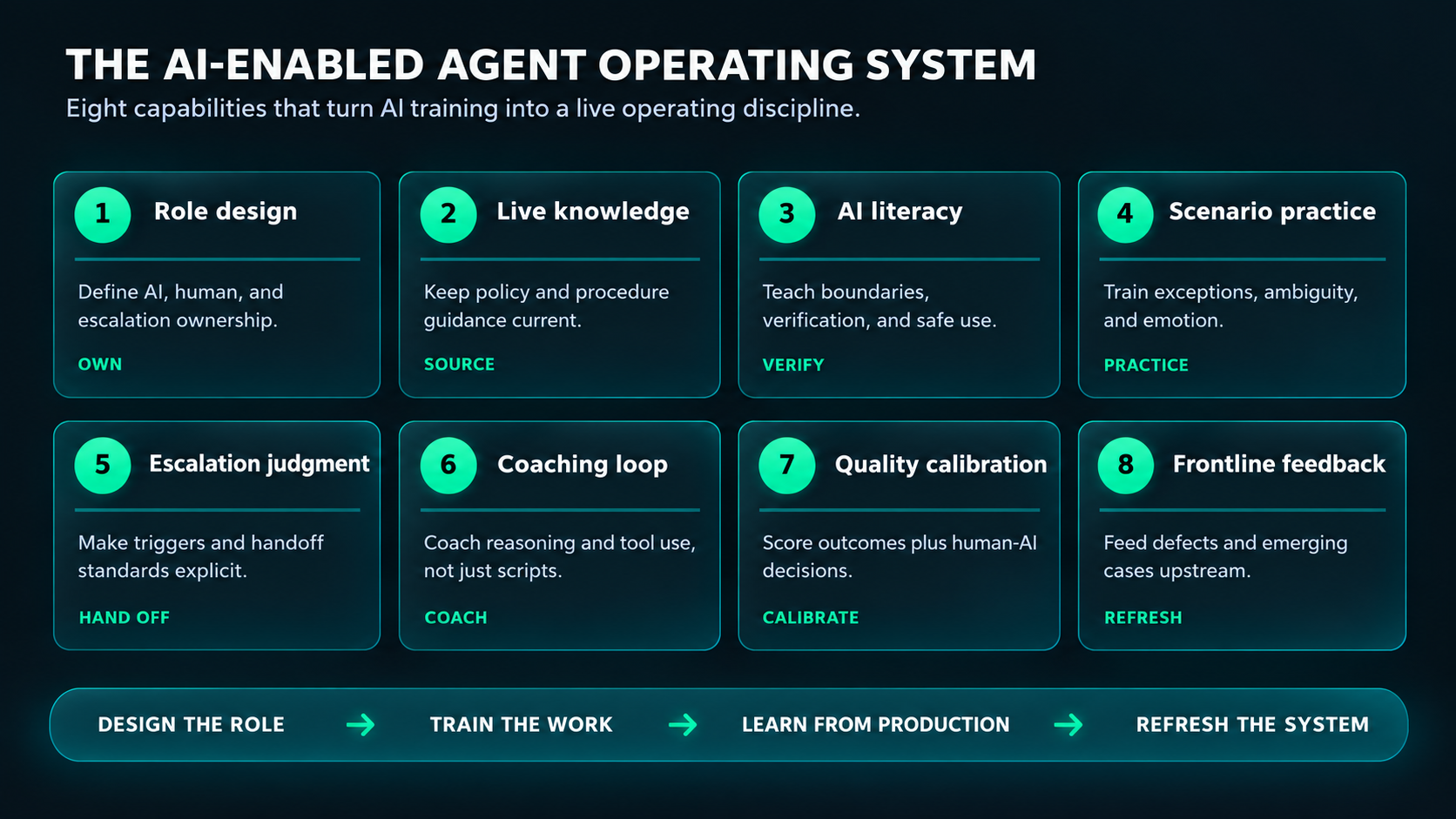
The first question is not "How do we teach agents to use the AI?" It is "What work do we now expect the agent, the AI, the workflow, and the supervisor to own?" If that division is vague, training will be vague too. Agents will either over-trust the tool, ignore it, or make inconsistent judgment calls because the operating model never defined what good looks like.
A useful role design separates four things: work the system can complete autonomously; work where AI can assist but a person remains accountable; work that should default to human judgment; and work that requires escalation to a specialist, supervisor, or controlled process. This is less glamorous than a demo of the newest model, but it is what turns technology into an operating capability.
NIST's human-centered AI Use Taxonomy is useful here because it describes AI in terms of the activities people and systems perform toward an outcome rather than in terms of the model alone. [3] That is the right mental model for training design. Train the task architecture first; train the tool inside it.
- Autonomous: the system can complete the work within defined guardrails.
- Assisted: AI can recommend or draft, but a person remains accountable for the outcome.
- Human-led: the interaction requires context, empathy, negotiation, exception handling, or judgment.
- Escalated: the case requires a specialist, supervisor, controlled process, or higher authority.
Teach AI literacy at the level of real work
Agents do not need to become machine-learning engineers. They do need enough AI literacy to understand what the tools are doing, where they are strong, where they can fail, what information they are allowed to use, and how to verify a recommendation before acting on it. OECD's 2025 work on the AI skills gap makes the broader point that general AI literacy is becoming a workforce requirement and that training supply may not yet be keeping pace with demand. [4]
For frontline customer operations, that literacy should be practical. An agent should know the difference between a retrieved policy and a generated answer, recognize when a recommendation is based on incomplete context, understand that confidence and fluency are not the same as correctness, and know the organization's rules for sensitive data, customer commitments, regulated topics, and human override. The best test is not whether the agent can define a large language model. It is whether the agent can use the tool safely when the customer's real situation is messy.
Make live knowledge part of the operating system
AI-enabled service makes knowledge management more important, not less. If policy, product information, procedures, entitlements, exception rules, and troubleshooting guidance are stale or inconsistent, the same defects can propagate through agents, bots, copilots, and self-service at greater speed. Knowledge quality becomes shared infrastructure.
That changes training in two ways. First, new-hire training should teach agents how the knowledge system is structured, how to find the authoritative source, and how to spot conflicts or gaps. Second, the organization needs a live mechanism for capturing what agents learn in production and turning it into updated knowledge. The agent is no longer just a consumer of the knowledge base; the agent becomes one of its most important sensors.
This is one reason the Gartner finding on knowledge-management upskilling matters. When AI is present in the workflow, maintaining useful source knowledge becomes part of frontline performance rather than a separate documentation project. [1]
Practice exceptions, ambiguity, and escalation
Traditional training often overweights the happy path because it is easier to document and score. AI can make that imbalance worse: the system handles the obvious interaction well, while the human agent increasingly receives the interaction that does not fit the template. Training should therefore spend more time on exceptions, conflicting evidence, incomplete data, emotional customers, policy edge cases, ambiguous intent, and multi-step problem solving.
Simulation is especially valuable here. Give agents the AI tools they will actually use, then place them in scenarios where the recommendation is correct, partly correct, out of date, overconfident, or simply inappropriate. Ask the agent to explain what they accepted, what they rejected, and why. The point is not to “catch” the AI making a mistake. The point is to build the habit of responsible judgment.
Escalation belongs in the same practice. Agents should know the triggers, the destination, the handoff standard, and the information that must travel with the case. NIST’s Generative AI Profile emphasizes governance, evaluation, testing, and risk management across the AI lifecycle; those ideas translate operationally into clear human oversight and defined response paths when the system is uncertain or wrong. [5]
Coach judgment, not just compliance
AI can compress the time it takes newer agents to become productive. In a large customer-support deployment studied by Brynjolfsson, Li, and Raymond and published in The Quarterly Journal of Economics in 2025, access to a generative AI assistant increased issues resolved per hour by about 15% on average, with larger gains among less experienced and lower-skill agents. The study also found evidence that AI helped diffuse the conversational patterns of stronger performers and accelerate the experience curve. [6]
That is encouraging, but it creates a coaching challenge. If the system supplies more of the wording, the next layer of performance is less about memorizing the preferred phrase and more about reading the situation, validating the recommendation, choosing the right action, and knowing when not to follow the suggestion. Coaches need visibility into those decisions.
Coaching sessions should therefore look at reasoning as well as outcome: What context did the agent notice? Which AI suggestion was used? Was it verified? What alternative was available? Was the escalation decision sound? This lets the organization develop human judgment instead of allowing good performance to become indistinguishable from passive tool adherence.
Recalibrate quality for human-plus-AI work
Quality assurance also has to evolve. A scorecard built for a fully human workflow can miss the most important failure modes in an AI-enabled one. The customer may receive a polished answer that is wrong. The agent may follow a recommendation that should have been challenged. Or the issue may be resolved correctly, but the underlying knowledge defect remains in the system and reappears across dozens of future interactions.
A modern QA model should still measure the basics—accuracy, resolution, policy adherence, empathy, communication, and customer outcome—but it should add a small number of AI-specific dimensions. Did the agent use the tool appropriately? Was verification adequate for the risk level? Was the decision to accept, modify, reject, or escalate reasonable? Did the interaction expose a knowledge, workflow, or model problem that should be corrected upstream?
The goal is not to create a 40-line scorecard. It is to make the control system match the work. If AI changes what can fail, QA has to change what it observes.
Turn the frontline into a learning loop
The most valuable training system is not the one with the best launch curriculum. It is the one that keeps learning after launch. Frontline teams see new customer language, edge cases, policy conflicts, product defects, broken workflows, and AI failure modes before most central teams do. The operating model should make it easy to capture that information and route it to the right owner.
That feedback loop can feed knowledge updates, prompt or workflow changes, product fixes, coaching priorities, QA calibration, and future training scenarios. It also gives agents agency in the AI transition. Instead of being told that a system has arrived and that they need to adapt to it, they become participants in making the system better.
The ILO's 2025 global update on generative AI and jobs concluded that, because human input remains important, most exposed jobs are more likely to be transformed than simply made redundant. [7] Customer service is a practical example of what that transformation can look like: less time spent finding routine information, more responsibility for judgment, exceptions, relationships, and system improvement.
What good looks like after go-live
A mature AI-enabled service operation should not be judged by whether every agent completed an AI module. It should be judged by whether the role, tools, knowledge, coaching, escalation, and quality system work together in production.
The signals are operational. Agents know what they own. They can explain the boundaries of the tools they use. They can find and challenge source knowledge. They practice exceptions before they encounter them live. Escalations are fast and information-rich. Coaches can see decision quality, not just handle time. QA can distinguish a human error from a knowledge or system defect. And the frontline has a credible path for improving the system itself.
That is the real shift in customer-service training. AI does not reduce the need to develop people. It raises the value of developing the human capabilities that the operation increasingly depends on.
Sources & References
- Gartner, Feb. 18, 2026. Survey of 321 customer-service and support leaders; new-skills and knowledge-management findingsReference 1
- Gartner, Apr. 28, 2026. Survey of 321 customer-service and support leaders; workforce redesign and expanded human responsibilitiesReference 2
- NIST, 2024. AI Use Taxonomy: A Human-Centered Approach — Outcome-based classification of human-AI activities.Reference 3
- OECD, 2025. Bridging the AI skills gap: Is training keeping up? — AI literacy, upskilling, and training-supply gap.Reference 4
- NIST, 2024. Artificial Intelligence Risk Management Framework: Generative Artificial Intelligence Profile — Cross-sector GenAI risk-management profile covering governance, evaluation, testing, and lifecycle risk.Reference 5
- Brynjolfsson, Li & Raymond, QJE, 2025. Generative AI at Work — Field evidence from 5,172 customer-support agents; productivity, learning, and heterogeneity effects.Reference 6
- ILO. Generative AI and Jobs: A 2025 Update — Global task-exposure research emphasizing transformation with continued human input.Reference 7
Related Resources
AI + Human Operations
The AI Customer-Operations Stack: What Is Actually Changing?
AI is moving beyond the chatbot. It is becoming a capability layer across knowledge, workflow, routing, quality, analytics, and orchestration - while operating design and human accountability remain the system that makes those capabilities useful.
AI + Human Operations
Using Software to Be More Human: 5 Ways Computational Thinking Will Revolutionize Human-Powered Customer Service
AI is getting better at acting human. The bigger opportunity may be using computational thinking to design the system around people so customer operations become more focused, adaptive, scalable, resilient, and intelligent.
AI + Human Operations
A Human Response to the Rise of Chatbots
AI has moved far beyond the chatbot boom. The operating question Alan posed years ago is more urgent now: how do we design the human side of customer service to work with increasingly capable machines?