AI + Human Operations
The AI Customer-Operations Stack: What Is Actually Changing?
AI is moving beyond the chatbot. It is becoming a capability layer across knowledge, workflow, routing, quality, analytics, and orchestration - while operating design and human accountability remain the system that makes those capabilities useful.

AI is moving beyond the chatbot. It is becoming a capability layer across knowledge, workflow, routing, quality, analytics, and orchestration - while operating design and human accountability remain the system that makes those capabilities useful.
AI is moving into the operating stack, not just the conversation
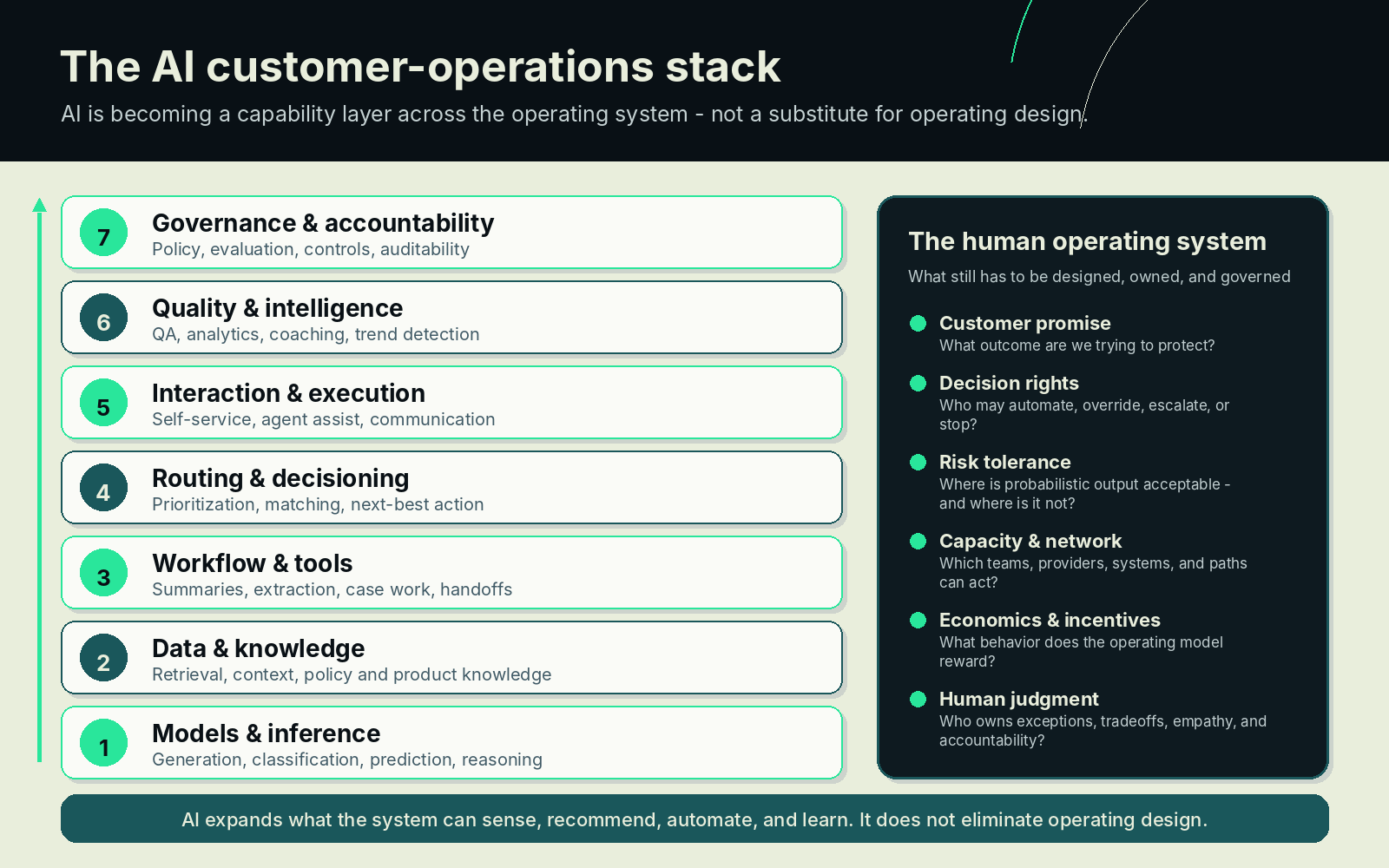
For years, customer-operations conversations about artificial intelligence tended to collapse into one question: will the bot answer the customer? That is now too narrow. The more consequential shift is that AI is moving into multiple layers of the operating system at once - the knowledge an agent can reach, the workflow surrounding a case, the way work is classified and routed, the quality process, the analytics layer, and the mechanisms that help leaders coordinate a distributed service network.
That does not mean every layer becomes autonomous, or that the same model should be trusted with every decision. It means the architecture of customer operations is changing. Leaders increasingly need to decide where probabilistic intelligence belongs, what context it may use, which actions it may take, how its output is evaluated, and where a person or an explicit rule must remain in control. The useful question is therefore not simply, 'Where can we use AI?' It is, 'How should AI fit into the operating stack we are responsible for?'
1. Models and inference are becoming infrastructure
At the bottom of the stack are the models that generate, classify, summarize, predict, retrieve, and reason over information. They matter, but they are becoming less useful as a standalone strategy. The same underlying model capability can support a customer-facing assistant, an internal knowledge tool, a quality-review workflow, a routing recommendation, or a manager's analysis. What changes the business outcome is the context, permissions, workflow, evaluation criteria, and operating decision wrapped around that model.
This is one reason an 'AI strategy' built around a single assistant can become obsolete quickly. Model choices will continue to move. The more durable design is to treat inference as a replaceable capability inside a governed operating system, with clear expectations for latency, cost, privacy, reliability, and the consequences of being wrong.
2. Data and knowledge become an active operating layer
AI makes knowledge more usable when it can retrieve the right source material in the context of the work being performed. Current contact-center tooling already reflects this pattern: Google Cloud documents knowledge suggestions and generative knowledge assist that combine supplied documents with the live conversation and available customer metadata, while agents remain able to inspect the suggested material before using it. The important architectural point is not the product. It is that knowledge is shifting from a passive library agents must search into an active layer that can surface relevant context at the moment of need.
That raises the standard for knowledge operations. A model can make an obsolete policy easier to find just as efficiently as it can make a current policy easier to find. Organizations therefore need clearer ownership of source-of-truth content, access rights, versioning, retrieval scope, and feedback. AI can improve the retrieval experience; it cannot decide which policy the company meant to keep current.
3. Workflow and tools absorb more of the mechanical work
The next layer is the work around the interaction: case notes, summaries, disposition, extraction, search, drafting, handoffs, and follow-up. This is one of the clearest places where AI can remove mechanical constraints around people. AWS, for example, documents AI-generated note taking and case summarization that create draft summaries from contact transcripts and case context, with agents able to review or edit the result before saving it. Google Cloud similarly documents generated session summaries that agents can insert into wrap-up notes and amend before submission.
The operating opportunity is larger than reducing after-call work. When repetitive transcription, summarization, and information gathering become easier, organizations can redesign the workflow itself: what information is captured, when a handoff is triggered, which context follows the case, and where a person should spend attention. The strongest implementations should give time back to judgment, empathy, problem solving, and ownership rather than simply converting every saved minute into more throughput.
4. Routing and decisioning become more adaptive - but ownership still matters
Traditional routing is largely deterministic: queue, skill, priority, language, channel, geography, service level, contract rule. AI can add richer classification and recommendation to that layer by interpreting intent, context, risk, predicted effort, or likely next action. Over time, that can make the network more responsive because the system has more information with which to match work to the right resource.
But a recommendation is not the same thing as authority. Customer operations still need explicit decision rights around what may be routed automatically, which classes of work require a specialist, when a model may influence commercial allocation, what data a decision may use, and how to override a poor recommendation. This is especially important in multi-provider networks, where routing choices can affect cost, contractual commitments, customer experience, and partner economics at the same time.
5. Interaction and execution become a spectrum, not a bot-versus-human choice
At the interaction layer, the useful distinction is no longer simply automated versus human. Work can move along a spectrum: fully self-served, AI-assisted self-service, human service with AI assistance, specialist escalation, or human-led exception handling. The right point on that spectrum depends on the customer's objective, the reversibility of the action, the quality of available context, the cost of an error, and the organization's ability to detect when the system is wrong.
That framing helps avoid a common trap: automating the visible conversation while leaving the hard operating problem untouched. If identity is unreliable, policies conflict, fulfillment is broken, engineering escalation is unclear, or a provider lacks the required access, a better-generated answer will not solve the customer's problem. AI changes the interface and the workflow; it does not make broken dependencies disappear.
6. Quality and intelligence can move from sampling toward broader observation
AI also changes what organizations can observe. Quality programs have historically depended heavily on human sampling because reviewing every interaction is expensive. Current platforms now support automated or AI-assisted evaluation across much larger interaction sets. Amazon Connect, for example, documents generative-AI performance evaluations that can automate selected evaluation questions and provide transcript-based context for the answer. AWS also explicitly recommends sampling and manual evaluation because AI-generated evaluations are not perfectly accurate and can drift.
That caveat is the design lesson. More coverage is valuable, but automated measurement should not become unquestioned truth. A strong quality system separates what can be measured deterministically from what requires interpretation, compares automated results with human review, tracks disagreement and drift, and uses the expanded data to find patterns that merit coaching or process redesign. AI can increase the field of view; people still decide what the organization learns from it.
7. Governance and accountability move into the architecture
When AI is embedded across multiple layers, governance cannot sit in a policy document off to the side. It becomes part of the operating architecture. NIST's Generative AI Profile is designed to help organizations incorporate trustworthiness considerations into the design, development, use, and evaluation of AI systems. ISO/IEC 42001 similarly frames AI governance as a management-system discipline rather than a one-time technology review.
For customer operations, that translates into practical questions: Which sources may a model use? Which customer data can it access? Which outputs need human confirmation? How are model changes tested? What constitutes an unacceptable error? Who can disable an automation? How are incidents investigated? How do teams know whether a quality problem comes from the model, the retrieval layer, the policy source, the workflow, or the underlying operation? Governance is useful when it makes those questions answerable in the flow of work.
What remains fundamentally human and operational
The technology layers are changing quickly. Several of the most important responsibilities are not. Someone still has to decide the customer promise, define acceptable tradeoffs, allocate authority, design escalation, choose which provider or internal team should own which work, set incentives, interpret exceptions, and take accountability when the system produces an outcome the company does not want.
Human involvement should not be preserved merely because it is familiar. It should be concentrated where judgment has real value: ambiguous situations, consequential exceptions, relationship repair, ethical or commercial tradeoffs, novel failures, and decisions where the cost of a plausible-but-wrong answer is high. The objective is not to protect every manual task. It is to remove mechanical constraints so that human capability is applied where it matters most.
Design the stack around work, not around the latest model
A durable AI operating model starts with the work. Map the customer journey and the operating processes behind it. Identify where information is hard to find, where people repeat mechanical steps, where routing decisions are weak, where quality is invisible, and where managers lack timely signals. Then decide which layer should change and what evidence would show that the change is working.
The sequence matters. Start with clear sources of truth and permissions. Make actions observable. Define the human override and the failure path. Test with representative work rather than only demonstrations. Measure quality as well as speed. Keep model and vendor choices replaceable where practical. Most importantly, preserve a coherent operating owner across the stack, because a customer does not experience your knowledge system, routing model, BPO, workflow tool, and AI assistant as separate products. They experience one service system.
That is what is actually changing. AI is expanding the number of layers that can sense, recommend, automate, and learn. The companies that benefit most will not be the ones that bolt the most AI onto the edge. They will be the ones that redesign the operating stack so technology and people can each do more of what they are best positioned to do.
Sources & References
- Google Cloud. Google Cloud Agent AssistReference 1
- Google Cloud. Google Cloud Generative Knowledge AssistReference 2
- AWS. AWS - AI-generated note takingReference 3
- AWS. AWS - Generative AI performance evaluationsReference 4
- National Institute of Standards and Technology. NIST AI RMF: Generative AI Profile (NIST AI 600-1)Reference 5
- International Organization for Standardization. ISO/IEC 42001Reference 6
Related Resources
AI + Human Operations
AI Changes the Sourcing Decision — Not the Need for One
AI is changing what customer-operations leaders are buying, how they evaluate providers, and where responsibility sits. That makes sourcing more important—not less.
AI + Human Operations
Using Software to Be More Human: 5 Ways Computational Thinking Will Revolutionize Human-Powered Customer Service
AI is getting better at acting human. The bigger opportunity may be using computational thinking to design the system around people so customer operations become more focused, adaptive, scalable, resilient, and intelligent.
AI + Human Operations
A Human Response to the Rise of Chatbots
AI has moved far beyond the chatbot boom. The operating question Alan posed years ago is more urgent now: how do we design the human side of customer service to work with increasingly capable machines?
AI + Human Operations
Bots Won’t Make Us Better People, but They Might Make Our People Better
AI does not have to replace the human side of service to transform it. The more interesting opportunity is using software to remove mechanical friction around people so judgment, empathy, and creativity can matter more.