BPO Sourcing & RFP Management
The BPO Geography Decision Map
A decision-oriented guide to compare BPO geographies by program fit - without pretending there is a universal best country.

A decision-oriented guide to compare BPO geographies by program fit - without pretending there is a universal best country.
Geography is a fit problem, not a leaderboard
BPO geography decisions are often framed as if the market were a tournament: collect a list of countries, compare a few labor-cost statistics, and identify a winner. That framing is attractive because it looks objective. It is also usually too shallow for the decision at hand.
A location that is excellent for one program can be a poor fit for another. A U.S. consumer-support program may care heavily about time-zone overlap, spoken English, seasonal scale, and cost. A multilingual enterprise program may care more about language breadth, privacy requirements, technical skills, and specialist retention. A regulated workflow may eliminate otherwise attractive options before economics are even compared.
The useful question is therefore not 'Which country is best?' It is 'Which delivery configuration best fits this work, these customers, these constraints, and this risk posture?' Country-level evidence helps narrow the field. The real decision eventually moves down to country, city, provider, site, shift, and operating model.
Start with requirements before looking at countries
The most common geography mistake happens before the first country is discussed: the buyer has not defined the work precisely enough. If the program requires a particular language, customer-facing schedule, sector control, system environment, credential, security posture, or launch window, those conditions should be explicit before the market is screened.
Separate hard constraints from preferences. A hard constraint can eliminate an option. A preference should influence the comparison without pretending to be absolute. For example, same-time-zone delivery may be valuable but not mandatory; a specific data-residency requirement may be non-negotiable. Keeping those two categories separate prevents an attractive cost profile from disguising an operating incompatibility.
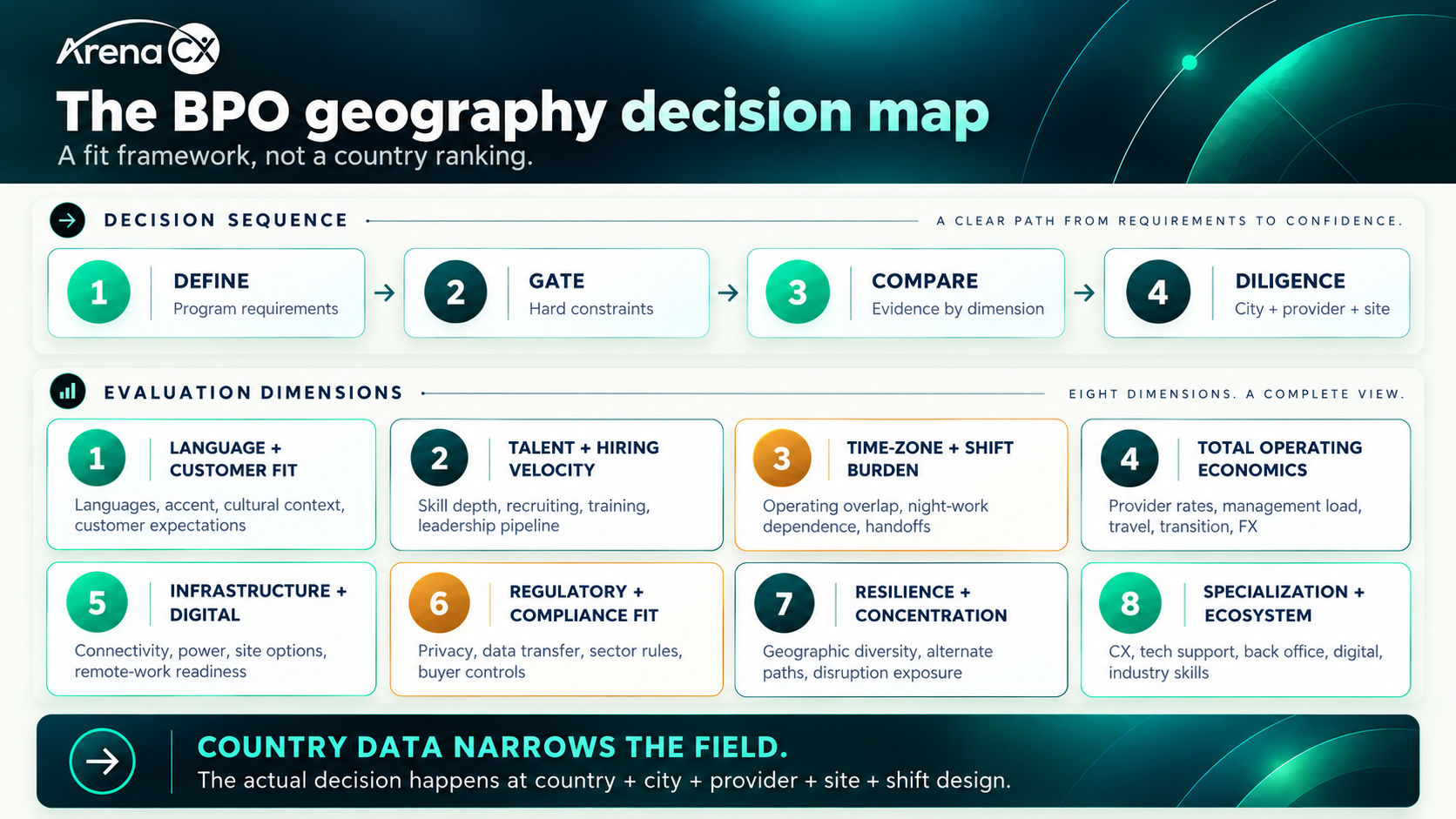
Eight lenses for comparing geography
- Language + Customer Fit: Languages, accent, cultural context, customer expectations
- Talent + Hiring Velocity: Skill depth, recruiting, training, leadership pipeline
- Time-Zone + Shift Burden: Operating overlap, night-work dependence, handoffs
- Total Operating Economics: Provider rates, management load, travel, transition, FX
- Infrastructure + Digital Environment: Connectivity, power, site options, remote-work readiness
- Regulatory + Compliance Fit: Privacy, data transfer, sector rules, buyer controls
- Resilience + Concentration Risk: Geographic diversity, alternate paths, disruption exposure
- Specialization + Ecosystem Maturity: CX, tech support, back office, digital, industry skills
1. Language and customer fit
Language capability is more than whether a country has speakers of a target language. Evaluate the depth of the addressable talent pool, proficiency required for the interaction, accent or localization expectations, written versus spoken work, and the availability of team leads, trainers, QA staff, and specialists in the same language.
Customer context matters as well. Some work benefits from cultural familiarity, regional market knowledge, or close collaboration with product and operations teams. These requirements should be tested in actual provider teams rather than inferred from a national label.
2. Talent depth and hiring velocity
The relevant talent question is not national population. It is whether the target city and providers can recruit, train, retain, and supervise the skills your program needs at the scale and pace required. Look at the existing services ecosystem, leadership depth, competition for similar profiles, training infrastructure, attrition assumptions, and the realistic ramp curve.
Published industry figures can signal ecosystem scale, but they do not answer a program-specific hiring question. Use them to form hypotheses, then require providers to show recent, local evidence for comparable roles.
3. Time-zone alignment and shift burden
Time zones shape both customer coverage and the employee experience. A location may technically cover a U.S. schedule while relying on overnight work. That may be entirely workable, but it changes recruiting, retention, transport, management coverage, and resilience considerations.
Evaluate overlap with the customer day, management and escalation windows, handoff design, and how much of the operation depends on nonstandard shifts. Treat time-zone fit as an operating-design variable, not simply a map coordinate.
4. Total operating economics
Hourly rates alone are a weak geography model. Compare the total operating configuration: provider pricing, productivity assumptions, management overhead, training, transition, travel, security controls, technology, telecommunications, facilities, currency exposure, minimum commitments, and the cost of redundancy or overflow.
Do not use national GDP or average-wage statistics as BPO price benchmarks. They can provide macroeconomic context, but a buyer needs actual provider and site economics for the work being sourced.
5. Infrastructure and digital environment
Reliable power and connectivity are necessary but not sufficient. Ask how the proposed site is connected, what redundancy exists, how remote or hybrid work is controlled, which alternate facilities are available, and how quickly traffic can move when a dependency fails.
The same country can contain very different site-level risk profiles. Infrastructure diligence therefore belongs at the city and provider level, with evidence that reflects the actual building, network, and recovery path.
6. Regulatory and compliance fit
Every geography has its own privacy, labor, data-transfer, sector, and employment framework. The fact that a country has a modern privacy law does not by itself make a program compliant, nor does a different legal framework automatically make the location unsuitable.
Map the actual data, customer, industry, contractual, licensing, and security requirements. Then confirm what controls the provider and buyer must implement. Compliance is a diligence gate, not a country score.
7. Resilience and concentration risk
A location can be operationally strong and still increase portfolio risk if too much of the buyer's work already sits in the same geography, provider group, infrastructure corridor, or time-zone dependency. Geography decisions should therefore be made in the context of the whole delivery network.
Look for alternate processing paths, geographic diversification, tested failover, cross-training, and the ability to move work. A second country that cannot actually take the same work is diversity on paper, not resilience.
8. Specialization and ecosystem maturity
BPO is not one capability. Customer experience, technical support, trust and safety, healthcare operations, finance processes, analytics, software support, collections, multilingual service, and back-office work draw on different labor markets and provider strengths.
A mature services ecosystem can help with leadership, recruiting, vendor choice, training, and specialist depth. But maturity should be evaluated against the specific work. The goal is fit, not the largest possible ecosystem.
Reference markets: useful evidence, not recommendations
The Decision Map uses eight reference markets - Mexico, Colombia, Costa Rica, Jamaica, the Philippines, India, South Africa, and Egypt - because together they illustrate different nearshore, offshore, language, scale, and specialization patterns. Their inclusion is not an ArenaCX ranking or preferred-provider list.
Current industry and investment-promotion sources show materially different ecosystem signals. IBPAP reports a Philippine IT-BPM workforce of 1.9 million and $40 billion in revenue. NASSCOM's FY2025 estimate puts India's BPM segment at $54.6 billion within a technology industry employing 5.8 million people. BPESA reports 26,346 new South African GBS jobs serving international markets in 2025. Egypt's ITIDA reports $5.2 billion in offshoring exports in FY2025/26 and approximately 195,300 workers in exporting companies as of June 2026.
Other markets illustrate different forms of fit. CINDE says Costa Rica supports about 100 business functions in more than 12 languages, while also reporting that the corporate-services sector experienced its first slowdown in 2025, with nearly 2,000 fewer jobs. Jamaica's investment agency reports more than 60,000 digital-services jobs and approximately $900 million in estimated ICT/BPO spend. ProColombia continues to identify BPO and digital services as areas of nearshoring investment, while Mexico's 2025 federal private-sector personal-data law is an example of why country-level compliance assumptions should be revalidated rather than inherited from old sourcing decks.
Move from country screen to operating diligence
A country screen should produce a shortlist, not a selection. Once a market survives the hard constraints, move the diligence down a level. Compare specific cities. Compare providers. Inspect the proposed site and network architecture. Review recruiting evidence for the actual role. Validate supervisor ratios, training capacity, security controls, routing dependencies, transport, shift assumptions, business-continuity paths, and commercial terms.
Then run the economics against the operating design you would actually buy. A cheaper nominal location may require more management, travel, training, redundancy, or shift premium. A higher-rate market may reduce other costs or improve alignment. The answer depends on the program.
Use a portfolio view when one geography is not enough
Many organizations do not need a single location answer. They need a portfolio. One market may carry the core program, another may provide language or technical specialization, and a third may provide overflow or continuity. The useful architecture is the smallest set of delivery paths that creates the required fit and optionality without adding unnecessary complexity.
That is the purpose of the companion workbook. It gives buyers a way to define requirements, gate constraints, compare evidence across eight dimensions, record diligence, and document a portfolio decision. It does not contain ArenaCX country scores. The buyer supplies the weights and evidence for the program being evaluated.
The decision map in one sentence
Use country evidence to narrow the field, then make the decision at the level where the operating reality actually lives: country + city + provider + site + shift design.
Sources & References
- Philippines - IBPAP. IBPAPReference 1
- India - NASSCOM. NASSCOM Strategic Review FY2025Reference 2
- South Africa - BPESA. BPESAReference 3
- Egypt - ITIDA. ITIDAReference 4
- Costa Rica - CINDE. CINDE corporate & business processesReference 5
- Costa Rica - CINDE. CINDE 2026 hiring updateReference 6
- Jamaica - JAMPRO. JAMPRO Global Digital ServicesReference 7
- Colombia - ProColombia. ProColombia 2026 digital investment analysisReference 8
- Mexico - Diario Oficial de la Federacion. Diario Oficial de la FederacionReference 9
- Philippines - National Privacy Commission. National Privacy CommissionReference 10
- Colombia - SIC. SICReference 11
- South Africa - Information Regulator. Information RegulatorReference 12
- Egypt - Personal Data Protection Center. Personal Data Protection CenterReference 13
- India - MeitY. MeitYReference 14
Related Resources
BPO Sourcing & RFP Management
How to Select the Right Contact Center Partner
The right BPO is not the company with the best pitch. It is the provider whose operating model fits your work, clears your risk constraints, can prove the fit with evidence, and can keep adapting as demand, technology, and AI change the job.
BPO Sourcing & RFP Management
BPO Sourcing Is Not Vendor Shopping
The real job is not to gather familiar provider names. It is to define the operating requirement, create a meaningful option set, expose the tradeoffs, and choose a structure that can adapt as the business changes.
Network Design & Orchestration
One Provider or Many? A Decision Framework for Customer Operations
The right provider model is not a philosophy. It is a design choice. Use this framework to decide when simplicity, diversification, specialization, flexibility, and governance matter most.
Network Design & Orchestration
Designing a Customer-Operations Network for Optionality
Optionality is not the same as having more vendors. It is the ability to move work, capacity, or capability to another credible path without rebuilding the operating model when conditions change.